
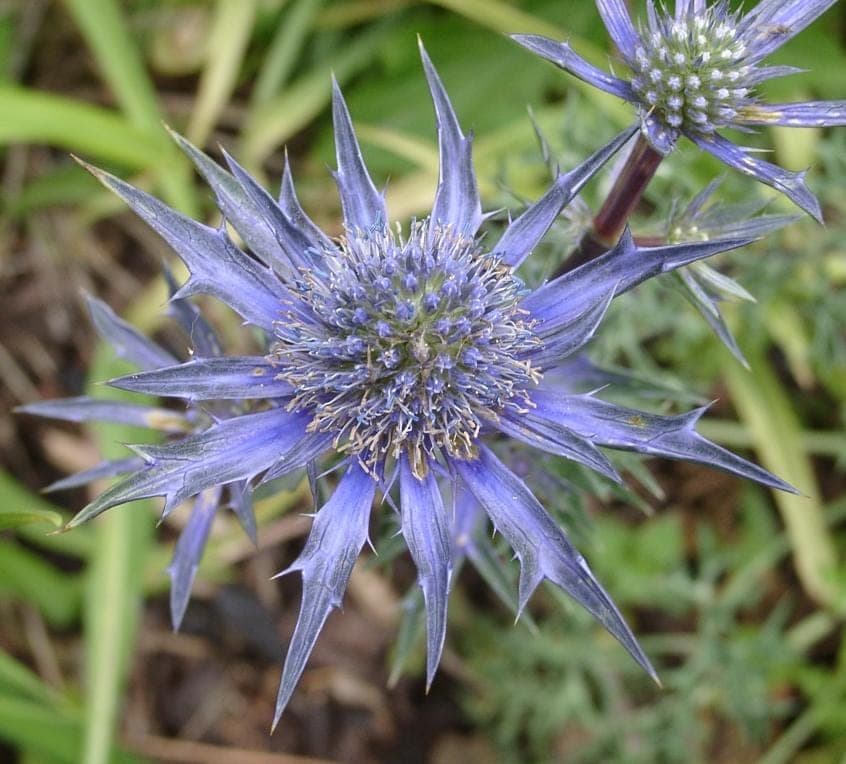
Eryngium 'Psychic Purple' is a compact sea holly cultivar that produces intensely saturated violet-purple bracts and stems surrounding a dense central head from midsummer through fall. It belongs to the carrot family (Apiaceae) despite its resemblance to thistles. The architectural form, long season of color, and strong appeal to bees and wasps make it effective in mixed perennial borders, gravel gardens, and dry-climate plantings.
This cultivar forms a deep taproot quickly, making it drought resilient but very difficult to relocate after its first season; choose a permanent site before planting. Poor to average, sharply drained soil produces the sturdiest stems - rich soil and excess moisture cause lax, flopping growth. Cold-hardy to zone 4a, it may self-seed modestly, though seedlings from cultivar selections often revert toward the species type in color.
The roots of wild Eryngium species, particularly E. maritimum and E. campestre, were candied and sold as a confection called 'eringoes' in 16th- and 17th-century England. The genus has a long tradition in European herbalism as a diuretic and for urinary and kidney complaints.
Root rot
Plants wilt, yellow, and stunt even in moist soil; lower stems and roots turn brown, soft, and mushy and the plant may collapse. Most common in heavy, wet, or poorly drained ground.
Improve drainage and stop overwatering, and never plant too deep. Lift and destroy badly affected plants along with the soil around the roots. Grow in raised or free-draining beds to prevent it returning.
Crown Rot
Lower leaves yellow and wilt; the base of the rosette turns brown and soft, sometimes with white fungal threads at the soil line. Plants collapse in wet conditions.
Remove and destroy affected plants. Improve drainage and avoid overhead watering. Do not mulch directly against the crown. Space plants for airflow and avoid replanting in the same wet spot.
Powdery mildew
White or grey powdery coating on leaves - usually starting on older growth in humid conditions or when nights cool.
Improve air circulation by thinning plants. Apply neem oil or potassium bicarbonate spray at first sign. Avoid overhead watering.