
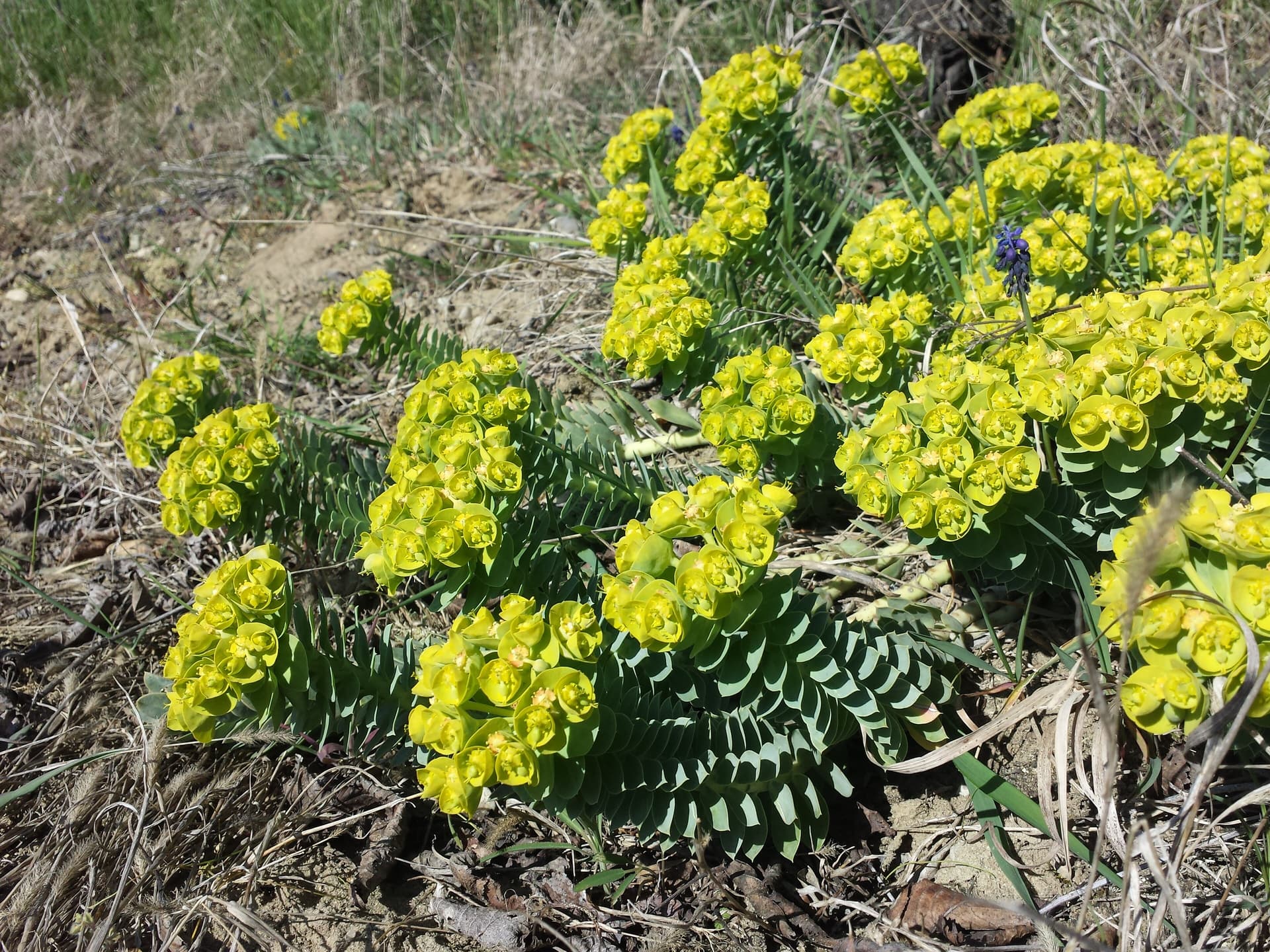
Euphorbia myrsinites is a trailing succulent perennial native to rocky hillsides and cliffs across southeastern Europe and western Asia. Its stems wind outward from a central crown, each clothed in spiraling rows of fleshy, blue-green leaves that hold color year-round in mild climates. Chartreuse-yellow flower bracts appear in late winter to early spring, making it one of the earliest-interest plants in a dry or rock garden. It works well draped over retaining walls, tucked into gravel beds, and planted at the top of dry slopes.
The plant is classified as invasive in Colorado, Montana, Oregon, and Utah, where self-seeding allows it to escape into natural areas; do not plant it where it can spread beyond the garden. Cutting spent flower stalks before seeds ripen is the primary containment measure. The milky latex is a serious contact irritant that causes dermatitis and can permanently damage eyes-wear nitrile gloves and eye protection whenever stems are cut or disturbed. Performance is best in poor, sharply drained soil; heavy clay or consistently wet ground causes rapid crown and root rot, and supplemental fertilizer is unnecessary and counterproductive.
Root rot
Plants wilt, yellow, and stunt even in moist soil; lower stems and roots turn brown, soft, and mushy and the plant may collapse. Most common in heavy, wet, or poorly drained ground.
Improve drainage and stop overwatering, and never plant too deep. Lift and destroy badly affected plants along with the soil around the roots. Grow in raised or free-draining beds to prevent it returning.
Crown Rot
Lower leaves yellow and wilt; the base of the rosette turns brown and soft, sometimes with white fungal threads at the soil line. Plants collapse in wet conditions.
Remove and destroy affected plants. Improve drainage and avoid overhead watering. Do not mulch directly against the crown. Space plants for airflow and avoid replanting in the same wet spot.