
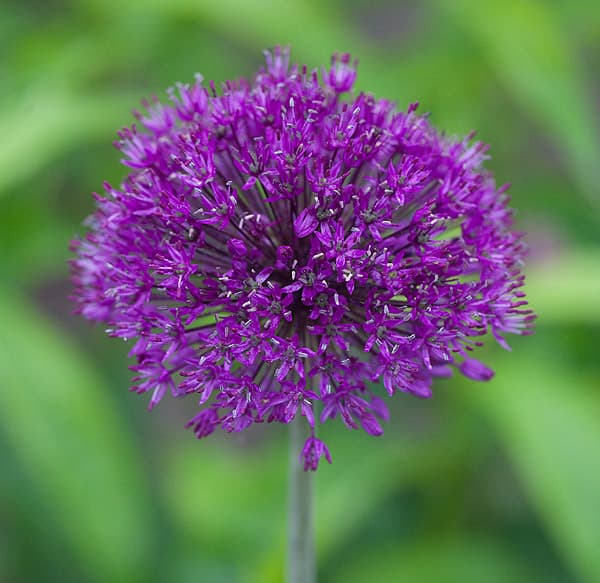
Allium hollandicum is a bulbous perennial native to Iran and Kyrgyzstan, grown widely as an ornamental for its large, spherical umbels of deep violet-purple atop tall, upright stems in late spring. It is reliably hardy and long-lived in the garden when given good drainage.
Foliage emerges in early spring and begins to yellow before or during the flowering period - a normal trait of the species. Planting around low-growing perennials like catmint helps mask the declining leaves. Bulbs multiply slowly and can be divided every three to four years once foliage fully dies back. Deer and most rodents largely avoid it, and it naturalizes readily in well-drained, open soils.
Ornamental alliums are interplanted with roses specifically to exploit the sulfur-containing compounds the genus produces, which have a documented deterrent effect on aphids and other soft-bodied pests.
Onion White Rot
Yellowing and dieback of leaves, soft rotting at the base, and a fluffy white fungal growth with small black sclerotia on roots and lower stems.
Remove and destroy infected plants. Do not compost. Avoid replanting alliums in affected soil for several years and rotate crops. There is no chemical cure once established.
Downy mildew
Yellowing on top of leaves with grey-purple fuzz underneath. Spreads rapidly in humid conditions.
Remove affected leaves. Improve air circulation. Avoid overhead watering. Copper spray as preventive.
Botrytis (grey mould)
Grey fuzzy mould on petals and stems, worst in cool wet conditions.
Remove affected parts immediately. Improve air circulation. Avoid overhead watering. Apply copper fungicide if severe.