
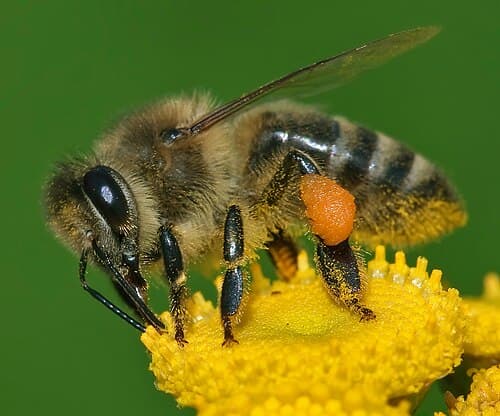
Honeybee
The honeybee is not a wild insect in North America — it arrived with European settlers in the 1600s and has been managed for honey and pollination ever since. But it has naturalized widely, and feral colonies occupy tree cavities, wall voids, and other sheltered spaces throughout the Northeast. Understanding its biology makes you a better host for it, regardless of whether you keep bees.
A colony is a superorganism. The 20,000 to 80,000 workers in a productive hive operate as a single decision-making unit, allocating foragers through a process called the waggle dance: a successful forager returns to the hive and performs a figure-eight dance on the vertical comb face, encoding the direction and distance of a food source in the angle and duration of the dance's straight run. Other workers read the dance, calibrate for the current sun angle, and navigate to the precise flower patch. The system is accurate to within a few meters at distances of a mile or more.
Foraging peaks from late April through early August, tapering sharply as the colony shifts to winter preparation. Workers born in fall are physiologically different from summer workers — they are “fat bees,” loaded with protein reserves, and they live for months rather than weeks. These are the bees that carry the colony through winter. Loss of late-season forage (August–October) starves these bees before they fully develop and is a leading contributor to colony collapse over winter.
The implications for garden planting are direct: early spring bloom (crocus, willow, maple) is critical for building spring population, midsummer diversity sustains foragers, and late-season bloom (asters, goldenrod, anise hyssop) produces the fat winter bees. A garden that goes quiet in August and September is not supporting the colony through the most critical period.
Essential pollinator for fruit, vegetable, and flower crops; requires a succession of bloom from early spring through late fall.
Honeybees cannot be introduced as individuals — they operate as a colony. If you want managed bees, take a beekeeping course and start with a locally adapted nucleus colony (nuc) from a regional beekeeper, not a package shipped from the South. Locally raised queens have already selected for the disease resistance and foraging patterns suited to your climate. For supporting feral and neighboring colonies without keeping bees yourself, focus entirely on habitat.
Plant a succession that covers early March through late October: willow and red maple for early pollen, fruit trees and spring bulbs for April, native perennials through summer, and asters, goldenrod, and borage into October. Avoid double-flowered cultivars — the extra petals block access to nectar and pollen. Provide a shallow water source with stones or corks for bees to land on. Never spray systemic insecticides on flowering plants or on soil near flowering plants.