
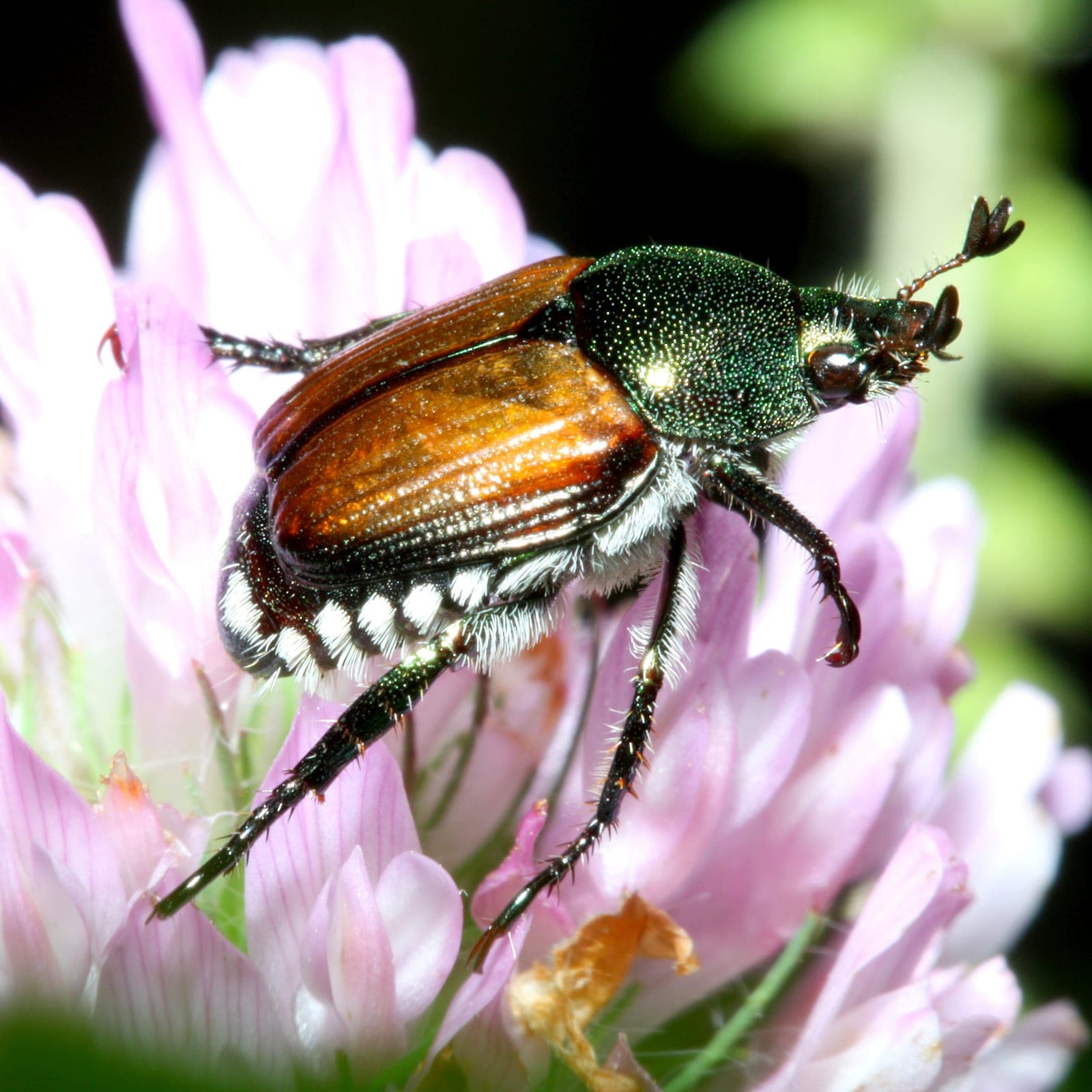
Japanese Beetle
Japanese beetle arrived in New Jersey around 1916, hitchhiking in a nursery shipment from Japan, and has been spreading west and south ever since. It is now established across most of the eastern United States and is among the most economically damaging landscape insects on the continent. Part of what makes it so difficult is that it causes serious damage at two completely different life stages, in two completely different ways.
The adult is a handsome insect, bronze and metallic green, and it would be admirable in other circumstances. It feeds by skeletonizing foliage — eating the tissue between the leaf veins and leaving a brown, lacy skeleton behind. Worse, it aggregates. One beetle releases aggregation pheromones while feeding, which draws more beetles, which release more pheromones. A small infestation escalates into a cloud within days on preferred hosts: roses, dahlias, grapes, lindens, and crabapples take the worst of it. Adults are active for roughly six weeks — typically late June through early August — and the timing is brutal, coinciding with peak bloom on many ornamentals.
Below ground, the white C-shaped grubs spend ten months feeding on grass roots just below the soil surface. A heavy infestation kills turf in irregular patches that peel back like a rug, detached from the soil entirely. Skunks, raccoons, and birds aggravate the damage by digging for grubs, which are nutritious and easy to find.
The most counterintuitive piece of advice about Japanese beetles concerns traps. Pheromone-baited traps do attract and catch enormous numbers of beetles — but they also attract more beetles than they catch, functioning as a lure that concentrates beetles on your property. Studies consistently show that traps increase feeding damage on nearby plants. Do not use them.
Skeletonizes foliage and destroys flowers of roses, dahlias, and many ornamentals; grubs kill turf grass roots.
Adults skeletonize leaves and devour petals and buds; aggregations escalate rapidly. Grubs destroy turf in late summer and fall.
Hand-pick adults in early morning into soapy water — beetles are sluggish when cool. Neem oil applied to foliage deters feeding but must be reapplied after rain. For grubs, apply milky spore (Bacillus popilliae) to turf — it takes 1–3 seasons to establish but provides long-term biological control. Beneficial nematodes (Heterorhabditis bacteriophora) applied in late August when grubs are young and near the surface offer faster results. Never use pheromone traps.
Tolerate light skeletonizing on large plants. Intervene aggressively on dahlias and roses where flower damage is the point of growing them.