
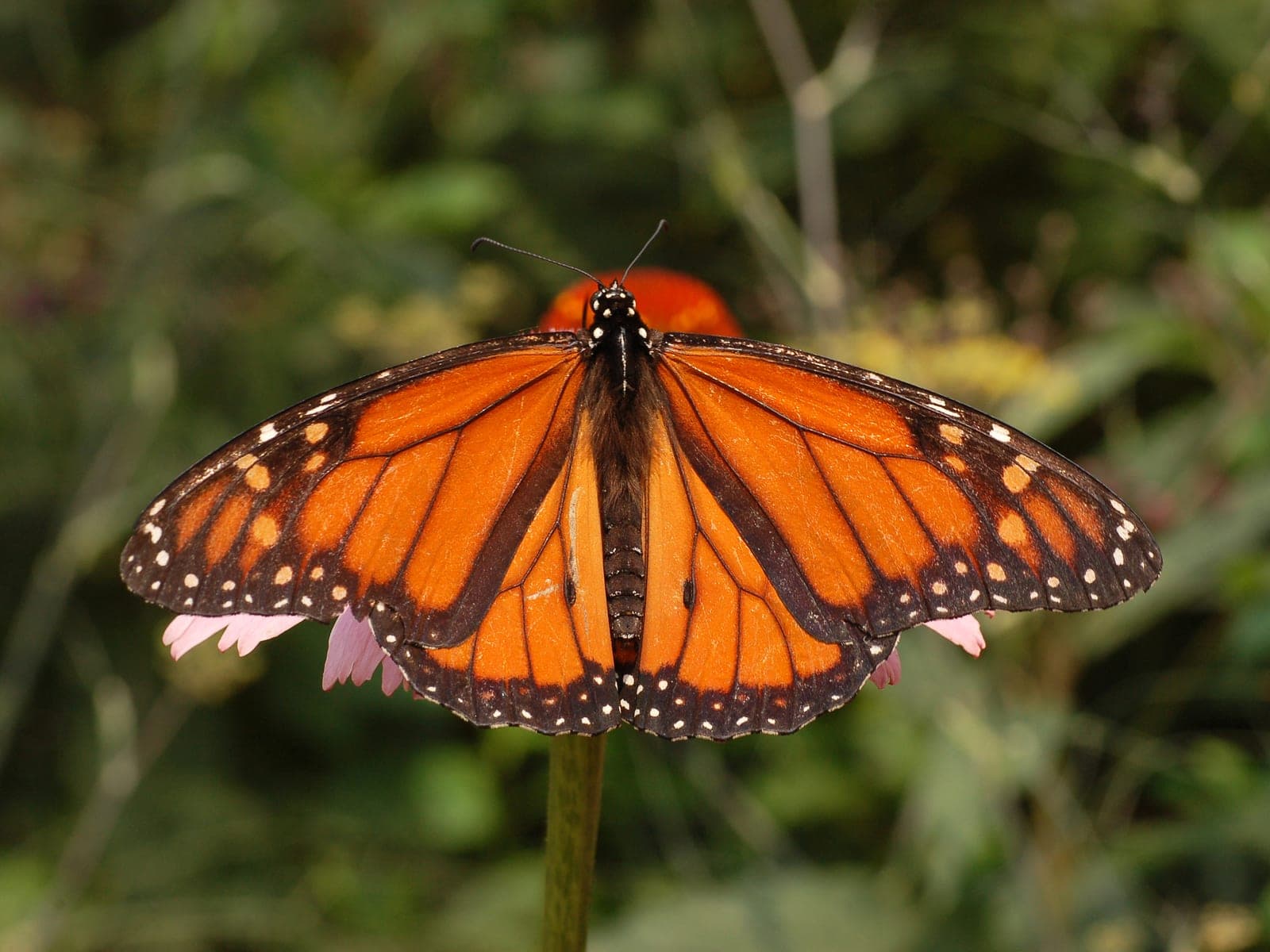
Monarch Butterfly
The monarch is the most widely recognized butterfly in North America and one of the most studied insects on the planet, yet it continues to reveal new complexity. Its annual migration — up to 3,000 miles from the eastern United States and Canada to overwintering grounds in the oyamel fir forests of Michoacán, Mexico — is not carried out by any individual butterfly. The monarchs that arrive in Mexico each November are the great-grandchildren or great-great-grandchildren of those that left the previous spring. The migratory generation, called the Methuselah generation, lives eight months; summer generations live only two to six weeks. How the Methuselah generation navigates to forests they have never seen, to trees their ancestors occupied, remains incompletely understood — they use a time-compensated sun compass calibrated by circadian clocks in their antennae, but the full picture is not yet assembled.
The relationship between monarch and milkweed is one of the most famous examples of obligate plant-herbivore coevolution. Monarch larvae eat only milkweed (genus Asclepias), which contains cardiac glycosides — toxic steroids that would kill most insects. The monarch larva has evolved to sequester these compounds rather than detoxify them, storing them in its body and carrying them through metamorphosis into the adult. The orange and black coloration of the adult is an honest signal to predators: this insect is poisonous, and a bird that eats one remembers. The viceroy butterfly, which is not toxic, mimics this coloration — one of the clearest examples of Batesian mimicry in North America.
Milkweed decline is the primary driver behind monarch population collapse. The eastern migratory population has fallen by an estimated 80 to 90 percent since the 1990s, driven largely by herbicide-resistant agriculture eliminating milkweed from the corn and soybean belt, which was once the primary breeding ground. Planting milkweed in gardens directly addresses this — the Hudson Valley sits along the main migratory corridor, and local breeding populations depend on milkweed throughout the region.
An important detail for Zone 6b gardeners: do not plant tropical milkweed (Asclepias curassavica), which is sold widely but doesn't die back in warm climates, disrupting migration cues and hosting a parasite (Ophryocystis elektroscirrha) at higher rates. Plant native species — common milkweed (Asclepias syriaca), butterfly weed (Asclepias tuberosa), or swamp milkweed (Asclepias incarnata) — which die back naturally and support healthy migration behavior.
Pollinator of late summer and fall flowers; essential milkweed-dependent species in active population decline. Every milkweed plant in the garden directly supports the migratory population.
Monarchs cannot be introduced directly — they are wild migratory insects that navigate to gardens on their own during migration. The most effective action is planting native milkweed species, which provide the only larval host plant. Common milkweed (Asclepias syriaca) and butterfly weed (Asclepias tuberosa) are the best choices for Zone 6b. Plant in the sunniest, most open part of the garden — monarchs prefer to lay eggs on milkweed in full sun, away from forest edge. Avoid tropical milkweed (Asclepias curassavica), which is widely sold but disrupts migration timing and increases parasite loads.
Plant a succession of nectar sources from July through October to support southbound migration: zinnias, cosmos, and lantana in summer; goldenrod (Solidago spp.), asters (Symphyotrichum spp.), and ironweed (Vernonia noveboracensis) in fall. These late-season plants provide the nectar monarchs need to build fat reserves for the 3,000-mile flight to Mexico. Leave milkweed standing until after the first frost so late-season larvae can complete development. Eliminate pesticide use entirely during July through October migration window.