
Spotted Lanternfly
The spotted lanternfly is one of the most significant invasive insects to reach the eastern United States in decades. Native to China, Vietnam, and parts of South Asia, it was first detected in Berks County, Pennsylvania in 2014 and has since spread to over a dozen states, with the Mid-Atlantic and Northeast bearing the worst of the pressure. It is not a fly — it is a planthopper, related to cicadas — and it feeds by piercing plant tissue and drinking phloem sap, a feeding mode that is slow but cumulative and can kill susceptible plants over multiple seasons.
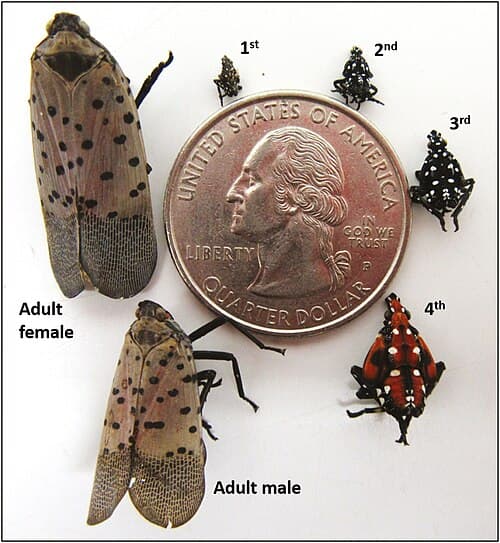
Its appearance is deceptive. The early instar nymphs are black with white spots — striking, almost elegant. As they mature, red patches appear. The adult has spotted tan forewings and vivid red hindwings revealed only in flight, which makes a flushed individual briefly stunning before it becomes a problem again. Part of the challenge in public communication about spotted lanternfly is that people are reluctant to kill something they find beautiful.
The primary host is tree of heaven (Ailanthus altissima), itself an invasive species from China that established widely in the Northeast and is nearly impossible to eradicate. Lanternfly populations can reach enormous densities on Ailanthus, which functions as a breeding reservoir. From there, adults disperse to a broad range of economically valuable hosts: grapevines, hops, apples, peaches, cherries, plums, maples, birches, and willows. Grapes and hops are particularly vulnerable — heavily infested vines accumulate honeydew (excreted sugar), which grows a black sooty mold that blocks photosynthesis, and the sap loss alone can kill young vines.
Egg masses are the most important target for management. Each female lays one or two masses of 30 to 50 eggs in a gray-brown cement-like coating on any flat surface: tree bark, fence rails, stone walls, lawn furniture, vehicle bumpers, firewood. Egg masses are present from September through May. Learning to identify and scrape them is the most effective single action a property owner can take.
See also: Milkweed and the spotted lanternfly, on early research into milkweed's cardiac glycosides as a possible control.
Phloem-feeding pest of grapevines, fruit trees, and ornamentals; produces honeydew that promotes sooty mold; populations can reach damaging densities rapidly.
Phloem sap removal weakens plants over successive seasons; honeydew leads to sooty mold growth on leaves and fruit; grapevines and hops can be killed by heavy multi-year infestations.
Egg mass scraping (fall through spring), circle trunk traps, neem oil on nymphs, approved systemic insecticides on high-value woody plants. Eliminate Ailanthus on the property to reduce the breeding population.
No tolerance threshold — report and eliminate at first sighting. This is a quarantine pest in most Northeast states.
Scrape egg masses into a bag of hand sanitizer or rubbing alcohol — do not crush them dry, as eggs may still hatch. Report confirmed sightings to your state department of agriculture (Pennsylvania: 1-888-4BADFLY; New York: through iMapInvasives or the DEC). Kill adults and nymphs on contact — stomping, soapy water spray, or approved insecticides including neem oil for lighter infestations. Circle traps on tree trunks intercept climbing nymphs without pesticide use. Remove Ailanthus from the property where possible — it is the primary breeding host. Do not move firewood, outdoor furniture, or vehicles without inspecting them for egg masses.
Act in fall and early spring when egg masses are present and most vulnerable. Egg mass scraping is the highest-value action. Adult populations in July through September are mobile and difficult to suppress — focus control energy on the egg stage.