
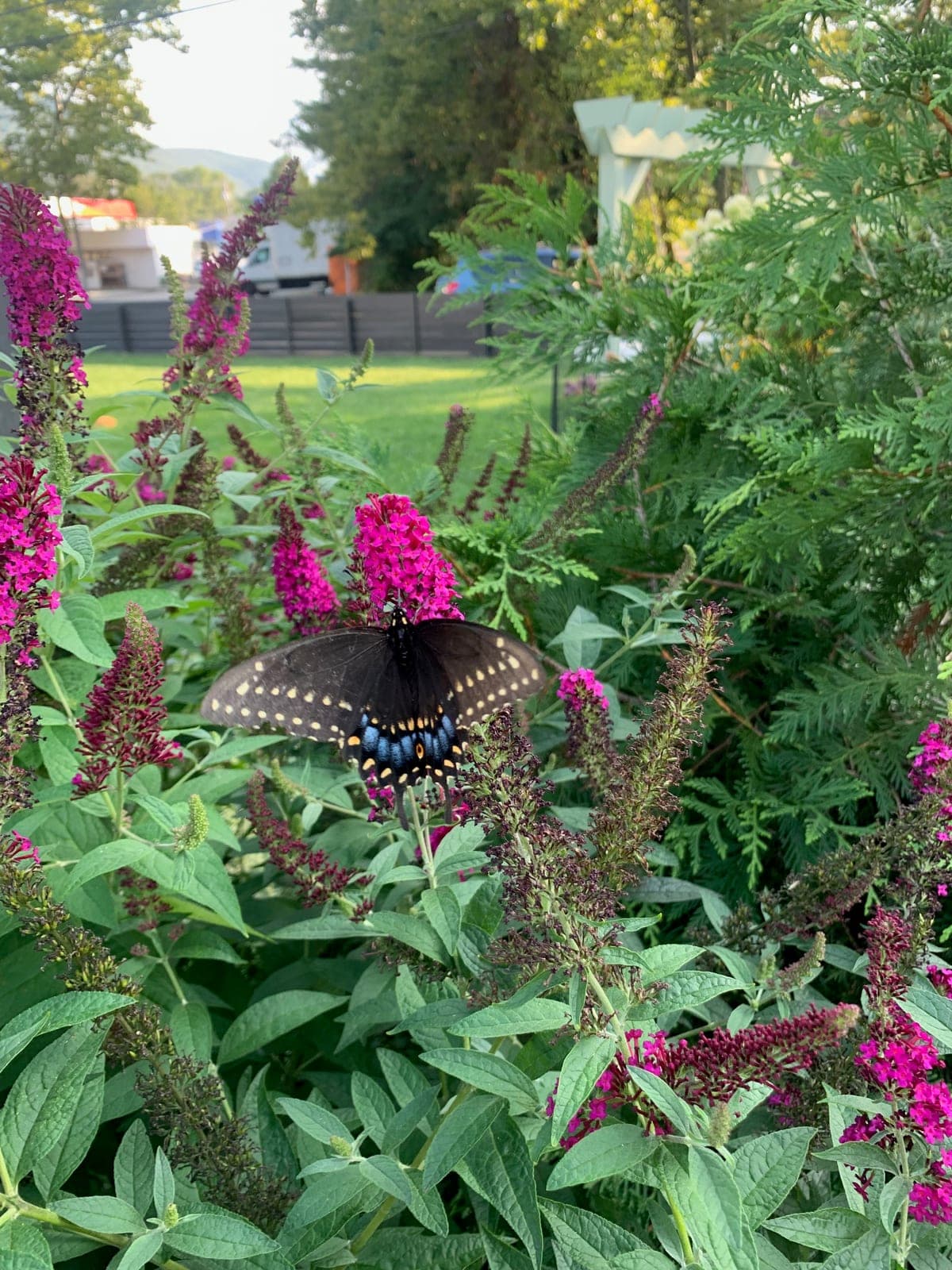
Black Swallowtail
The Black Swallowtail is a common butterfly across eastern North America and a familiar sight in vegetable and herb gardens. Adults are strong fliers with black wings marked by yellow spot bands, blue scaling, and a red-orange eyespot on the hindwing; females show more blue and less yellow than males. They produce two to three broods per year in this region, with adults active from late spring through early fall.
Larvae feed almost exclusively on plants in the carrot family (Apiaceae), including cultivated dill, parsley, fennel, and carrot, as well as wild relatives like Queen Anne's lace. Young caterpillars are dark with a white saddle, mimicking bird droppings, while mature larvae are green with black bands and yellow spots. When threatened, larvae evert an orange forked gland called an osmeterium that emits a deterrent odor. The species overwinters as a chrysalis, which may be brown or green depending on attachment surface, and survives Zone 6b winters in this resting stage.
Adults nectar on a wide range of flowers and contribute to garden pollination while moving between blooms. Gardeners often find caterpillars on herb plants; because the species is native and beneficial, many growers plant extra dill or parsley specifically to support larvae rather than treating them as pests.
A native pollinator whose larvae feed on Apiaceae host plants and whose adults nectar across many garden flowers.
Plant host species such as dill, parsley, and fennel, and provide nectar-rich flowers to attract egg-laying females.
Sunny, sheltered planting areas with both larval host plants and continuous flowering nectar sources encourage residents to stay and breed.