
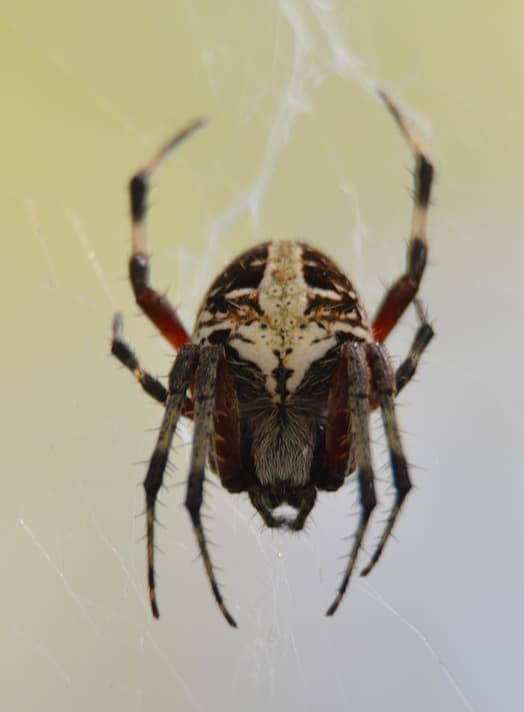
Spotted Orb-Weaver
The spotted orb-weaver is one of the most common and conspicuous spiders in eastern North American gardens from midsummer through fall. Females are stout and variable in color — ranging from pale tan to reddish-brown with a distinctive spotted or streaked abdominal pattern — while males are considerably smaller and rarely noticed. The species reaches peak adult size and visibility in August and September, when females build their largest webs and occupy the same site for weeks at a time.
The orb web itself is a geometric structure: a sticky spiral supported by radial threads, replaced in whole or in part each night. The spider sits at the hub or retreats to a nearby curl of leaves connected by a signal thread, waiting for vibration. Prey includes any flying or crawling insect that enters the web: flies, moths, beetles, aphids, whiteflies, and small caterpillars. Larger webs can span a foot or more across and intercept insects considerably larger than the spider itself.
Mating occurs in late summer. Females produce egg sacs in fall, wrapping several hundred eggs in silken cases attached to sheltered plant material or bark crevices. Eggs overwinter and hatch in spring; juveniles disperse immediately and grow slowly through the season, becoming visible only when they approach adult size in late July or August. Adults die with the first hard frost.
Orb-weavers are harmless to humans. They bite only under direct physical pressure, and the venom causes, at most, a mild local reaction in non-sensitive individuals. They are not aggressive and will retreat when approached. The instinct to knock down a web near a doorway is understandable but worth resisting — each web represents hundreds of caught insects.
Beneficial predator that captures a wide range of flying and crawling pest insects in sticky orb webs; most active at garden perimeters and fence lines from midsummer through frost.
Orb-weavers are wild colonizers — they cannot be purchased or transplanted. They arrive naturally when habitat and prey are suitable.
Leave undisturbed vegetation at garden edges and allow some leaf litter to accumulate in border areas as overwintering habitat for juveniles. Reduce or eliminate broad-spectrum pesticide use, which depletes prey populations and kills spiders directly.