Edelweiss, the song and the flower
The little white star of the Alps is sixty-one years famous for a song that isn't Austrian and isn't old — but the plant behind it is stranger and more demanding than the tune lets on.
Sixty-one years on from the film, most people who can name edelweiss have never seen one. They know it the way I first did — as the slow waltz Captain von Trapp sings in The Sound of Music, a song so bound up with alpine Austria that it is often taken for an old folk anthem, even on occasion mistaken for the country's national one. It is neither. Richard Rodgers and Oscar Hammerstein wrote it for the stage musical in 1959, and it was the last lyric Hammerstein ever finished; he died of cancer the following summer. The song is barely older than colour television, and it is American to the bone. What it borrowed from Austria was a flower, and a feeling about a flower — that a small white bloom on a high, hard mountain could stand for a whole idea of home worth grieving for.
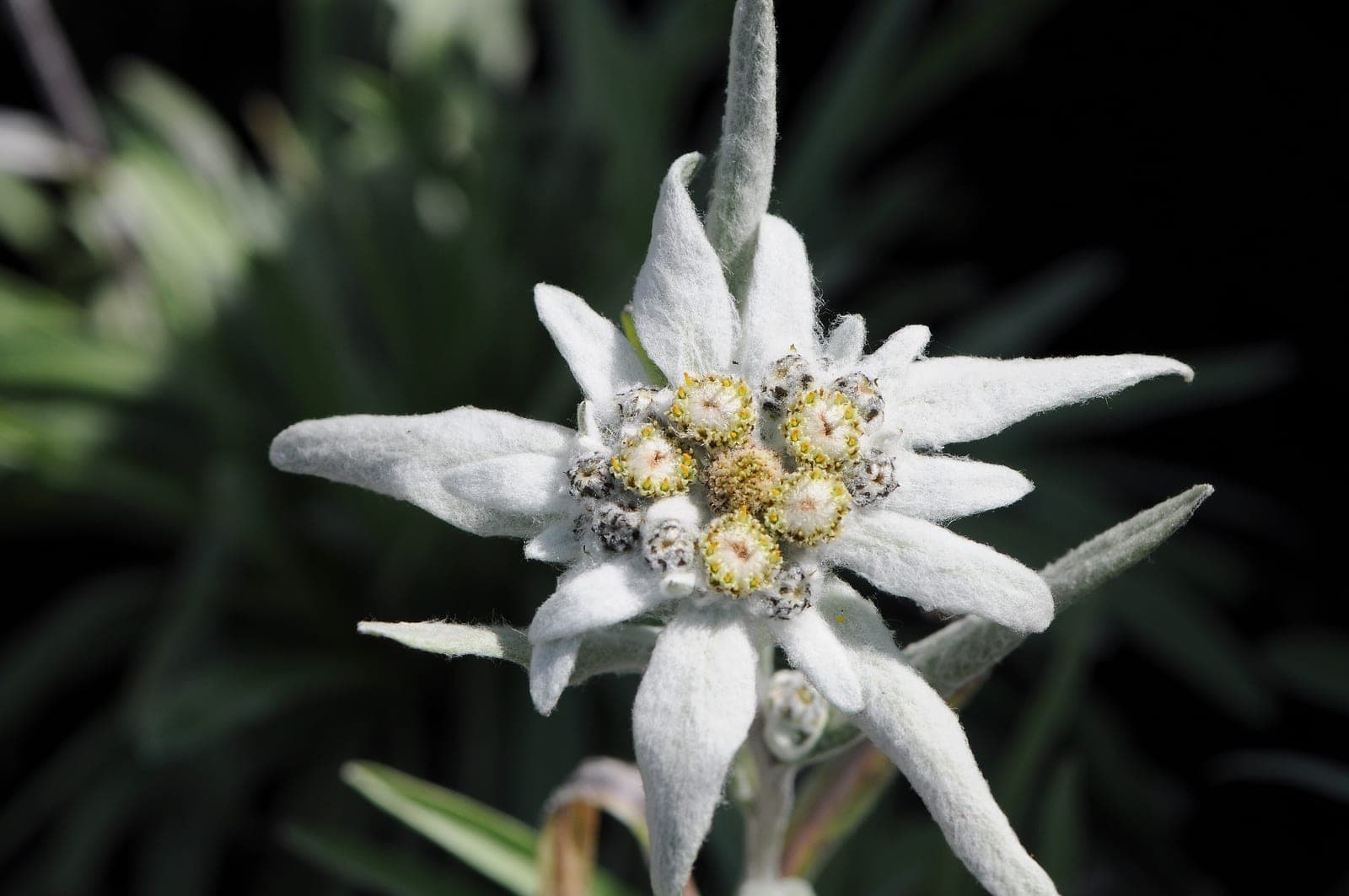
The plant itself is Leontopodium alpinum, and it is a good deal less sentimental than the tune. It grows on limestone crags in the Alps and Carpathians, up between roughly 1,800 and 3,400 metres, where the air is thin and the ultraviolet light is savage. Everything soft-looking about it is armour. The white you see is not petals at all but bracts — modified leaves — packed with a dense woolly felt whose fibres, at a scale smaller than a wavelength of light, scatter and soak up the near-ultraviolet that would otherwise cook the flowering parts sheltered at the centre. It is one of the few plants whose survival trick has been studied for how it might be copied into sunscreens and coatings. The star shape that reads as delicate is, up close, a piece of high-altitude engineering.
None of which makes it easy to grow, and that is the honest warning to put at the front. Edelweiss will not forgive a rich border or a wet winter. It wants what its home gives it: lean, gritty, alkaline soil, full sun, and above all sharp drainage, so that meltwater and rain run off the crown rather than sitting against it. Kill it and you will almost always have killed it with kindness — good soil, a mulch of bark, a damp spot — the crown rotting from beneath while the top still looks well. A raised bed or a rock garden is what it wants, with a collar of gravel around each plant. Give it these things and it will hold for its short life of a few years, self-sowing where it is happy. Sow the seed in the winter on the surface, for it needs light and cold to germinate.
This is the first of a run of posts on alpine plants — the cushion-formers and crevice-dwellers that make gardening on the scale of a dinner plate as absorbing as a whole border; the sky pilot comes next. They are a different discipline: less about abundance than about getting a few hard conditions exactly right. The flower is not soft, not tender, not lowland, and not asking to be loved. It is asking, like all the best alpines, to be left cold, dry, and largely alone.