
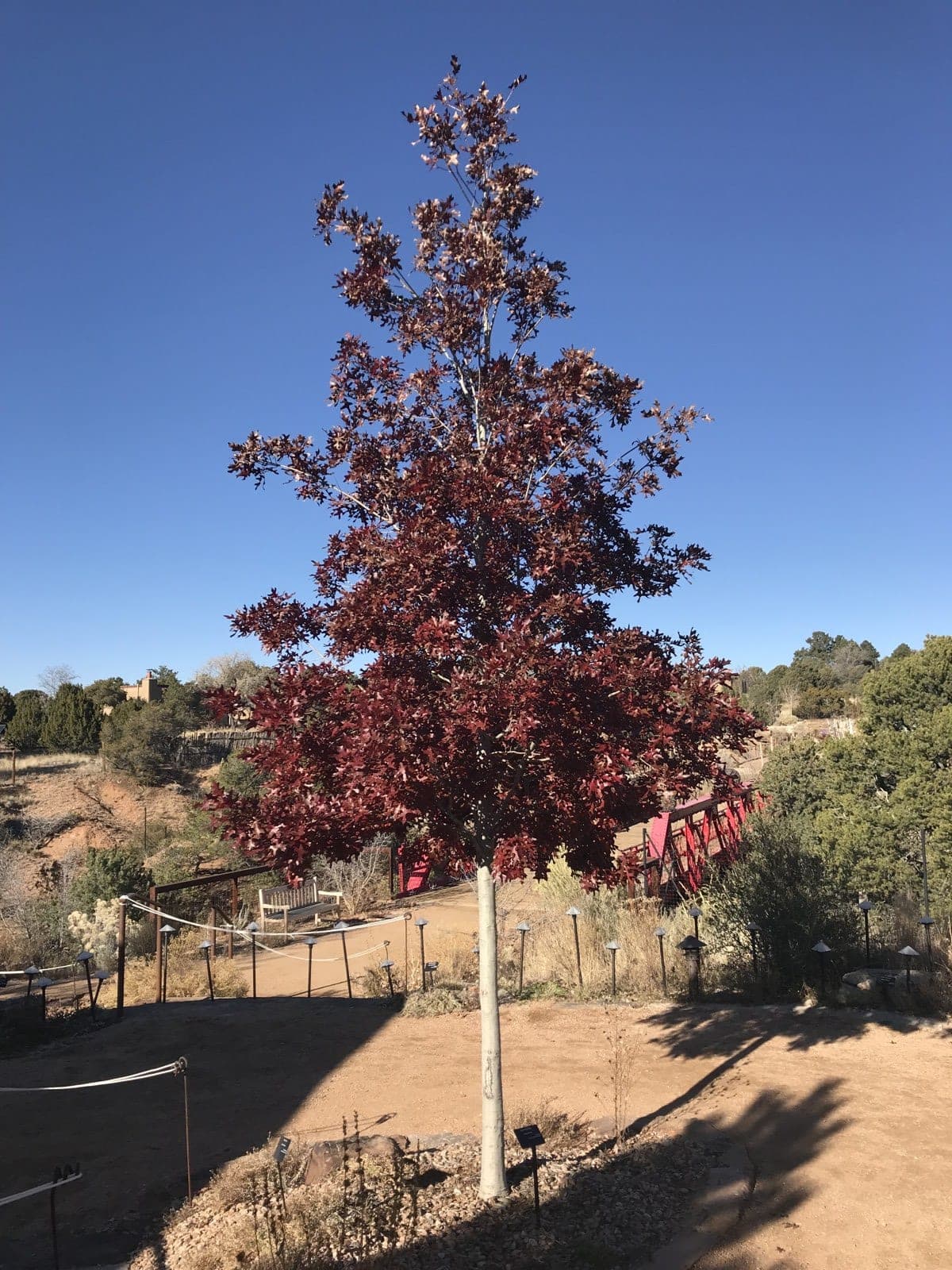
Texas red oak is a deciduous native tree endemic to the Cross Timbers and Edwards Plateau of Texas and southwestern Oklahoma. Its deeply lobed leaves turn deep red to orange in fall, making it one of the most reliable fall-color oaks for the southern Great Plains. Acorns are a significant food source for white-tailed deer, wild turkey, and squirrels.
The species establishes well on rocky, shallow, or calcareous upland soils and tolerates extended summer drought once rooted in. It grows at a moderate rate, reaching 30–50 feet. Oak wilt is the primary disease threat across its range; any pruning or wounding should be done only in December or January and never between February and June, when sap-feeding nitidulid beetles are active and capable of transmitting the pathogen. Fresh wounds outside the dormant window should be painted immediately with pruning sealant.
Acorns contain high levels of tannins and require leaching before they are palatable. Processed acorn meal has a documented history of use as a food staple among indigenous peoples of the southern Plains.
Ecoregions:Great Plains
Oak Wilt
Leaves wilt and brown starting at branch tips, progressing rapidly toward the trunk. Discoloration may appear as brown or yellow veining across the leaf blade. Individual branches or the entire canopy can defoliate within days to weeks. A cross-section of affected branches reveals dark streaking in the outer sapwood ring.
Contact a certified arborist for trunk injection of propiconazole fungicide, which is most effective as a preventive measure or at earliest symptom onset. Sever root grafts between infected and neighboring live oaks by cutting a trench 3–4 ft deep between trees to prevent fungal spread through connected root systems. Remove and immediately chip, burn, or bury all infected wood; do not store as firewood. Avoid any pruning from March through July when nitidulid sap-feeding beetles that carry the pathogen are most active. Apply wound sealant to all cuts made outside this window within minutes of cutting.
Hypoxylon Canker
Outer bark sloughs off stressed limbs to reveal gray, tan, or black crusty fungal stromata on the exposed wood surface; affected branches die back progressively and cross-sections of sapwood show brown streaking.
No effective chemical control exists. Remove affected limbs promptly and dispose of all infected wood off-site - do not chip or compost it on the property. Reduce predisposing stress by providing deep irrigation during drought and avoiding mechanical injury to roots and bark. The fungus is opportunistic; healthy, unstressed trees resist infection.
Oak Anthracnose
Brown, irregular dead areas along and between leaf veins appearing soon after bud break, typically in cool, wet springs. Affected leaves curl, wither, and drop prematurely. Severe or repeated infections cause twig dieback in the lower and interior crown.
Rake and dispose of all fallen leaves in autumn to reduce overwintering inoculum. Prune affected twigs back to healthy wood during dry winter weather and dispose of the material. Apply a copper-based or mancozeb fungicide at bud break for young trees or those with a history of severe annual infection. Healthy established trees typically recover without chemical treatment and produce a second flush of foliage.
Oak Leaf Blister
Raised, blister-like bulges on the upper leaf surface with corresponding concave depressions on the underside. Affected tissue may turn light brown or grayish by midsummer. Heavy infections can cause early defoliation but rarely threaten tree health on an established tree.
No treatment is needed on mature, vigorous trees. Rake and dispose of fallen leaves in autumn to reduce the overwintering spore load of the causal fungus (Taphrina caerulescens). On trees with a history of severe symptoms, apply a single dose of copper-based fungicide at bud swell in early spring before leaf tissue is exposed.
Tubakia Leaf Spot
Angular to irregular brown spots, often bordered by leaf veins, appearing on leaves from midsummer onward. Spots may coalesce into large blighted areas. Heavily infected leaves drop weeks before normal fall senescence. Most common on red oak group species, including pin oak.
Rake and destroy all fallen leaves each autumn to reduce overwintering inoculum. Keep trees vigorous through appropriate watering and soil pH management, as stressed trees are more vulnerable. Fungicide applications (myclobutanil or propiconazole) at bud break can reduce severity in trees with repeated severe defoliation, but are rarely warranted for established specimens.
Armillaria Root Rot
Thinning, yellowing canopy with progressive dieback; white, fan-shaped mycelial mats visible beneath bark at or just below the soil line; honey-colored mushroom clusters appearing at the trunk base or on surface roots in autumn.
No chemical cure exists. Improve drainage and avoid any injury to roots or trunk. Remove severely infected trees along with as much root material as possible. Do not replant susceptible species in the same spot.
Bacterial Leaf Scorch
Marginal leaf browning that progresses inward from the edges, often with a yellow or reddish band separating scorched from green tissue. Symptoms appear in late summer, affect more branches each successive year, and eventually contribute to dieback over a decade or more. Caused by Xylella fastidiosa, transmitted by leafhoppers.
No cure exists. Trunk injections of oxytetracycline can temporarily suppress symptoms and are sometimes used on high-value trees. Minimize stress through consistent irrigation and corrected soil pH. Avoid wounding the trunk. Remove severely declining trees to limit leafhopper-mediated spread to nearby susceptible oaks.