
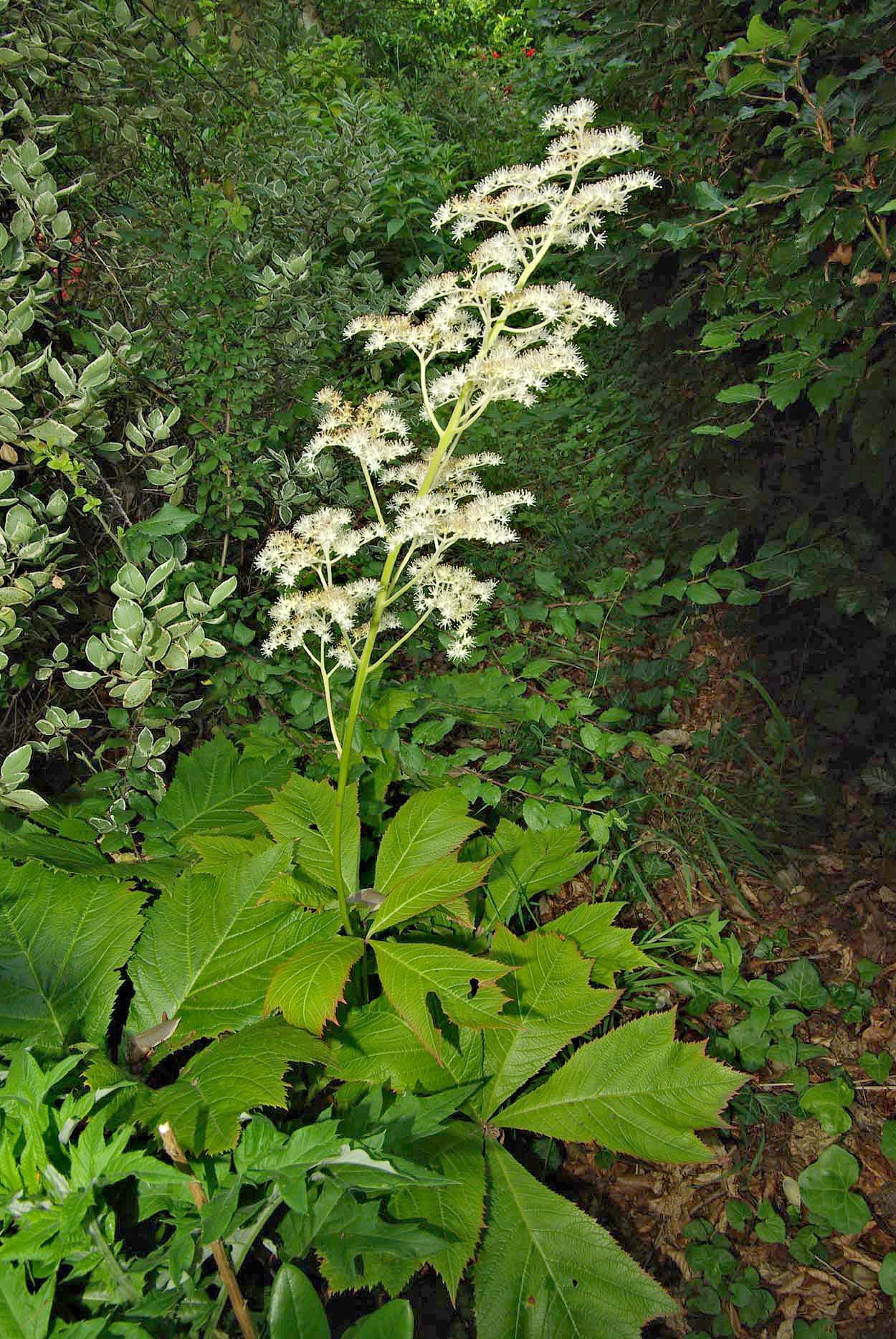
Rodgersia podophylla is a large herbaceous perennial native to Japan and Korea, grown primarily for its bold, deeply lobed palmate leaves rather than its flowers. Foliage emerges bronze in spring, turns green through summer, and shifts to bronze-red in autumn, giving three seasons of interest from a single planting.
It spreads steadily by underground rhizomes and can eventually cover an area up to 2 m (6.6 ft) across, making it useful as a large-scale ground cover beneath mature trees or along shaded stream margins. It performs best in consistently moist, humus-rich soil with a neutral to slightly acid pH, sheltered from drying winds. A thick organic mulch helps maintain even soil moisture and insulates rhizomes in zones 5 and 6.
Powdery mildew
White or grey powdery coating on leaves - usually starting on older growth in humid conditions or when nights cool.
Improve air circulation by thinning plants. Apply neem oil or potassium bicarbonate spray at first sign. Avoid overhead watering.
Fungal leaf spot
Brown or purplish spots on the leaves, often ringed with a yellow halo, that spread and merge in warm, humid, or wet weather; heavily spotted leaves yellow and drop early.
Pick off spotted leaves and clear fallen debris to remove overwintering spores. Improve air circulation by thinning, and water at the base so foliage dries quickly. If it persists, apply a copper- or sulfur-based fungicide at the first sign.
Crown Rot
Lower leaves yellow and wilt; the base of the rosette turns brown and soft, sometimes with white fungal threads at the soil line. Plants collapse in wet conditions.
Remove and destroy affected plants. Improve drainage and avoid overhead watering. Do not mulch directly against the crown. Space plants for airflow and avoid replanting in the same wet spot.