
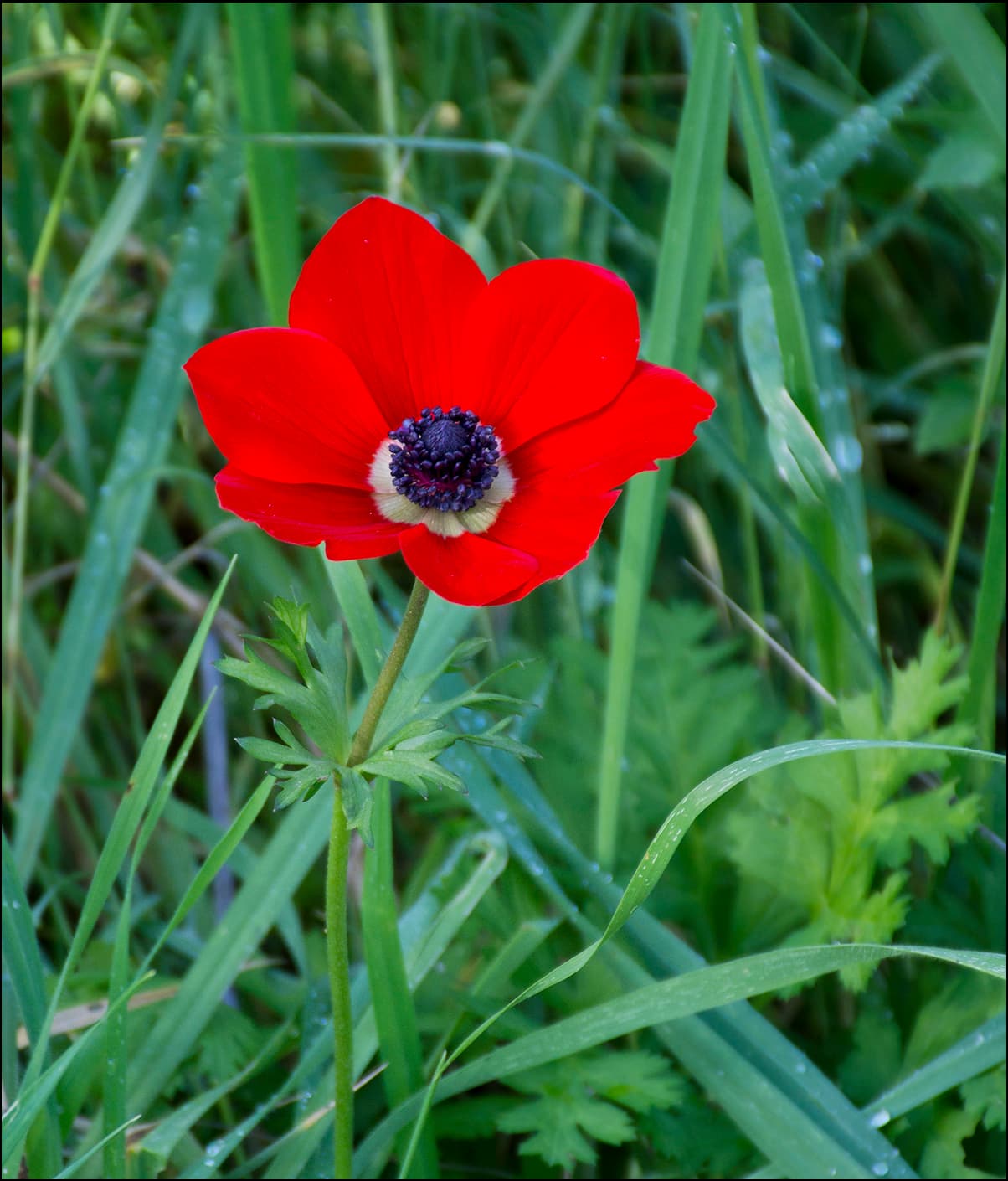
Anemone coronaria, the poppy anemone, is a corm-grown flower prized by florists and cutting gardeners for its saturated jewel-tone blooms - poppy-like cups of red, purple, blue, or white centered on a near-black boss, held on wiry stems above finely cut, fern-like foliage. De Caen types are single-flowered; St Brigid types carry a fuller, semi-double ruffled bloom.
Winter severity decides the planting calendar. In zones 8 and warmer, corms can stay in the ground over winter, so they go in during fall for flowers from late winter into spring. Everywhere colder, a hard winter will rot or kill corms left in the ground, so plant in late winter instead, close to when the ground becomes workable. Either way, soak corms in room-temperature water for 3–4 hours before planting to rehydrate them, then set them about 2 inches deep, 4–6 inches apart - the corms are small, irregular, and knobby with no reliable top or bottom, so don't worry about orientation; plant them on their side if unsure. Specialty growers sell out of De Caen and St Brigid stock early, so order corms roughly two months ahead of whichever planting window applies.
All parts of the plant contain protoanemonin, an irritant compound typical of the buttercup family, and can cause skin and gastrointestinal irritation if handled roughly or ingested - wear gloves when cutting or dividing in quantity, and keep away from children and pets.
Powdery mildew
White or grey powdery coating on leaves - usually starting on older growth in humid conditions or when nights cool.
Improve air circulation by thinning plants. Apply neem oil or potassium bicarbonate spray at first sign. Avoid overhead watering.
Botrytis (grey mould)
Grey fuzzy mould on petals and stems, worst in cool wet conditions.
Remove affected parts immediately. Improve air circulation. Avoid overhead watering. Apply copper fungicide if severe.
Anemone Leaf Smut
Raised dark streaks and blisters on leaves and stems that rupture to release black powdery spores; affected leaves distort and die back.
Remove and destroy infected foliage as it appears. Avoid overhead watering and crowding. Dispose of all debris in fall rather than composting it, and divide congested clumps to improve air circulation.
Foliar Nematode
Angular brown or black patches on leaves, bounded by leaf veins, starting on lower foliage and moving upward. Affected leaves wither but stay attached.
Remove and destroy infected leaves and surrounding debris. Avoid overhead watering and wetting foliage. Space plants for airflow and do not compost affected material. Severely infested plants should be dug out and discarded.