
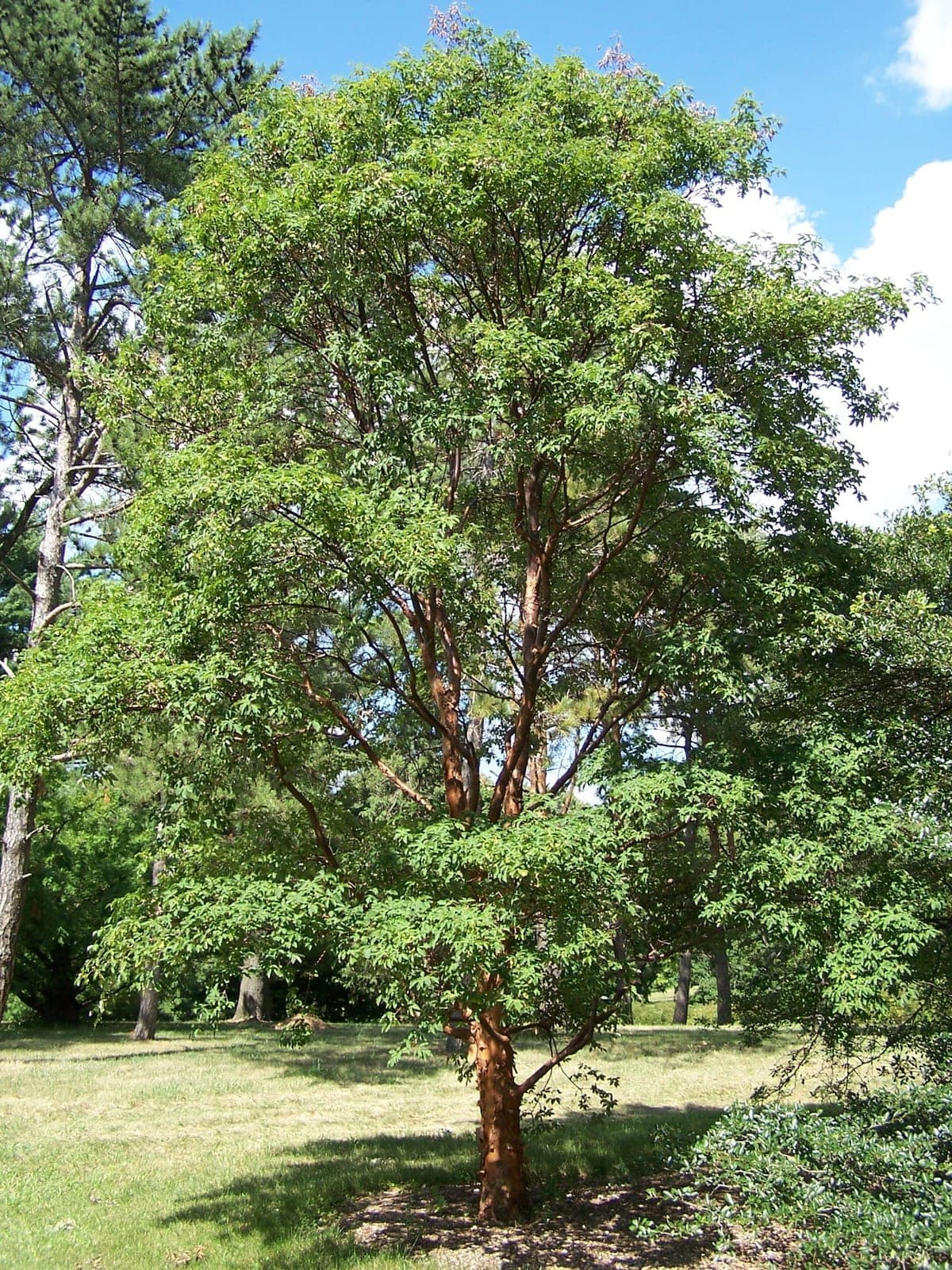
Paperbark Maple is a small deciduous tree native to central China, grown primarily for its exfoliating bark - cinnamon to orange-brown sheets that peel year-round to reveal fresh copper-toned inner bark. Trifoliate leaves turn rich red to orange-red in fall, giving the tree genuine four-season presence. Its modest mature size makes it well-suited to residential lots and small gardens where a large-canopy tree would overwhelm.
Acer griseum is naturally found at elevations of 1,500–2,000 meters across the Chinese provinces of Gansu, Henan, Hubei, Hunan, Shaanxi, Shanxi, and Sichuan. It grows slowly in cultivation, typically 12–18 inches per year, and rarely exceeds 25–30 feet at maturity. Organically rich, well-drained soil and a consistent moisture supply are most important during the first two or three years of establishment. A 3-inch mulch ring conserves soil moisture and moderates root temperatures. Bark exfoliation and fall color are most vivid in full sun, though the tree tolerates part shade without significant decline. It is generally free of serious pest and disease pressure.
Maple Anthracnose
Irregular brown or tan spots that follow and spread between leaf veins, giving leaves a scorched or blighted appearance. Severe infections cause premature leaf drop. In wet springs, small cankers may appear on young shoots.
Rake and remove fallen leaves each autumn to reduce overwintering fungal spores. Avoid overhead irrigation. Apply a copper-based fungicide at bud break during wet spring conditions. Prune selectively to improve canopy airflow.
Maple Tar Spot
Pale yellow-green spots appear on upper leaf surfaces in early summer. By late summer they enlarge into raised, glossy black blotches up to 1 in across, closely resembling tar splashes. Caused by Rhytisma acerinum and related species.
Rake and destroy all fallen leaves in autumn to eliminate overwintering spores. Fungicide applications are rarely justified on established trees. Improve air circulation through selective pruning where practical.
Verticillium Wilt
Lower leaves yellow and wilt, often on one side of the plant, with brown streaking in the stem and crown tissue when cut open. Plants are stunted and decline over the season.
Remove and destroy affected plants. Avoid planting in soil that has grown infected tomatoes, peppers, or other susceptible crops. Rotate beds and improve drainage; there is no cure once a plant is infected.