
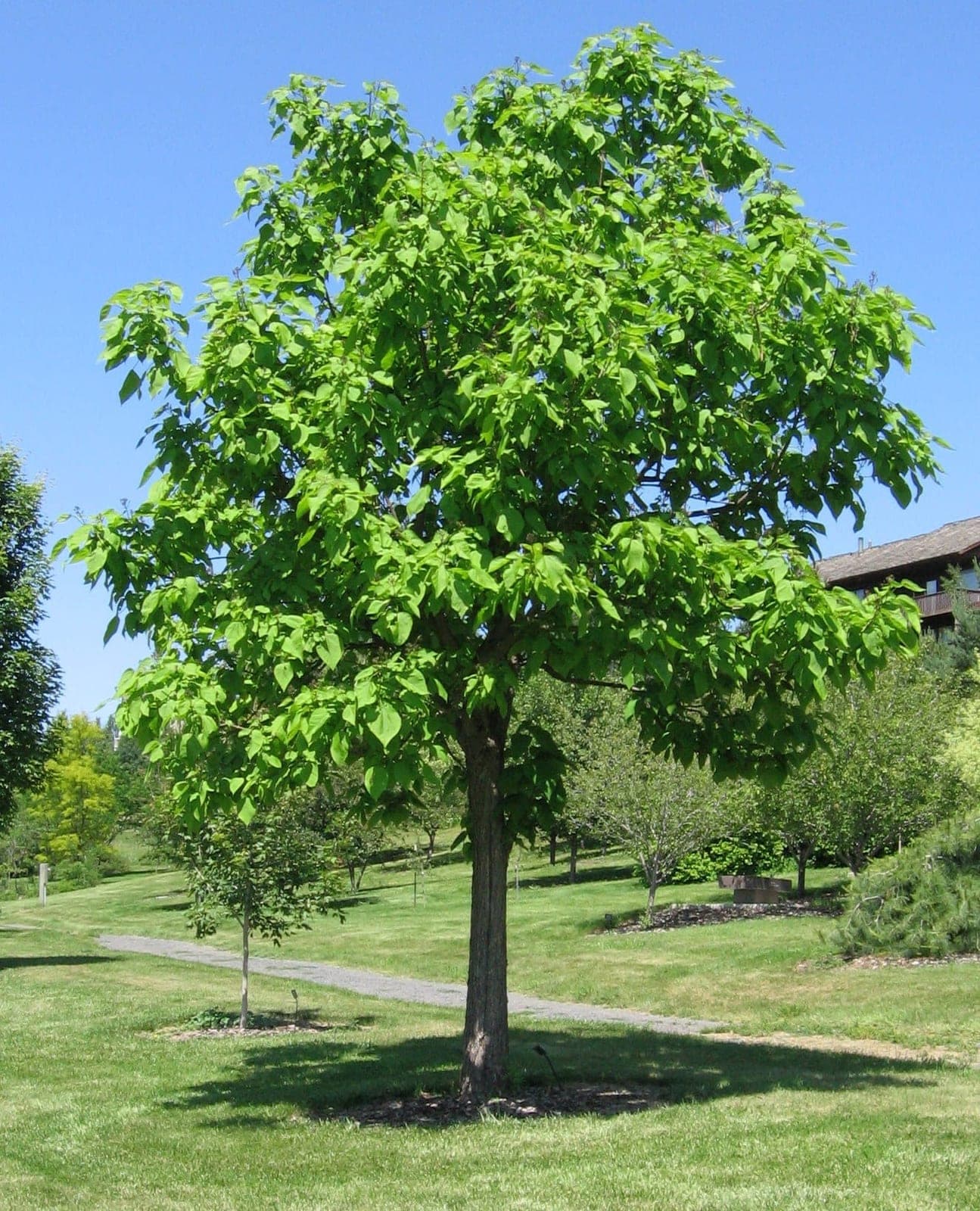
Northern catalpa (Catalpa speciosa) is a large deciduous tree native to a small region of the central United States and widely naturalized across eastern North America. Gardeners plant it for its enormous heart-shaped leaves, showy white tubular flowers marked with purple and yellow that appear in late spring, and long slender seed pods that remain on bare branches through winter. Few native trees offer this combination of bold foliage and ornamental structure in a large landscape.
The tree grows quickly and tolerates a wide range of soils including clay, compacted ground, and periodically wet or alkaline sites. It performs best in full sun with moist, moderately fertile soil. Seed pods reach 10–20 inches and drop significant litter; site the tree where cleanup is practical. It self-seeds readily in disturbed soil and can spread well beyond the planting site. Cold-hardiness extends to zone 4a, and the tree handles the heat of zone 8b without difficulty.
Northern catalpa is the primary larval host of the catalpa sphinx moth (Ceratomia catalpae). Its larvae, called catalpa worms, are a traditional and highly effective live fishing bait; some growers plant the tree specifically to harvest them. Heavy larval feeding rarely kills an established tree. The heartwood is exceptionally rot-resistant and was historically valued for fence posts and railroad ties. Indigenous peoples used bark preparations as a mild laxative and vermifuge.
Ecoregions:Eastern Temperate ForestsGreat Plains
Powdery mildew
White or grey powdery coating on leaves - usually starting on older growth in humid conditions or when nights cool.
Improve air circulation by thinning plants. Apply neem oil or potassium bicarbonate spray at first sign. Avoid overhead watering.
Fungal leaf spot
Brown or purplish spots on the leaves, often ringed with a yellow halo, that spread and merge in warm, humid, or wet weather; heavily spotted leaves yellow and drop early.
Pick off spotted leaves and clear fallen debris to remove overwintering spores. Improve air circulation by thinning, and water at the base so foliage dries quickly. If it persists, apply a copper- or sulfur-based fungicide at the first sign.
Verticillium Wilt
Lower leaves yellow and wilt, often on one side of the plant, with brown streaking in the stem and crown tissue when cut open. Plants are stunted and decline over the season.
Remove and destroy affected plants. Avoid planting in soil that has grown infected tomatoes, peppers, or other susceptible crops. Rotate beds and improve drainage; there is no cure once a plant is infected.
Root rot
Plants wilt, yellow, and stunt even in moist soil; lower stems and roots turn brown, soft, and mushy and the plant may collapse. Most common in heavy, wet, or poorly drained ground.
Improve drainage and stop overwatering, and never plant too deep. Lift and destroy badly affected plants along with the soil around the roots. Grow in raised or free-draining beds to prevent it returning.