
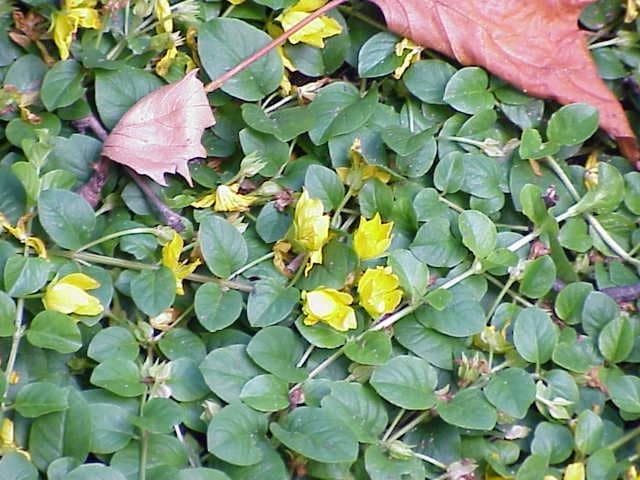
Creeping Jenny is a trailing perennial groundcover from Europe, only 2–4 in tall but running 12–24 in or more along the ground. Its paired, coin-shaped leaves (the old name is moneywort) root wherever a stem touches soil, and from early to midsummer the mat is dotted with bright yellow cup-shaped flowers. It stays green through most of the year in mild winters, and in cold climates the leaves die back and return in spring.
It wants moisture. Damp soil, a pond or stream edge, or a spot under downspout runoff keeps it lush, and it tolerates sun through fairly deep shade, though plants in dry sun scorch and thin out. It is also a favorite spiller for containers and hanging baskets. The catch is that it spreads quickly and is listed as invasive in a number of eastern and midwestern states, where it escapes into wet woodlands and stream banks. Keep it in a bounded bed, a pot, or between pavers, never beside natural wetlands, and pull rooted runners back every year. Check your state's invasive list before planting, and consider a native groundcover such as foamflower or wild ginger instead.
Run it along the front of astilbe. The low, bright green mat covers the bare soil around the astilbe crowns, holds moisture, and picks up the yellow-green of the leaves, and both thrive in damp ground with sun to part shade. Keep the jenny edged so it doesn't smother the astilbe.
Rust
Orange to brown raised pustules on the undersides of leaves, with yellow spotting on the upper surface. Heavy infections cause leaves to yellow and drop.
Remove and destroy infected leaves. Avoid overhead watering and improve air circulation. Apply a sulfur or copper-based fungicide if it spreads. Clear plant debris in fall.
Fungal leaf spot
Brown or purplish spots on the leaves, often ringed with a yellow halo, that spread and merge in warm, humid, or wet weather; heavily spotted leaves yellow and drop early.
Pick off spotted leaves and clear fallen debris to remove overwintering spores. Improve air circulation by thinning, and water at the base so foliage dries quickly. If it persists, apply a copper- or sulfur-based fungicide at the first sign.
Powdery mildew
White or grey powdery coating on leaves - usually starting on older growth in humid conditions or when nights cool.
Improve air circulation by thinning plants. Apply neem oil or potassium bicarbonate spray at first sign. Avoid overhead watering.