
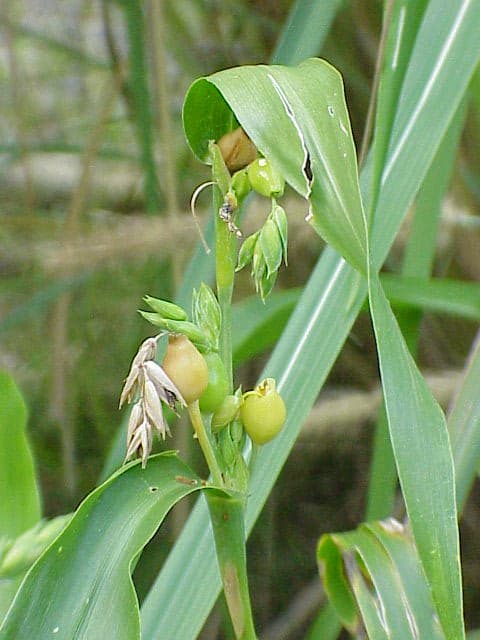
Job's Tears (Coix lacryma-jobi) is a tall warm-season tropical grass native to Southeast Asia, cultivated in Asia for thousands of years for its grain. The hulled grain is sold in Asian markets as Chinese pearl barley and used in soups, congees, teas, and fermented drinks, though it is unrelated to true barley (Hordeum vulgare). In temperate gardens it grows as a tender annual, typically reaching 3–6 feet in a single season.
The plant requires a long, hot summer to set mature seed. Husks harden at maturity and turn white, gray, or blue-violet; they are naturally perforated and have historically been strung as beads for jewelry, rosaries, and prayer beads across Asia and the Americas. In zones 9 and warmer the root crown may survive winter. Elsewhere, start seeds indoors 6 weeks before last frost and transplant once nights stay consistently above 55°F. Fertile, moist soil and a warm, humid site produce the strongest growth and heaviest seed set.
The hulled grain, known in Traditional Chinese Medicine as Yi Yi Ren, has a long documented history of use for edema and digestive complaints. Laboratory research on coixenolide and related lipids isolated from the seed has demonstrated anti-inflammatory and immunomodulatory activity; clinical interest in anti-tumor applications is ongoing.
Helminthosporium Leaf Spot
Small oval to elongated tan or brown lesions with reddish-purple borders appear on leaf blades and sheaths. In severe cases, blades yellow and die back from the tip downward.
Remove and dispose of heavily infected foliage. Avoid overhead irrigation and improve air circulation by thinning dense plantings. Fungicide applications are rarely warranted on established native grasses; correcting site conditions - spacing, drainage, and fertility - is the primary control.
Fungal leaf spot
Brown or purplish spots on the leaves, often ringed with a yellow halo, that spread and merge in warm, humid, or wet weather; heavily spotted leaves yellow and drop early.
Pick off spotted leaves and clear fallen debris to remove overwintering spores. Improve air circulation by thinning, and water at the base so foliage dries quickly. If it persists, apply a copper- or sulfur-based fungicide at the first sign.
Root rot
Plants wilt, yellow, and stunt even in moist soil; lower stems and roots turn brown, soft, and mushy and the plant may collapse. Most common in heavy, wet, or poorly drained ground.
Improve drainage and stop overwatering, and never plant too deep. Lift and destroy badly affected plants along with the soil around the roots. Grow in raised or free-draining beds to prevent it returning.