
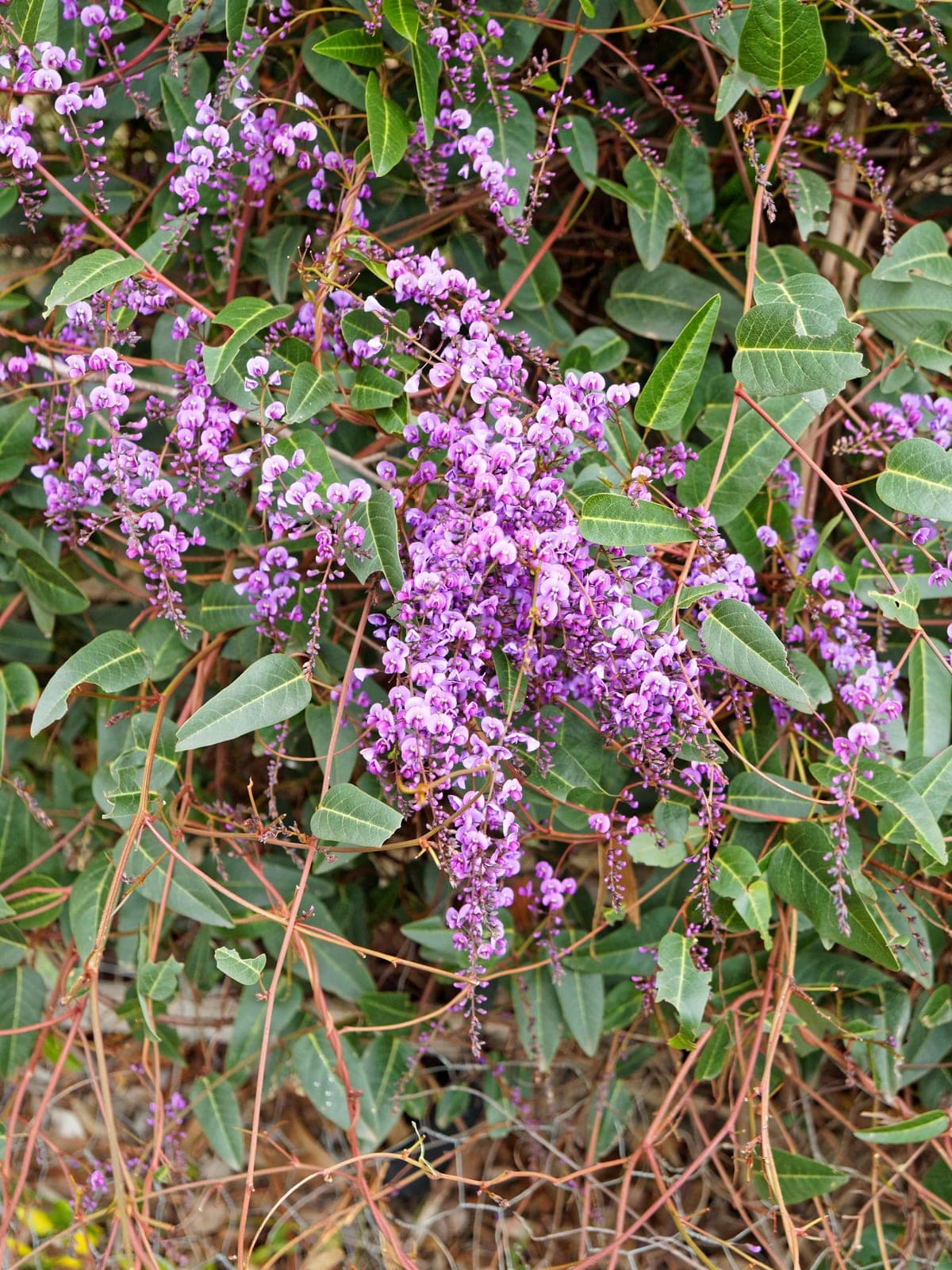
Hardenbergia violacea is an Australian native vine in the pea family, producing dense racemes of violet-purple pea-shaped flowers from late winter through spring, when few other climbers are actively growing. Evergreen and fast-establishing, it is one of the most practical screening plants for warm, dry-summer climates.
It climbs by twining and reaches 6–10 feet on a trellis or fence, or spreads along the ground as a slope cover without support. As a legume it fixes atmospheric nitrogen, gradually improving soil fertility over time. It tolerates drought once established and performs best in freely draining soil; persistent soil wetness is the primary cause of plant failure. Light pruning after the main flowering flush keeps it compact and stimulates denser regrowth. It handles coastal exposure and a range of soil types well.
Early European settlers in Australia brewed the roots as a substitute for true sarsaparilla, which gave rise to the common names false sarsaparilla and wild sarsaparilla. Aboriginal Australians used the roots as a food source.
Phytophthora Root Rot
Wilting despite moist soil, yellowing leaves, stunted growth, and dark, decayed roots and crown tissue. Vines may collapse during hot weather.
Plant in well-draining soil and avoid waterlogging. Remove and destroy affected vines. Improve drainage with raised beds or amended soil and avoid overwatering.
Powdery mildew
White or grey powdery coating on leaves - usually starting on older growth in humid conditions or when nights cool.
Improve air circulation by thinning plants. Apply neem oil or potassium bicarbonate spray at first sign. Avoid overhead watering.