
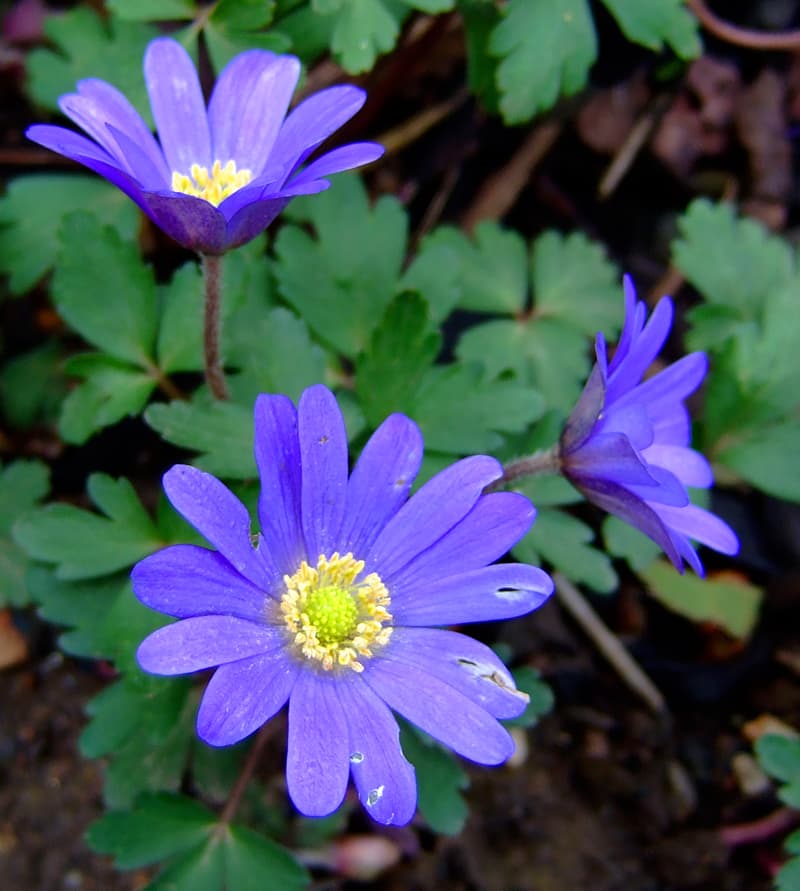
Anemone blanda, the Greek anemone or Grecian windflower, is a low, tuberous perennial native to Greece, Turkey, and the Balkans. Unlike its florist cousin the poppy anemone, its small daisy-like blooms in blue, white, or pink open flat over deeply cut, fern-like foliage just 4–6 inches tall - among the earliest flowers of the year, often overlapping the tail end of snowdrops and the first crocus. Left undisturbed, it spreads steadily by tuber offsets and self-seeding into a dense flowering carpet, making it a natural fit under deciduous trees, along woodland edges, and threaded through a lawn that isn't mowed until the foliage yellows.
The tubers are genuinely cold-hardy - reliably so through zone 4 - so unlike Anemone coronaria, there's no zone-dependent planting calendar to work around: plant in fall everywhere within its range, same as crocus or snowdrops, and the tubers stay in the ground and overwinter without protection. The dried, knobby tubers arrive shriveled and give no reliable clue as to which end is up; soak them in room-temperature water for 12–24 hours before planting to rehydrate, then tuck them in without worrying about orientation.
All parts of the plant contain protoanemonin, an irritant compound typical of the buttercup family, and can cause skin and gastrointestinal irritation if handled roughly or ingested - wear gloves when dividing in quantity, and keep away from children and pets.
The same protoanemonin keeps deer, rabbits and rodents off it.
Powdery mildew
White or grey powdery coating on leaves - usually starting on older growth in humid conditions or when nights cool.
Improve air circulation by thinning plants. Apply neem oil or potassium bicarbonate spray at first sign. Avoid overhead watering.
Anemone Leaf Smut
Raised dark streaks and blisters on leaves and stems that rupture to release black powdery spores; affected leaves distort and die back.
Remove and destroy infected foliage as it appears. Avoid overhead watering and crowding. Dispose of all debris in fall rather than composting it, and divide congested clumps to improve air circulation.
Foliar Nematode
Angular brown or black patches on leaves, bounded by leaf veins, starting on lower foliage and moving upward. Affected leaves wither but stay attached.
Remove and destroy infected leaves and surrounding debris. Avoid overhead watering and wetting foliage. Space plants for airflow and do not compost affected material. Severely infested plants should be dug out and discarded.