
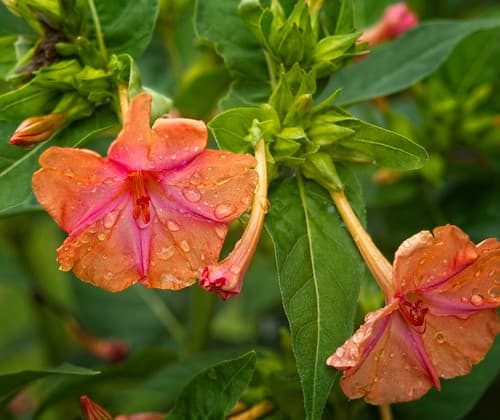
Mirabilis jalapa 'Salmon Sunset' is a large-mounding four o'clock with salmon-orange trumpet flowers that open in late afternoon and stay open through the night. In USDA zones 9–11 it grows as a perennial from thick tuberous roots; outside that range it performs as an annual or the tubers can be lifted and stored. Plants are dense and self-supporting, forming broad clumps with minimal intervention.
Full sun and good drainage are the primary requirements. Once established, the tuberous roots sustain the plant through periods of low rainfall. The evening flowers carry a light fragrance and draw hawkmoths and hummingbirds at dusk. The plant self-seeds freely in warm climates; seedlings are easy to remove while young but do not reliably come true to the cultivar's salmon coloring. Mulching over the root zone helps tubers persist through zone 9 winters.
Mirabilis jalapa roots have documented traditional use across South America and tropical Asia as a diuretic and purgative. Young leaves are cooked and eaten in parts of tropical Asia. Seeds have been ground as a pepper substitute in some cultures.
Root rot
Plants wilt, yellow, and stunt even in moist soil; lower stems and roots turn brown, soft, and mushy and the plant may collapse. Most common in heavy, wet, or poorly drained ground.
Improve drainage and stop overwatering, and never plant too deep. Lift and destroy badly affected plants along with the soil around the roots. Grow in raised or free-draining beds to prevent it returning.
Powdery mildew
White or grey powdery coating on leaves - usually starting on older growth in humid conditions or when nights cool.
Improve air circulation by thinning plants. Apply neem oil or potassium bicarbonate spray at first sign. Avoid overhead watering.
Mosaic virus
Yellowing, mottled, or distorted leaves. No cure - spread by aphids.
Remove and destroy infected plants. Control aphid populations to prevent spread. Do not propagate from infected tubers.
Root-Knot Nematode
Swollen galls on roots, poor vigor, wilting in heat, and reduced fruiting. Containers and sandy soils are more prone.
Use clean potting mix in containers. Avoid replanting in infested soil. Maintain plant vigor with mulch and steady watering. Solarize affected garden soil.
Fungal leaf spot
Brown or purplish spots on the leaves, often ringed with a yellow halo, that spread and merge in warm, humid, or wet weather; heavily spotted leaves yellow and drop early.
Pick off spotted leaves and clear fallen debris to remove overwintering spores. Improve air circulation by thinning, and water at the base so foliage dries quickly. If it persists, apply a copper- or sulfur-based fungicide at the first sign.