
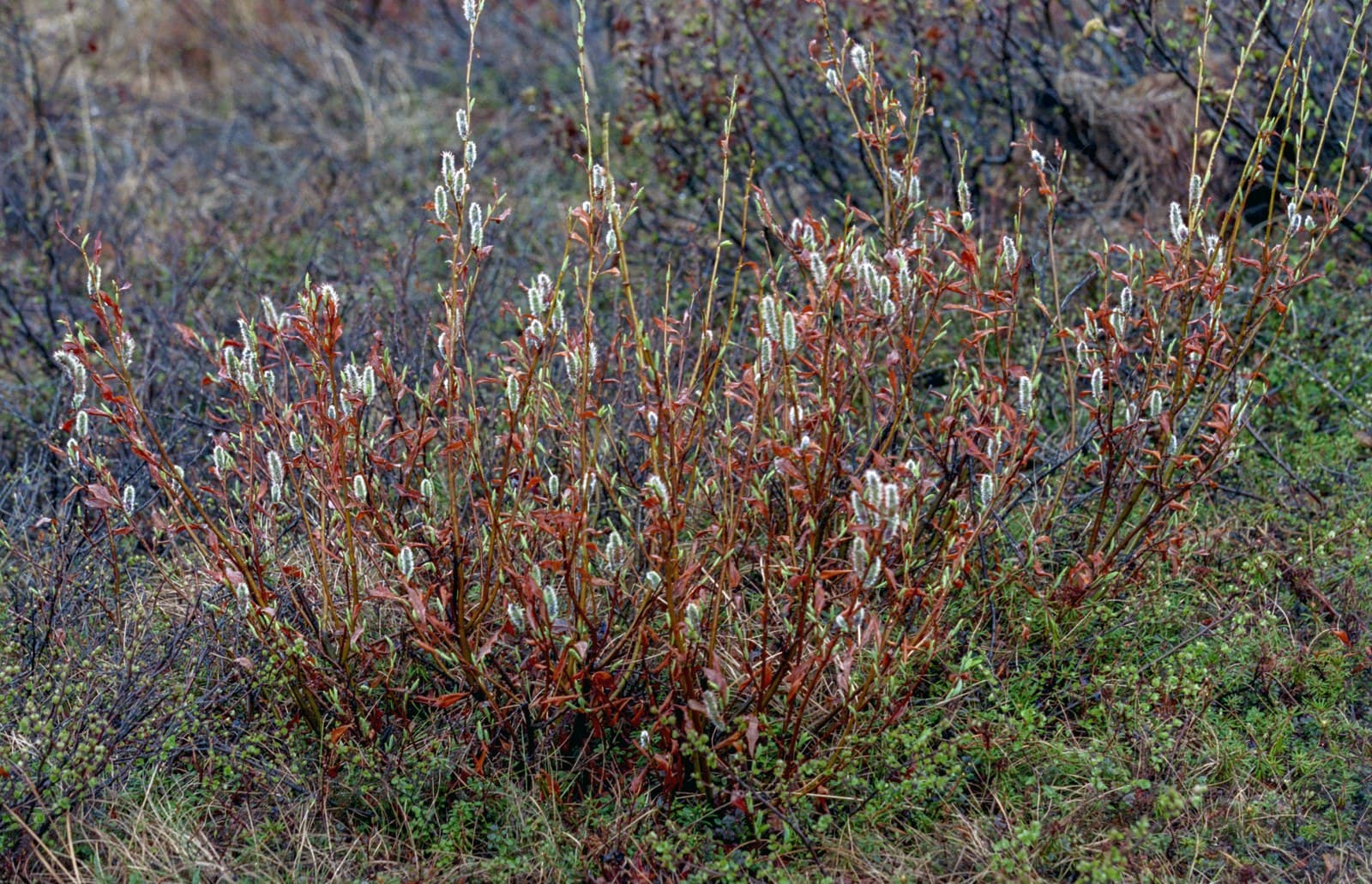
Feltleaf willow (Salix alaxensis) is a large native shrub or small tree reaching 15–25 ft, distributed across Alaska and northwestern Canada. Its defining characteristic is the dense white woolly felt covering leaf undersides, making it immediately identifiable among willows. It is one of the hardiest large woody plants available for extreme northern gardens, providing canopy and structure where most shrubs of comparable size cannot survive.
This species colonizes riverbanks, stream margins, and disturbed ground in subarctic and boreal regions. It grows quickly and spreads by root suckers, forming multi-stemmed thickets if unmanaged. Catkins emerge on bare stems in early spring before leaf-out, supplying a critical early-season pollen source for bees in cold climates. Moose, caribou, and ptarmigan rely on it for browse and cover year-round. It excels as a riparian stabilizer and windbreak on wet, cold sites where ornamental shrubs typically fail. Prefers slightly acidic to neutral soil and tolerates periodic flooding and poor drainage.
Alaska Native peoples used the inner bark of this and related willows to relieve pain and reduce fever. This practice is rooted in the presence of salicin, a glucoside related to salicylic acid.
Ecoregions:TundraTaigaHudson PlainNorthwestern Forested MountainsMarine West Coast Forest
Willow Scab
Olive-brown to black lesions appear on young leaves within days of bud break, causing rapid curling and leaf drop. Shoot tips blacken and die back. Dark, sunken lesions develop on current-season stems, and salmon-colored spore masses may be visible on infected tissue during humid weather.
Rake and destroy all fallen leaves and infected shoot tips each autumn. Apply a copper-based fungicide or myclobutanil at bud swell, then again at bud break. In persistently wet springs, repeat every 10–14 days until new shoot growth hardens off. Improve canopy airflow through selective pruning and avoid overhead irrigation.
Rust
Orange to brown raised pustules on the undersides of leaves, with yellow spotting on the upper surface. Heavy infections cause leaves to yellow and drop.
Remove and destroy infected leaves. Avoid overhead watering and improve air circulation. Apply a sulfur or copper-based fungicide if it spreads. Clear plant debris in fall.
Cytospora Canker
White or blue-white pitch masses ooze from bark on lower branches and the trunk. Affected branches die back progressively from the tip inward; bark beneath the resin is discolored brown and may have a resinous, sunken appearance.
Prune infected branches well below the canker margin into healthy wood and destroy all cuttings. Sterilize pruning tools with 70% isopropyl alcohol between each cut. No effective fungicide is available; prevent recurrence by avoiding drought stress, soil compaction, and mechanical bark injury.
Armillaria Root Rot
Thinning, yellowing canopy with progressive dieback; white, fan-shaped mycelial mats visible beneath bark at or just below the soil line; honey-colored mushroom clusters appearing at the trunk base or on surface roots in autumn.
No chemical cure exists. Improve drainage and avoid any injury to roots or trunk. Remove severely infected trees along with as much root material as possible. Do not replant susceptible species in the same spot.
Powdery mildew
White or grey powdery coating on leaves - usually starting on older growth in humid conditions or when nights cool.
Improve air circulation by thinning plants. Apply neem oil or potassium bicarbonate spray at first sign. Avoid overhead watering.