
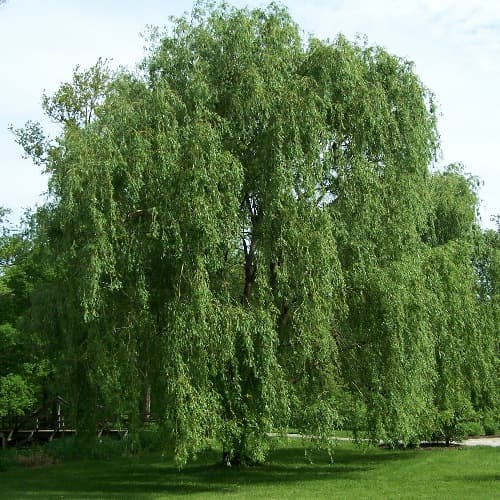
Salix babylonica 'Crispa' is a cultivar of the Weeping Willow distinguished by contorted, corkscrew-like branches and curled, twisted leaves. It combines the familiar weeping silhouette with year-round structural interest - the spiraling branch framework is especially striking in winter against open sky or reflective water. It grows quickly, often gaining 6–8 feet per year when young, and functions as a strong focal point near ponds, streams, or low-lying ground where most large trees perform poorly.
Like all Salix babylonica selections, it demands reliably moist to wet soil and tolerates periodic flooding. The root system is aggressive and wide-ranging; plant at least 50 feet from foundations, buried water and sewer lines, and septic systems. Trees typically live 30–40 years - short for a large deciduous tree - so structural pruning from an early age reduces the risk of large-limb failure later. In zone 6, a sheltered site near a body of water moderates winter temperature extremes and improves cold survival.
Willow bark from Salix species has a long history of use for pain and fever. The active compound salicin is metabolized to salicylic acid in the body and formed the chemical basis for the development of aspirin. Clinical research supports standardized willow bark extract for low back pain and osteoarthritis, and it appears in several national pharmacopoeias.
Willow Scab
Olive-brown to black lesions appear on young leaves within days of bud break, causing rapid curling and leaf drop. Shoot tips blacken and die back. Dark, sunken lesions develop on current-season stems, and salmon-colored spore masses may be visible on infected tissue during humid weather.
Rake and destroy all fallen leaves and infected shoot tips each autumn. Apply a copper-based fungicide or myclobutanil at bud swell, then again at bud break. In persistently wet springs, repeat every 10–14 days until new shoot growth hardens off. Improve canopy airflow through selective pruning and avoid overhead irrigation.
Rust
Orange to brown raised pustules on the undersides of leaves, with yellow spotting on the upper surface. Heavy infections cause leaves to yellow and drop.
Remove and destroy infected leaves. Avoid overhead watering and improve air circulation. Apply a sulfur or copper-based fungicide if it spreads. Clear plant debris in fall.
Cytospora Canker
White or blue-white pitch masses ooze from bark on lower branches and the trunk. Affected branches die back progressively from the tip inward; bark beneath the resin is discolored brown and may have a resinous, sunken appearance.
Prune infected branches well below the canker margin into healthy wood and destroy all cuttings. Sterilize pruning tools with 70% isopropyl alcohol between each cut. No effective fungicide is available; prevent recurrence by avoiding drought stress, soil compaction, and mechanical bark injury.
Fungal leaf spot
Brown or purplish spots on the leaves, often ringed with a yellow halo, that spread and merge in warm, humid, or wet weather; heavily spotted leaves yellow and drop early.
Pick off spotted leaves and clear fallen debris to remove overwintering spores. Improve air circulation by thinning, and water at the base so foliage dries quickly. If it persists, apply a copper- or sulfur-based fungicide at the first sign.
Armillaria Root Rot
Thinning, yellowing canopy with progressive dieback; white, fan-shaped mycelial mats visible beneath bark at or just below the soil line; honey-colored mushroom clusters appearing at the trunk base or on surface roots in autumn.
No chemical cure exists. Improve drainage and avoid any injury to roots or trunk. Remove severely infected trees along with as much root material as possible. Do not replant susceptible species in the same spot.