
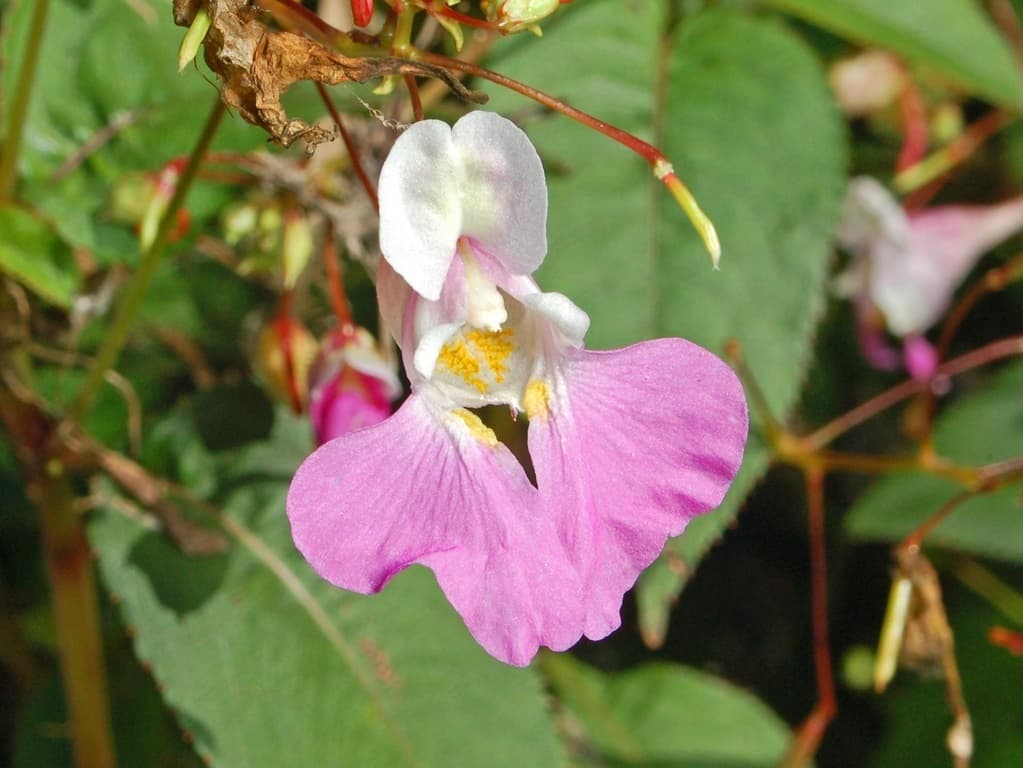
Impatiens balfourii is a frost-tender annual native to the Kashmir region of the western Himalayas. Its two-toned pink-and-white flowers closely resemble orchid blooms, earning it the nickname 'poor man's orchid.' Grown as a shade annual in temperate gardens, it fills gaps under trees and in north-facing beds from late spring through frost. Once established in a garden, it requires little intervention because it self-seeds reliably year to year.
The 'touch-me-not' name refers to explosive dehiscence: ripe seed pods burst at the slightest contact and scatter seeds a short distance. This mechanism allows the plant to spread and colonize moist shaded ground quickly. In parts of central and southern Europe it has naturalized along stream banks and woodland margins, and it can become weedy in ideal conditions. It performs best in consistently moist, humus-rich soil in partial to full shade. Plants wilt rapidly in heat or drought, so supplemental watering during dry periods is important, particularly in warmer climates.
Impatiens Downy Mildew
Leaves yellow, curl downward, and drop, leaving bare stems. A white, fuzzy coating forms on leaf undersides. Plants may collapse quickly in cool, wet conditions.
No effective home cure once infected. Remove and bag all infected plants, including roots; do not compost. Avoid overhead watering and crowding. Replant resistant impatiens varieties (such as Impatiens hawkeri) or other shade plants, and rotate away from the area, as spores persist in soil.
Botrytis (grey mould)
Grey fuzzy mould on petals and stems, worst in cool wet conditions.
Remove affected parts immediately. Improve air circulation. Avoid overhead watering. Apply copper fungicide if severe.
Damping Off
Seedlings collapse at the soil line with thin, water-soaked stems; seeds may fail to emerge or rot before sprouting.
Sow in well-draining mix, avoid overwatering, and ensure good airflow. Remove affected seedlings and let the surface dry between waterings.
Fungal leaf spot
Brown or purplish spots on the leaves, often ringed with a yellow halo, that spread and merge in warm, humid, or wet weather; heavily spotted leaves yellow and drop early.
Pick off spotted leaves and clear fallen debris to remove overwintering spores. Improve air circulation by thinning, and water at the base so foliage dries quickly. If it persists, apply a copper- or sulfur-based fungicide at the first sign.