
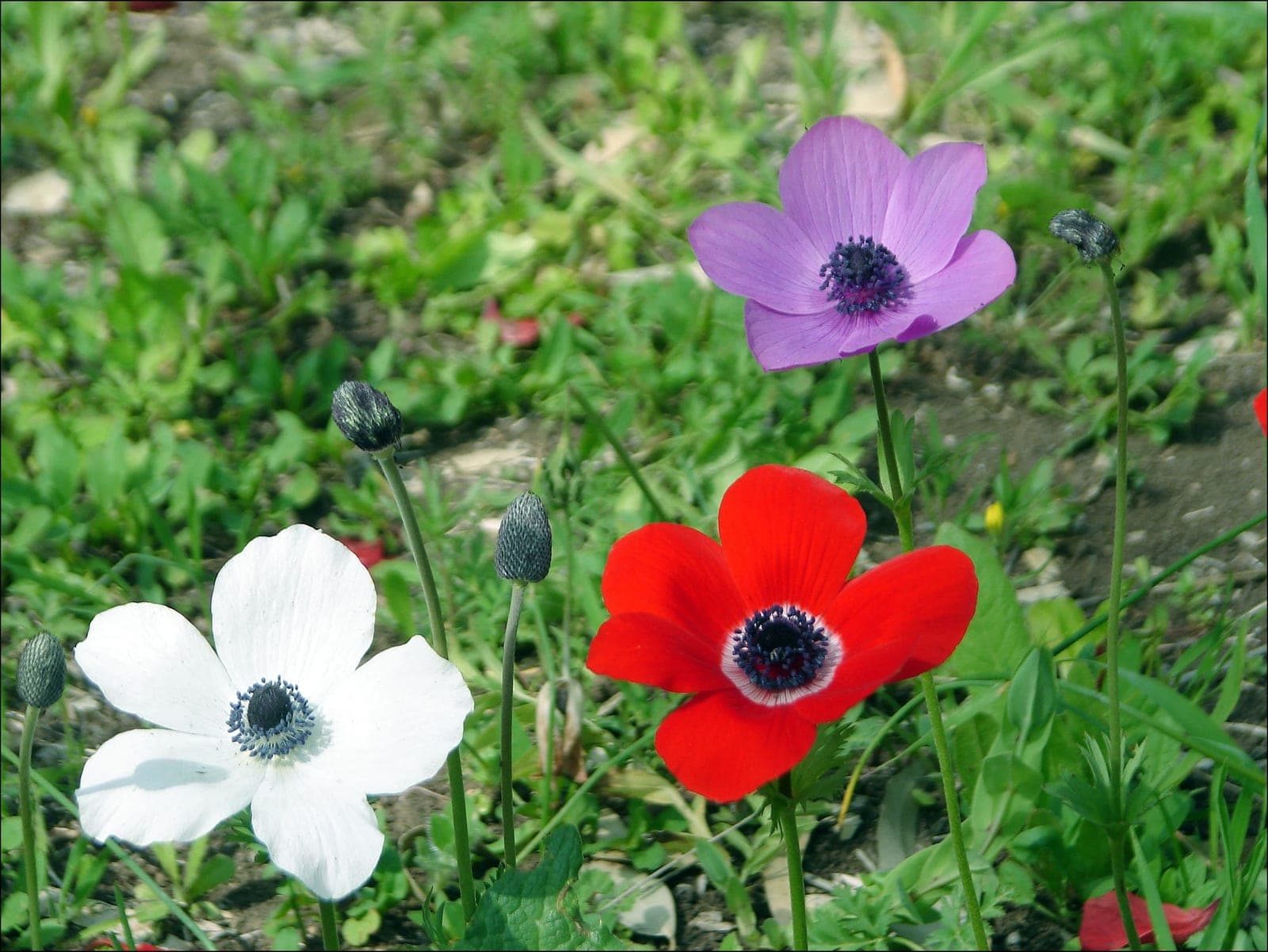
Anemone 'Peony Red & White' is a poppy-type anemone sold as dry corms, bred for fully double flowers that read as miniature peonies. The petals open white and blush toward deep rose at the edges, and every flower sits on a wiry stem above lacy, parsley-like foliage. The tag notes both deer resistance and cut-flower use, and it earns both: the stems hold well in a vase and the flowers are rarely browsed.
The corms are small, dry, and look like dead twigs, so they need a few hours of soaking in room-temperature water before planting; they swell noticeably, and soaked corms are far more reliable than dry ones. There is no clear top or bottom, so planting them on their sides is a safe default. In zone 8 and warmer they can be planted in fall for late-winter bloom, while colder gardens plant in late winter or early spring and treat them as tender or lift them after the foliage dies back. Foliage yellows and goes dormant by early summer; let it die back naturally to feed the corm.
Powdery mildew
White or grey powdery coating on leaves - usually starting on older growth in humid conditions or when nights cool.
Improve air circulation by thinning plants. Apply neem oil or potassium bicarbonate spray at first sign. Avoid overhead watering.
Botrytis (grey mould)
Grey fuzzy mould on petals and stems, worst in cool wet conditions.
Remove affected parts immediately. Improve air circulation. Avoid overhead watering. Apply copper fungicide if severe.
Anemone Leaf Smut
Raised dark streaks and blisters on leaves and stems that rupture to release black powdery spores; affected leaves distort and die back.
Remove and destroy infected foliage as it appears. Avoid overhead watering and crowding. Dispose of all debris in fall rather than composting it, and divide congested clumps to improve air circulation.
Foliar Nematode
Angular brown or black patches on leaves, bounded by leaf veins, starting on lower foliage and moving upward. Affected leaves wither but stay attached.
Remove and destroy infected leaves and surrounding debris. Avoid overhead watering and wetting foliage. Space plants for airflow and do not compost affected material. Severely infested plants should be dug out and discarded.