
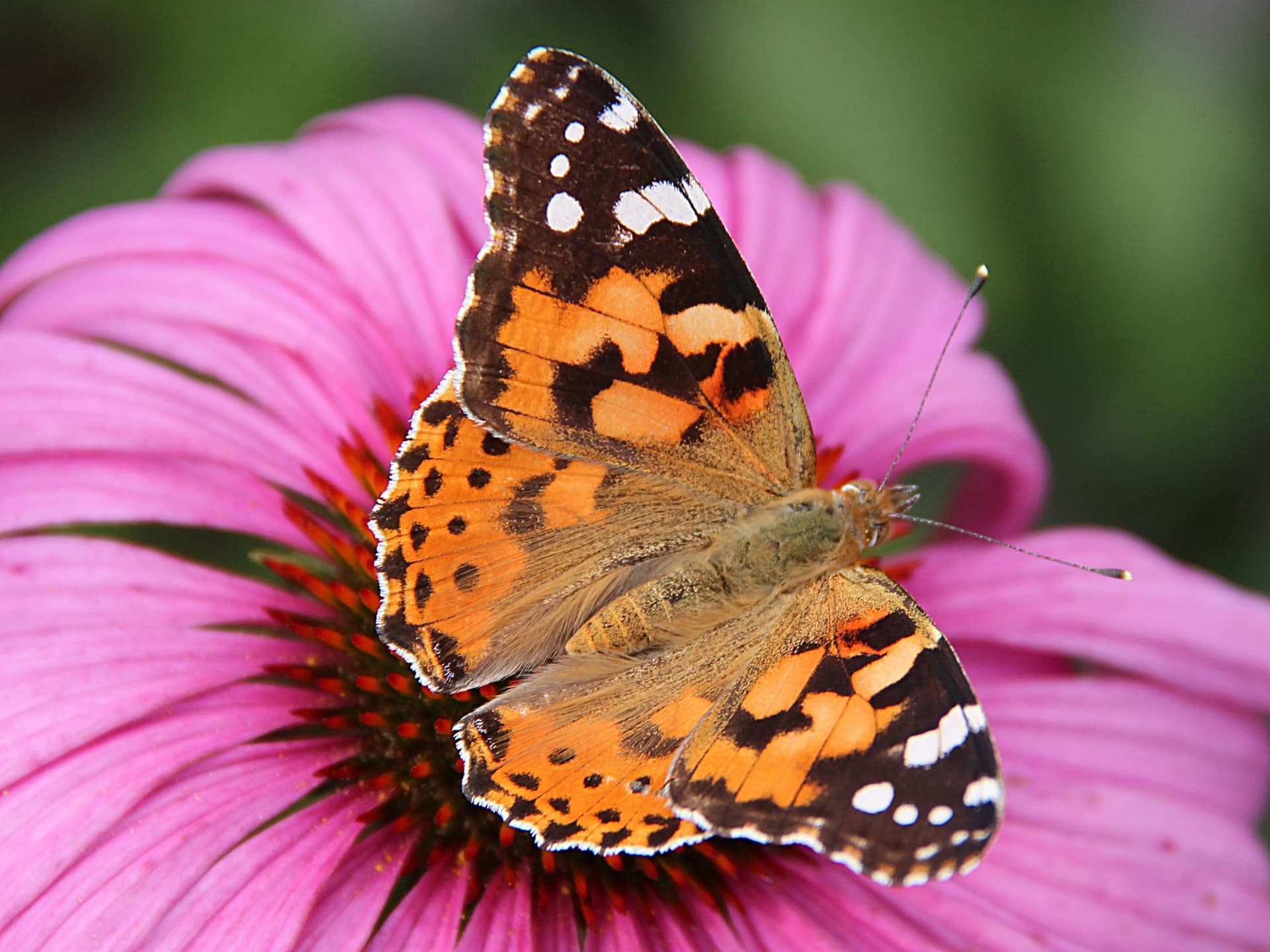
Painted Lady
The painted lady (Vanessa cardui) is the most widespread butterfly in the world, present on every continent except Antarctica. In Zone 6b gardens, it appears as a seasonal visitor from late spring through early fall, arriving each year from southern overwintering grounds rather than surviving local winters. It pollinates a broad range of ornamental and edible plants and tends to show up wherever flowering plants are abundant.
Painted ladies are multigenerational migrants. Each spring, successive generations move northward out of Mexico and the southern United States, with local population sizes shifting considerably from year to year. Adults are generalist foragers and visit dozens of flower species. Larvae feed on plants in the thistle, mallow, and borage families, including common garden hollyhocks, but feeding damage is usually light.
Population booms, sometimes involving millions of individuals moving through a region, are linked to wet winters on the Mexican plateau, where high rainfall drives plant growth and allows unusually large populations to build before the northward migration. Researchers have used Vanessa cardui as a model organism for studying long-distance insect navigation, and the species is now understood to complete multi-generational round trips spanning thousands of miles.
Generalist pollinator that visits a wide variety of garden flowers across the entire growing season.
Plant zinnias, coneflowers, milkweed, asters, and cosmos to attract nectar-seeking adults. Include larval host plants such as hollyhock, common mallow, or borage to encourage egg-laying and support caterpillar development through to pupation.
Open, sunny gardens with a mix of flowering plants that carry blooms from late spring through fall. Avoid broad-spectrum insecticide applications during peak flight periods in summer. Leaving some areas of low vegetation or bare ground supports resting and egg-laying behavior.