
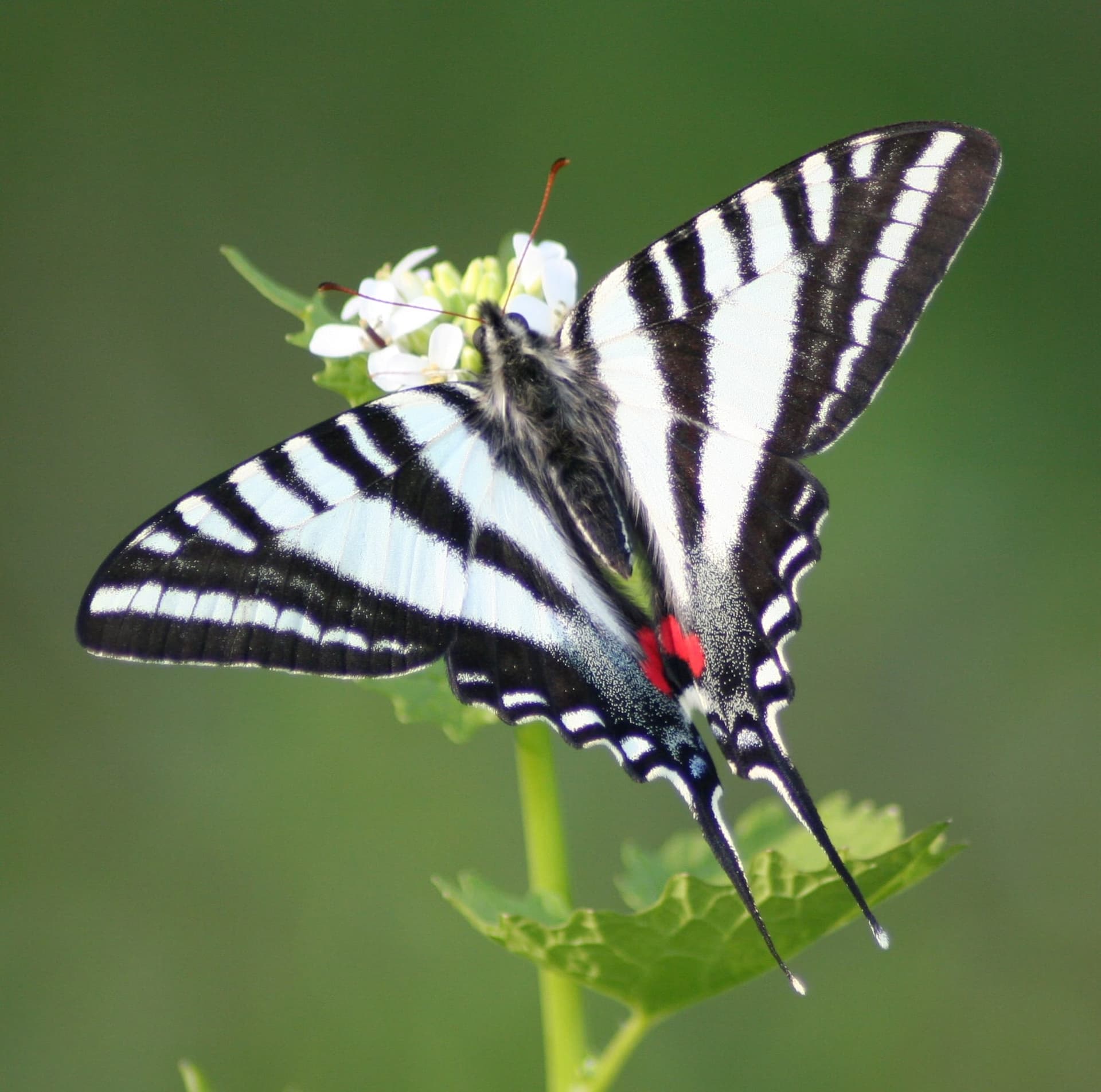
Zebra Swallowtail
The Zebra Swallowtail is a large butterfly native to the eastern United States and southeastern Canada. Its black-and-white striped wings and unusually long, slender tails make it one of the easier swallowtails to identify in the field. For gardeners in upstate New York, it sits at the northern edge of its range and is most reliably seen near stands of native pawpaw.
This species produces two broods per season across most of its range. The spring brood is slightly smaller, with shorter tails and more white coloring; the summer brood is larger, with longer tails and more prominent red banding. Adults nectar on a variety of flowering plants and also puddle — congregating on wet soil or damp sand to take up minerals. Caterpillars are green or black and feed almost exclusively on pawpaw foliage, which means the local population of this butterfly tracks the availability of that one host plant closely.
The Zebra Swallowtail's near-complete dependence on pawpaw (Asimina triloba and related species) links it directly to one of the few large native fruit trees suited to Zone 6b gardens. Planting pawpaw supports both the butterfly's breeding cycle and a productive edible landscape, making it one of the more ecologically efficient choices a gardener can make.
Adult Zebra Swallowtails are pollinators, visiting a range of flowers for nectar and transferring pollen in the process.
Plant at least one native pawpaw tree (Asimina triloba) — this is the single most effective step for attracting Zebra Swallowtails to a garden. Add native nectar sources such as milkweed, Joe-Pye weed, wild bergamot, and garden phlox to bring adults in to feed. A shallow dish of wet sand or a consistently damp bare patch of soil near the garden will support puddling behavior.
Gardens that include pawpaw trees, ideally with partial shade and moist soil nearby. Open sunny areas with native flowering plants give adults a reason to stay and nectar. Avoid broad-spectrum insecticides, including those applied to neighboring plants, as the caterpillars and adults are both vulnerable.