
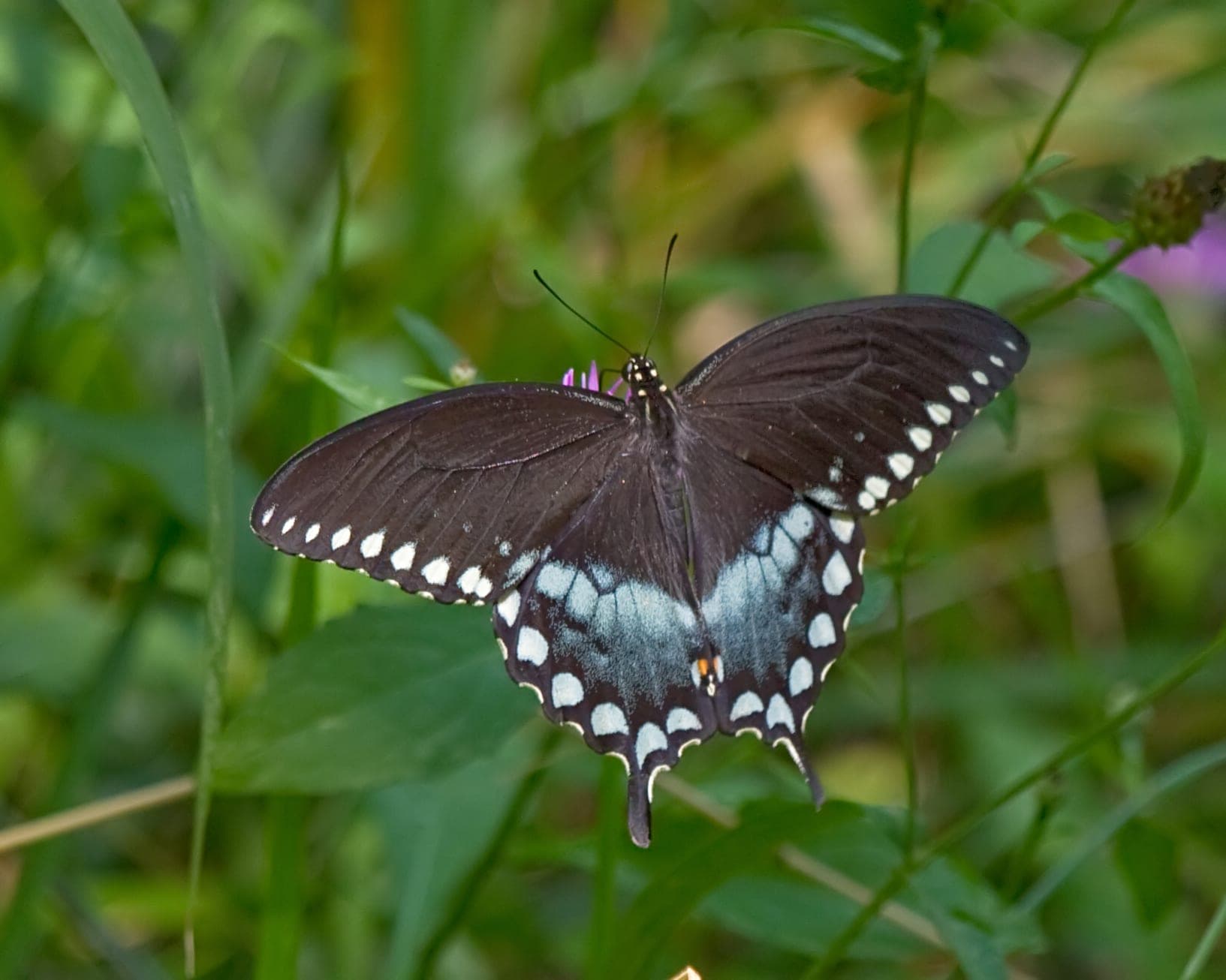
Spicebush Swallowtail
The spicebush swallowtail is a large native black butterfly found throughout eastern North America, including upstate New York, where it is one of the more reliably seen swallowtail species. Gardeners who grow native host plants can support breeding populations rather than simply attracting the occasional visiting adult.
Females lay eggs singly on the leaves of spicebush, sassafras, tulip poplar, and a handful of related native species. Early-instar caterpillars resemble bird droppings. Later instars develop prominent false eyespots that convincingly mimic the head of a small snake, a well-documented antipredator strategy. Caterpillars also fold leaf edges with silk to form daytime shelters. Adults nectar on milkweed, Joe Pye weed, jewelweed, and ironweed, among others. In Zone 6b the species produces two broods per season and overwinters as a chrysalis.
The spicebush swallowtail's dependence on native understory shrubs makes it a useful indicator of local native plant health. Its presence in a garden is closely tied to whether spicebush or sassafras are growing nearby, which means planting those shrubs is one of the more direct ways a gardener can support a breeding population rather than a transient one.
The spicebush swallowtail is a native pollinator whose adults transfer pollen across a wide range of flowering garden plants while feeding on nectar.
Plant spicebush (Lindera benzoin) or sassafras (Sassafras albidum) as host plants to attract breeding females. Supplement with nectar sources such as common milkweed (Asclepias syriaca), Joe Pye weed (Eutrochium purpureum), and ironweed (Vernonia noveboracensis) to retain adults through the season.
Gardens with native understory shrubs adjacent to or within woodland edges provide the strongest conditions for breeding and sustained presence. A mix of partial shade and open sun within the same garden supports both egg-laying and adult nectaring. Avoid broad-spectrum insecticide applications, particularly on or near host plants.