
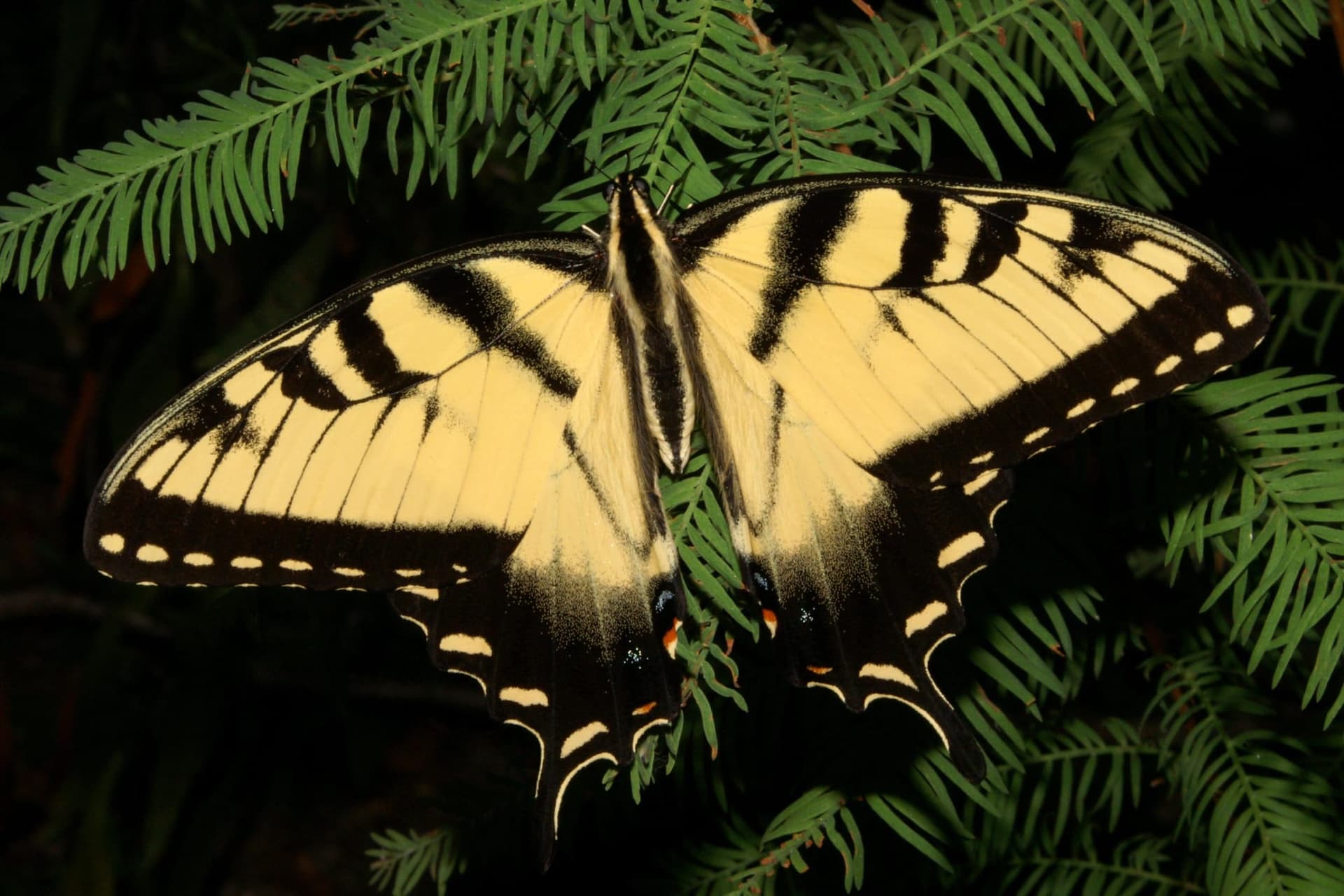
Eastern Tiger Swallowtail
The Eastern Tiger Swallowtail is one of the most recognizable butterflies in eastern North America, with a wingspan reaching up to 5.5 inches. Males are yellow with four black tiger stripes on each forewing. Females are dimorphic: the yellow form resembles the male but carries a band of blue spots along the hindwing, while the dark form is nearly all black, a pattern thought to mimic the toxic Pipevine Swallowtail and deter predators. For gardeners in upstate New York, it is a reliable presence from late spring through fall and a capable pollinator of many common garden plants.
Adults produce two to three broods per season in Zone 6b and nectar on a wide range of flowering plants, with a preference for species in the daisy, milkweed, and legume families. Garden staples like Joe-pye weed, wild bergamot, garden phlox, and milkweed are all effective attractants. Larvae feed on the foliage of native deciduous trees — primarily wild cherry, tulip poplar, birch, ash, and cottonwood — so the caterpillars are rarely seen in the flower garden itself.
As one of the largest butterflies in the region, the Eastern Tiger Swallowtail can access deep or tubular flowers that smaller pollinators visit less efficiently. It is also a meaningful link in the local food web, serving as prey for birds and as a host for parasitic wasps and flies, which helps regulate its own population over time.
A native pollinator that visits a broad range of flowering plants and transfers pollen across the garden from late spring through fall.
Plant nectar sources such as Joe-pye weed, wild bergamot, garden phlox, milkweed, and purple coneflower in sunny spots to attract adults. Including one or more host trees — wild cherry, paper birch, or tulip poplar — in or adjacent to the yard gives breeding females a reason to stay and increases the chance of resident populations.
Open, sunny gardens with a diversity of flowering plants blooming across the season, combined with nearby deciduous trees for larval development. Avoid broad-spectrum insecticide applications, which kill caterpillars on host trees and reduce adult populations throughout the yard.