
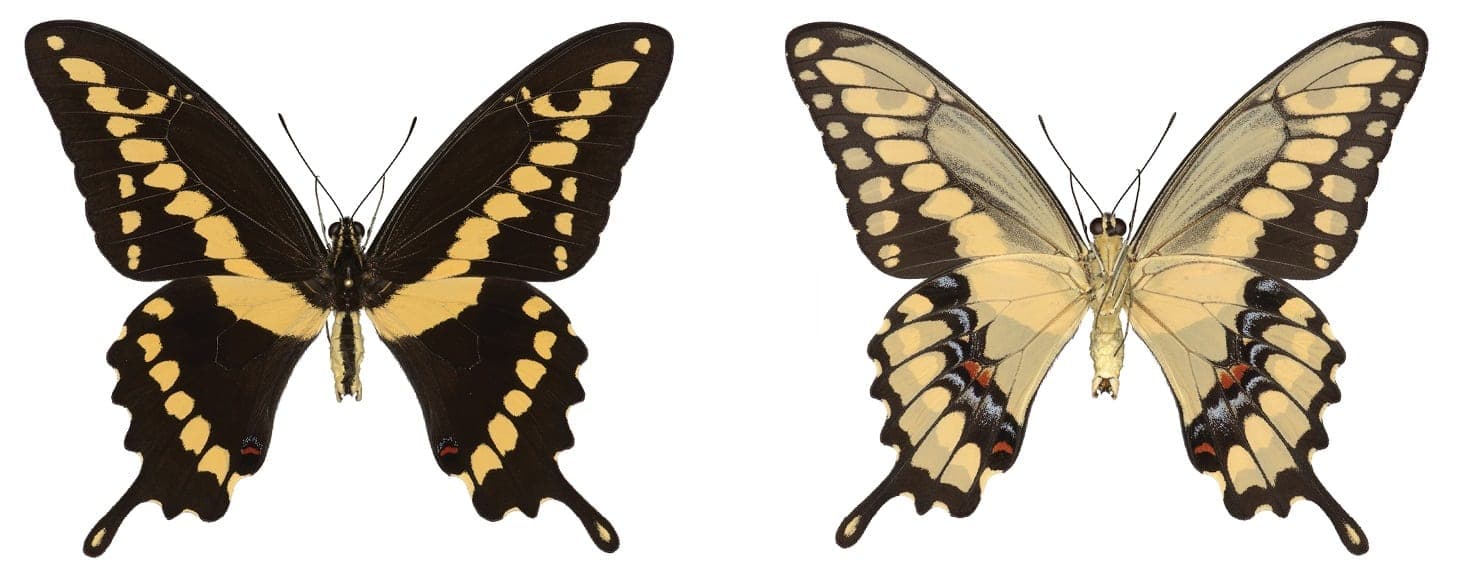
Western Giant Swallowtail
Papilio rumiko, the western giant swallowtail, is one of the largest butterflies in North America. It was formally separated from the closely related eastern giant swallowtail, Papilio cresphontes, through genetic and morphological work, and ranges from the southwestern United States — parts of Texas, New Mexico, Arizona, and as far north as northeastern Colorado — south through Mexico and Central America to Panama. Gardeners in Zone 6b upstate New York will not encounter this species in the field; the eastern giant swallowtail, P. cresphontes, is the species that appears in the eastern half of the continent.
Adults are strong, wide-ranging fliers that visit many flowering plants for nectar. Larvae feed exclusively on plants in the citrus family, Rutaceae, including prickly ash (Zanthoxylum spp.), hop tree (Ptelea trifoliata), common rue (Ruta graveolens), and cultivated citrus. In citrus-growing regions the caterpillars are called orange dogs and can cause meaningful defoliation on young trees. Early-instar larvae avoid predation by closely resembling bird droppings, a strategy common to giant swallowtails across the genus.
Adult western giant swallowtails are large-bodied pollinators that visit a broad range of flowering plants throughout their southwestern range.
This is a western species, so it is not a Hudson Valley visitor. Where it occurs, plant California hoptree as the larval host, along with other rue-family plants such as common rue or prickly ash. Nectar-rich plants like lantana, pentas, and native milkweeds attract adults and encourage them to stay. California hoptree is the host.
Open gardens with a mix of Rutaceae larval host plants and abundant nectar sources in full sun. Avoid broad-spectrum insecticide use, which kills larvae and discourages adults from returning. Plant hosts and nectar perennials in clumps of several rather than singly, so the butterflies can find them. A few flat stones in full sun give them a place to warm up, and a shallow dish of damp sand or mud gives them water and minerals. Avoid insecticides, organic ones included, because they kill caterpillars along with the pests. Buy by botanical name so you get the native species and not a lookalike.