
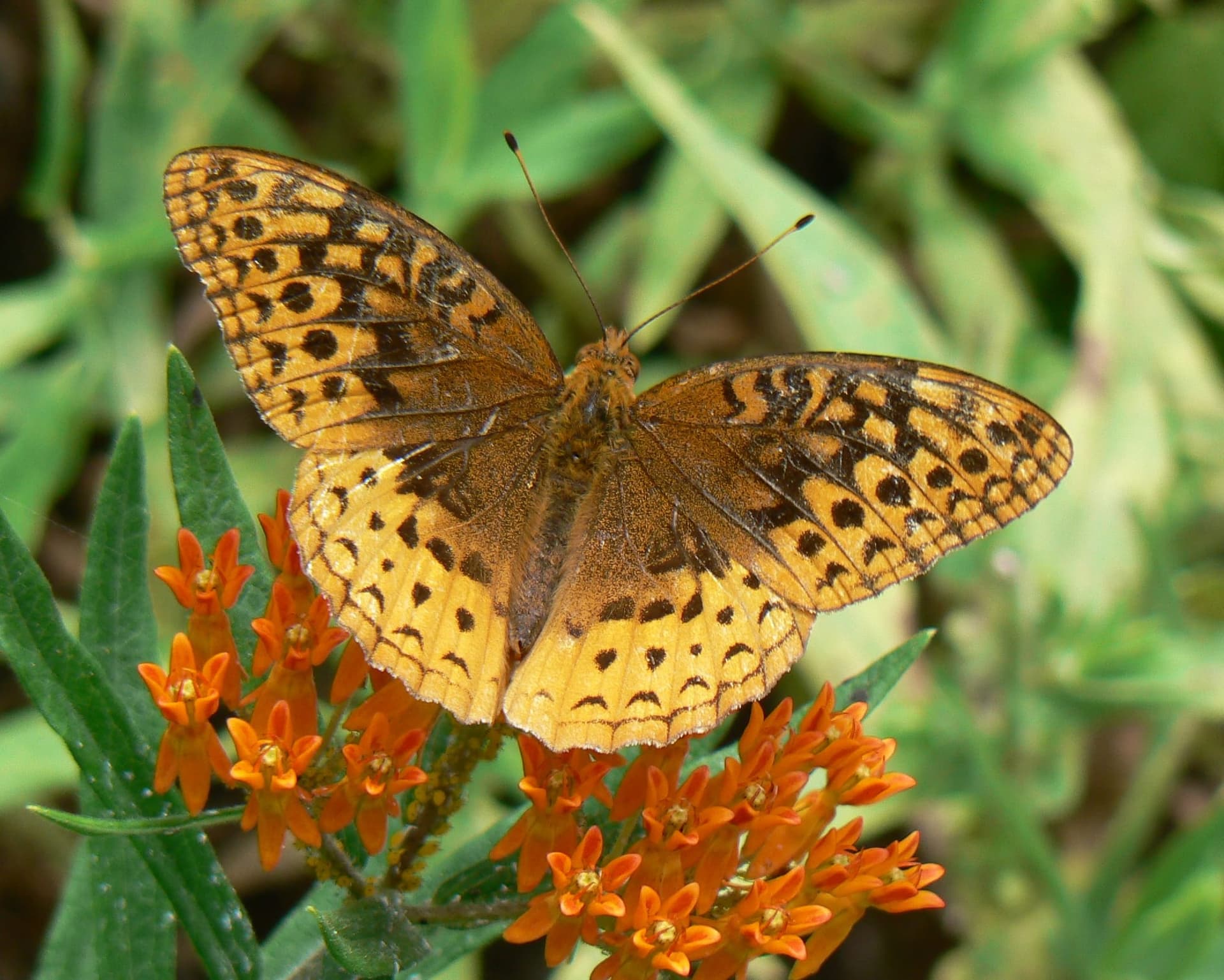
Great Spangled Fritillary
The Great Spangled Fritillary is one of the largest fritillary butterflies in North America. Adults are bright orange with bold black markings and carry a distinctive row of silver spots on the underside of the hindwing — the feature behind the common name. In upstate New York, it is a reliable summer presence and a productive pollinator of many native wildflowers.
This species has an unusual life cycle tied entirely to native violets. Females lay eggs in late summer, often in leaf litter near violet plants rather than on the leaves themselves. Eggs hatch into first-instar caterpillars that do not feed — they enter dormancy immediately and overwinter in that stage. Come spring, the larvae wake and feed nocturnally on violet leaves until they pupate. Adults emerge in June and remain on the wing through September or into early October in zone 6b. They range widely in search of nectar, visiting milkweed, ironweed, wild bergamot, thistles, and other open-faced flowers.
Because larvae are obligate violet feeders, the species functions as a useful indicator of habitat quality. Gardens and edges that support native violet patches tend to attract breeding females, while sites without violets may receive adult visitors but will not sustain a local population. The species belongs to the genus Speyeria, which was reestablished as distinct from Argynnis in 2017 and groups the greater fritillaries of North America, Europe, and Asia.
Adult Great Spangled Fritillaries are active pollinators that visit a wide range of native flowering plants throughout summer and early fall.
Plant native violets — common blue violet (Viola sororia) is the most widely used larval host in the Northeast — as a ground cover in borders, lawn edges, or shaded areas. Add summer nectar sources such as native milkweed (Asclepias tuberosa or A. syriaca), ironweed (Vernonia noveboracensis), and wild bergamot (Monarda fistulosa) in a sunny location. Leave some leaf litter in place through winter to protect overwintering first-instar larvae. Common blue violet is the best host in the East and dog violet in the West. Common blue violet is the best host in the East and dog violet in the West.
Gardens with native violet patches, an adjacent meadow or woodland edge, and a sequence of blooming native wildflowers from June through September. Avoid frequent soil disturbance near violet patches and limit pesticide use across the site, as larvae are nocturnal and ground-level and are vulnerable to contact insecticides. Plant hosts and nectar perennials in clumps of several rather than singly, so the butterflies can find them. A few flat stones in full sun give them a place to warm up, and a shallow dish of damp sand or mud gives them water and minerals. Avoid insecticides, organic ones included, because they kill caterpillars along with the pests. Buy by botanical name so you get the native species and not a lookalike.