
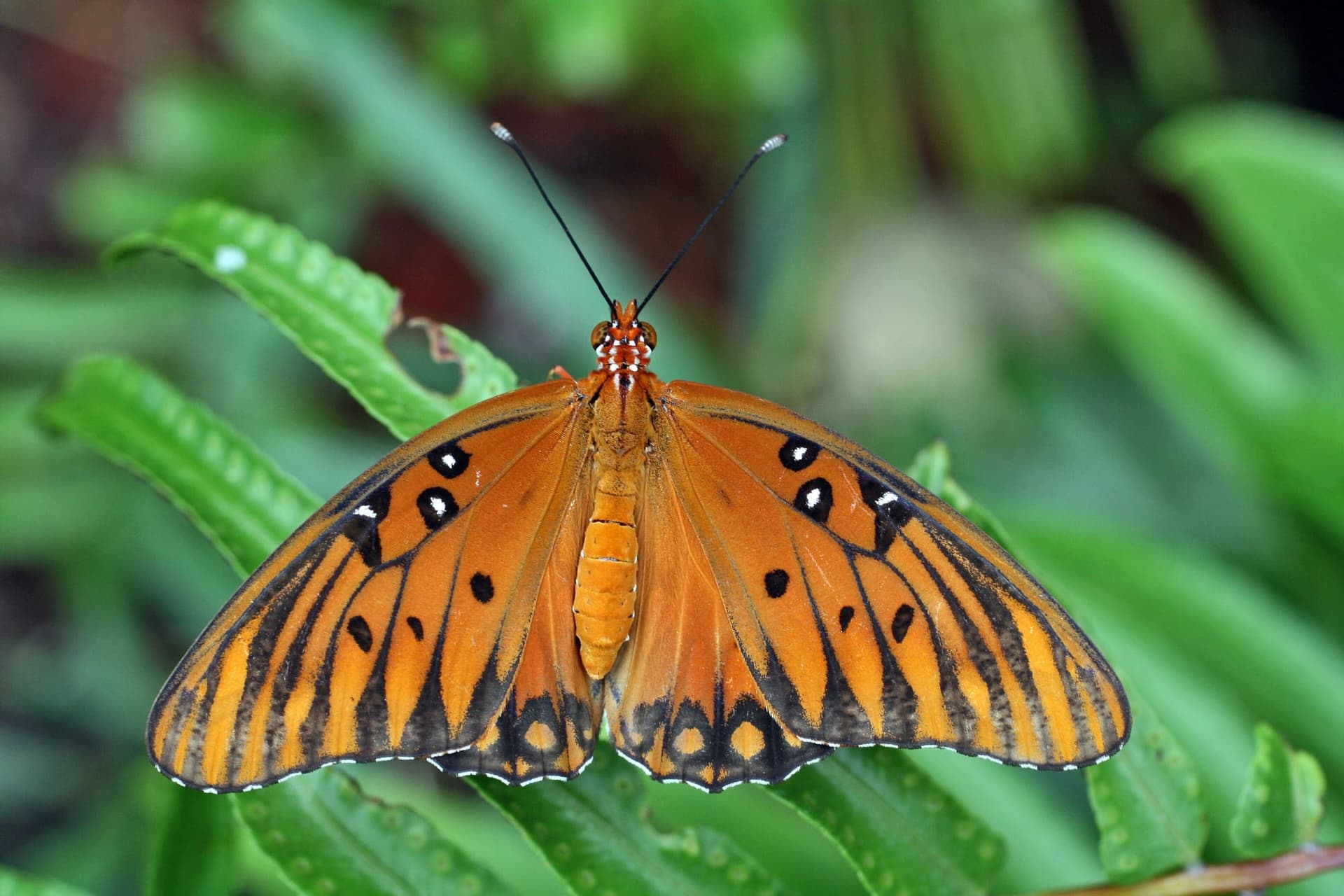
Gulf Fritillary
The Gulf Fritillary is a medium-to-large orange butterfly in the family Nymphalidae, subfamily Heliconiinae — a group sometimes called longwings for their characteristically narrow, elongated wings. Its core range runs from the Gulf Coast states through Florida and into Central and South America, but individual butterflies regularly disperse northward as strays. In Zone 6b, it is an occasional late-summer and early-fall visitor rather than a breeding resident, and gardeners who see one are likely watching a dispersing individual from a population further south.
Adults are generalist pollinators that work open, sunny sites and visit a wide range of nectar sources. The species has a strict relationship with passionflower vines (Passiflora spp.): females will only lay eggs on these plants, and caterpillars feed exclusively on the foliage. In the southern portions of its range, where Passiflora grows reliably outdoors year-round, the butterfly cycles through multiple broods per season. In upstate New York, Passiflora incarnata is cold-hardy enough to overwinter but the butterfly itself does not establish resident populations.
Gulf Fritillary caterpillars sequester chemical compounds from passionflower foliage that make both larvae and adults distasteful to many predators. This chemical defense, common across the Heliconiinae, is reflected in the butterfly's bold orange coloration, which functions as a warning signal.
The Gulf Fritillary is a pollinator that visits a broad range of garden flowers as an adult, contributing to cross-pollination across the bloom season.
Plant native passionflower (Passiflora incarnata) as a host plant and provide open nectar sources such as zinnias, lantana, and verbena. Passiflora incarnata is cold-hardy in Zone 6b and can be grown as a perennial vine. In this zone, these measures are more likely to support the occasional visitor than to establish a resident population. Purple passionflower and yellow passionflower are both good hosts.
Open, sunny gardens with a mix of nectar-producing flowers and passionflower vines. Avoid broad-spectrum insecticide applications, which kill adults directly and eliminate larvae on host plants. Reducing mowing and tillage near Passiflora plantings preserves any eggs or pupae present. Plant hosts and nectar perennials in clumps of several rather than singly, so the butterflies can find them. A few flat stones in full sun give them a place to warm up, and a shallow dish of damp sand or mud gives them water and minerals. Avoid insecticides, organic ones included, because they kill caterpillars along with the pests. Buy by botanical name so you get the native species and not a lookalike.