
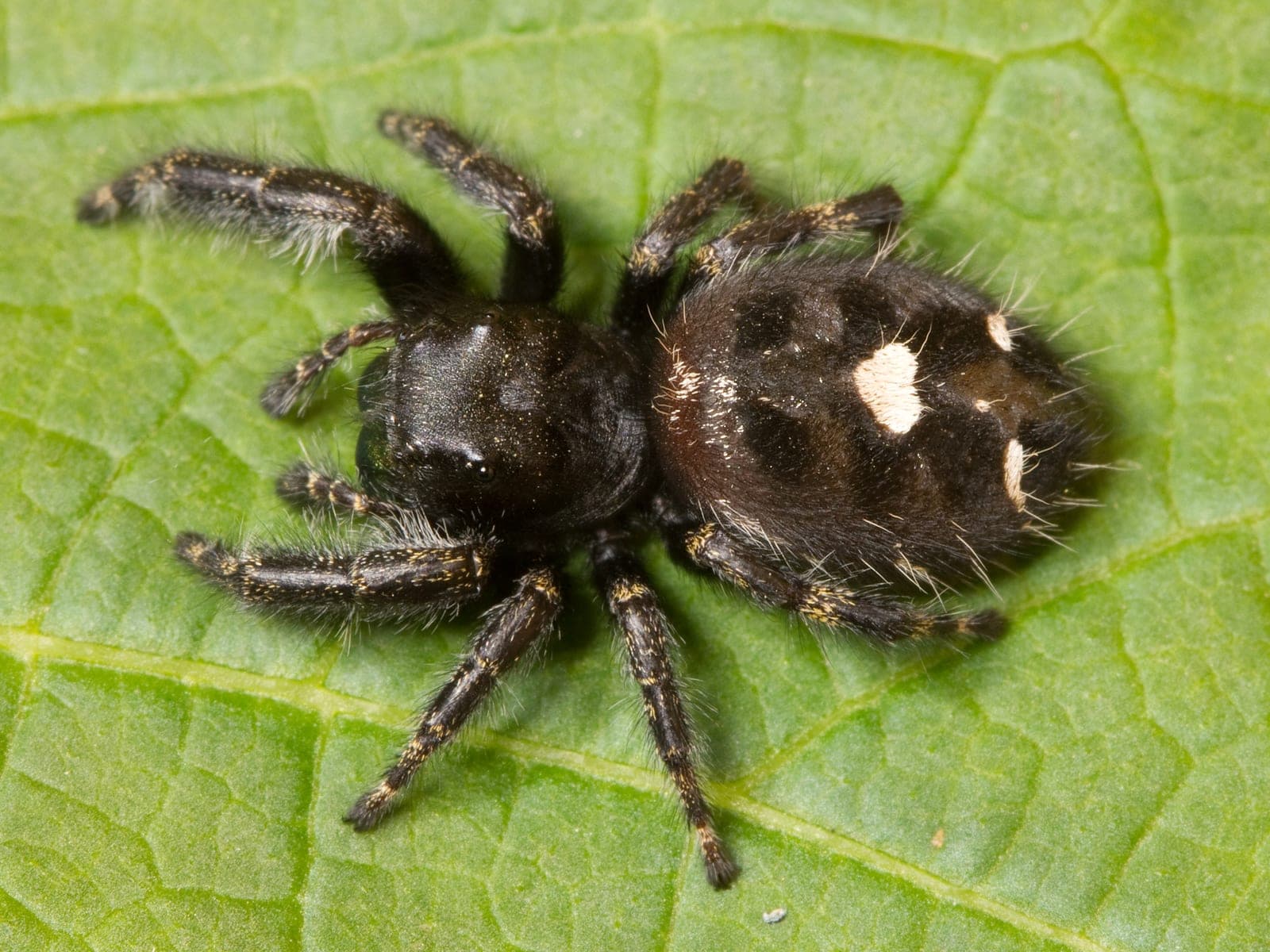
Bold Jumping Spider
The bold jumping spider is the small, fuzzy, black spider with a bright triangular patch on its abdomen (white, orange, or reddish) and, up close, a pair of iridescent green or blue jaws. It is one of the most endearing garden animals — it turns to look at you with its large forward-facing eyes, and its acute vision and curiosity make it seem far more aware than most invertebrates.
Unlike orb-weavers it spins no web to catch prey. It is an active daytime hunter that stalks across leaves and stems, fixes prey with its excellent eyesight, anchors a silk dragline, and pounces — often leaping many times its own body length. It takes flies, small caterpillars, leafhoppers, mosquitoes, and other spiders, hunting exactly on the foliage where many pests feed. It spins silk only for a retreat: a small tent under a leaf or bark where it rests at night, molts, and guards its eggs.
Females lay eggs in early summer inside a silk retreat and guard them until the spiderlings disperse. The spider is harmless to people — it is more likely to flee or watch you than to bite, and a bite (only if trapped against skin) is minor. Because it hunts on the plant surface rather than in a web, it is a valuable and mobile predator right where aphids, leafhoppers, and small caterpillars are doing their damage.
Beneficial daytime hunter that stalks and pounces on flies, caterpillars, leafhoppers, and other small pests directly on the foliage.
Colonizes naturally; cannot be purchased. It arrives wherever there are sunny surfaces and small prey.
Provide varied plant structure and sunny basking surfaces (stems, stakes, stone, bed edges) and avoid broad-spectrum sprays that wipe out its prey.