
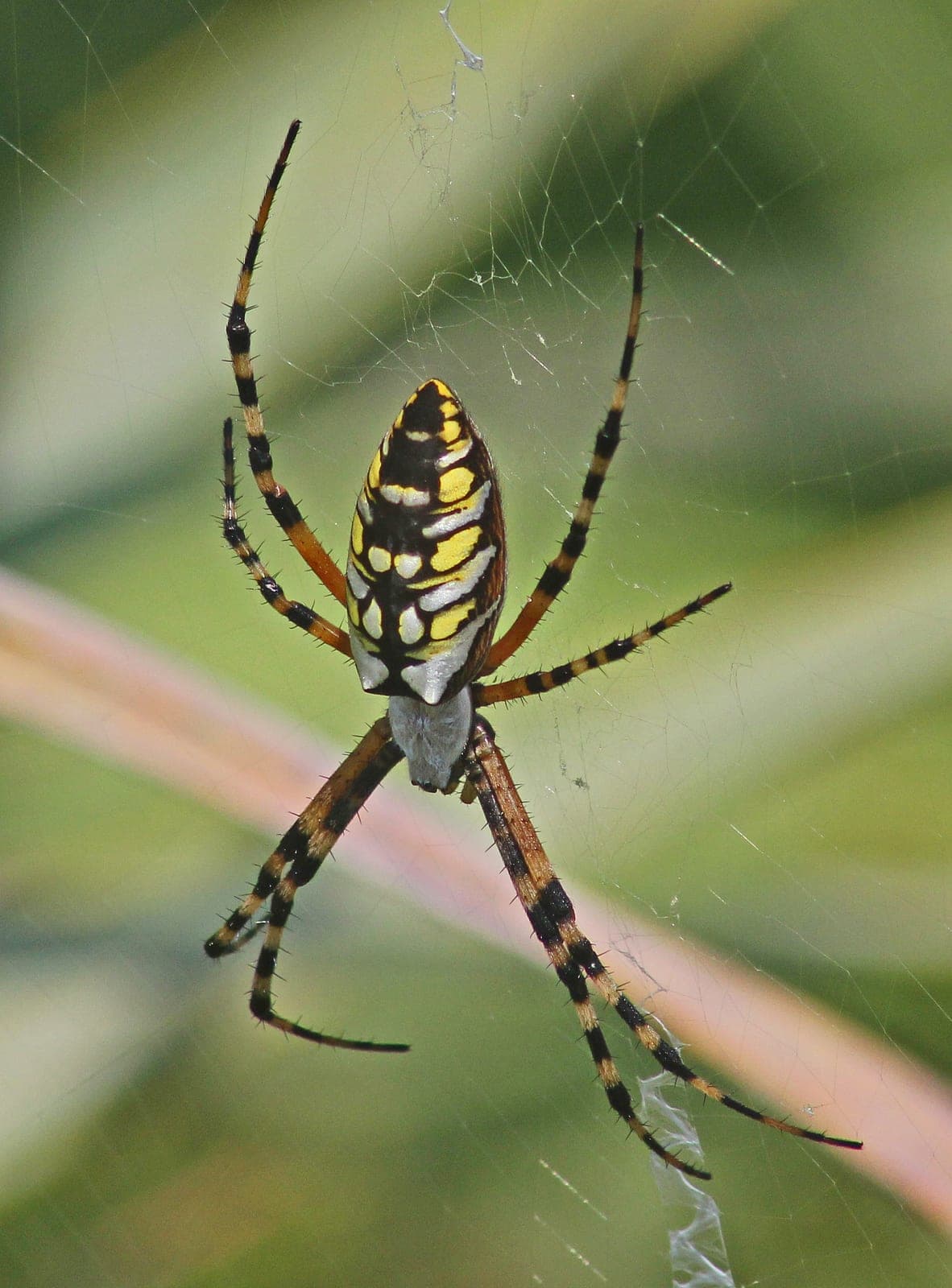
Yellow Garden Spider
The yellow garden spider is the big, unmistakable black-and-yellow orb-weaver that appears in gardens from midsummer through frost. The female's abdomen is boldly patterned in yellow and black; the male is small, drab, and easy to miss at the web's edge. It is one of the most conspicuous and welcome spiders a gardener will meet, and a single female can hold a spot in a sunny border for the whole of late summer.
The web is a large vertical orb with a distinctive zig-zag band of dense silk down the center, called a stabilimentum. Its exact function is debated — it may make the web visible to birds so they don't blunder through it, or help camouflage the spider — but it is a reliable field mark. The spider hangs head-down at the hub, often with its legs paired into an X, and waits for grasshoppers, flies, beetles, moths, and wasps to hit the web. Prey is bitten, wrapped, and stored; larger webs routinely catch insects bigger than the spider.
Females lay eggs in fall inside one or more papery brown egg sacs tucked into sheltered vegetation, then die at hard frost. Spiderlings hatch and overwinter inside the sac, emerging to disperse in spring. The spider is harmless to people — it is not aggressive and bites only if pinned, with an effect no worse than a bee sting. Left alone in a sunny bed, it is one of the most effective and self-installing pest controls in the garden.
Beneficial predator that intercepts grasshoppers, flies, beetles, moths, and wasps in a large orb web through late summer and fall.
Cannot be bought or moved; it colonizes on its own. Offer sunny, wind-sheltered plantings with sturdy stems to anchor a web and it will arrive.
Keep some tall, undisturbed vegetation in sunny borders and avoid broad-spectrum insecticides, which remove its prey and kill it directly.