
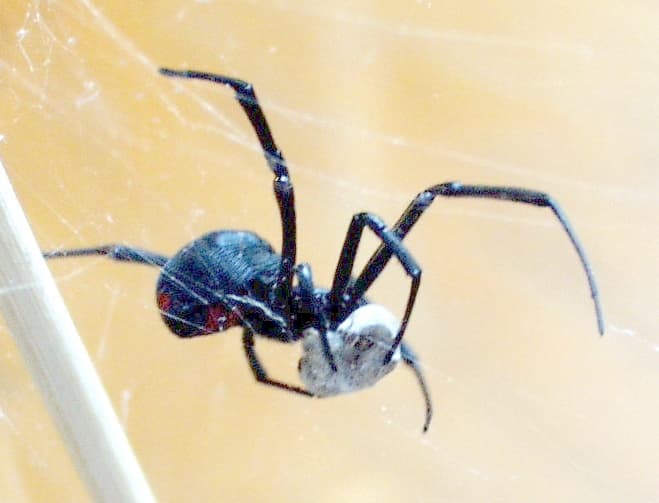
Black Widow
The black widow is the glossy jet-black spider whose female carries the famous red hourglass on the underside of her rounded abdomen. It is shy and reclusive, spending the day hidden in a dark retreat at the edge of a strong, messy, three-dimensional web built close to the ground in undisturbed places. It is not aggressive and does not seek people out; nearly all bites happen when a spider is unknowingly pressed against skin — reaching into a woodpile, a glove, or a dark corner of a shed.
Range matters. The southern black widow (Latrodectus mactans) is primarily a species of the southern and central United States; the widow actually resident in the Northeast is its close relative the northern black widow (Latrodectus variolus), which is uncommon and localized this far north. Both are the same idea to a gardener: a venomous but retiring spider found in exactly the sheltered, rarely-disturbed niches you should be cautious about anyway.
The venom is medically significant — a bite can cause intense pain, muscle cramping, sweating, and nausea (latrodectism), and while rarely life-threatening to a healthy adult, it warrants prompt medical attention, especially for children, older adults, or anyone with a severe reaction. Ecologically the spider is a predator of insects like any other, but it is listed here to be recognized and respected, not welcomed: wear gloves when moving wood, stone, or clutter in the places it favors, keep outbuildings tidy, and clear webs from spots where hands and children reach. Do not handle one.
A venomous, reclusive spider of dark, undisturbed corners — a predator of insects, but one to recognize and avoid rather than encourage. Wear gloves around woodpiles, stone, and sheds.