
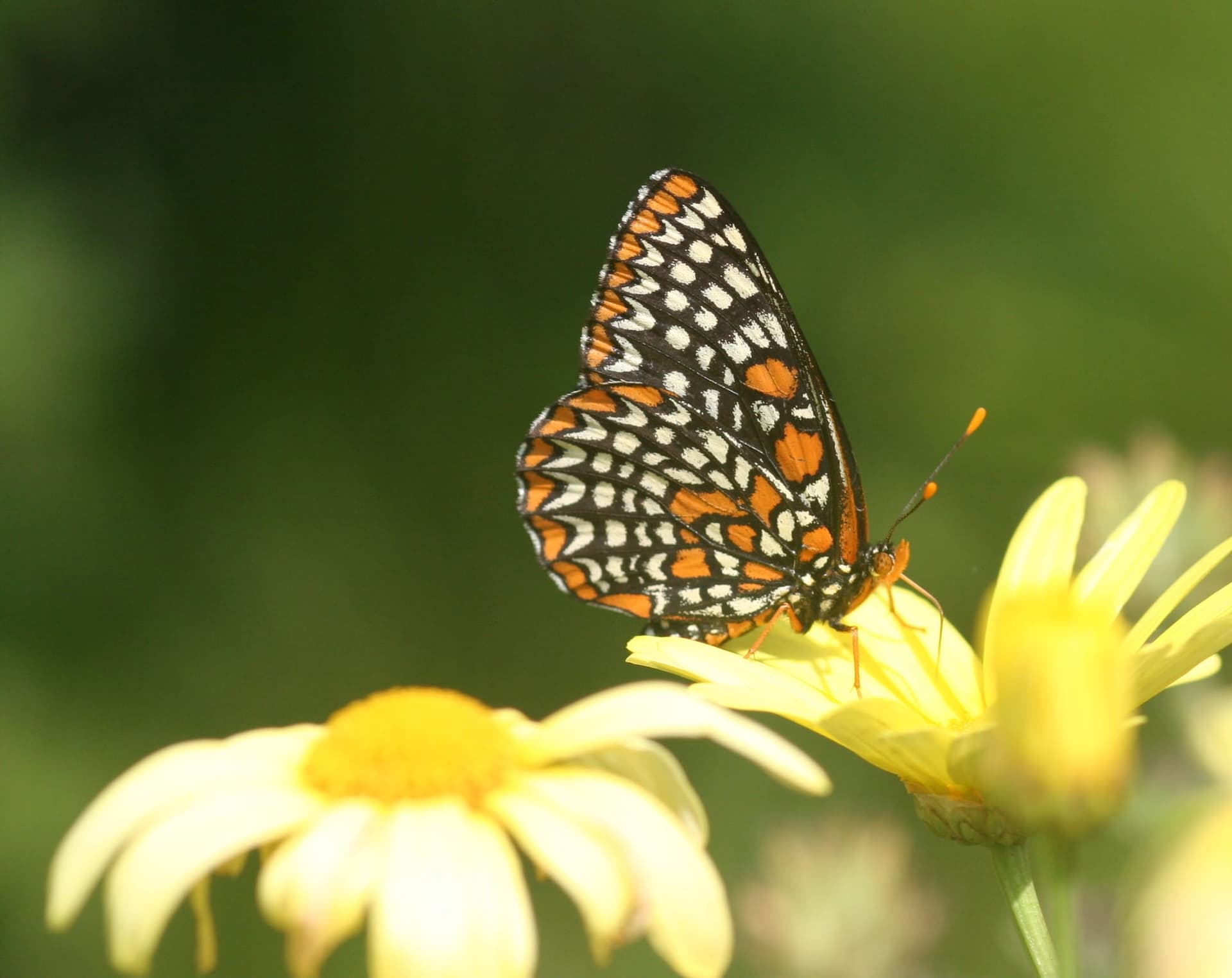
Baltimore Checkerspot
The Baltimore Checkerspot is a medium-sized native butterfly with a bold pattern of orange, white, and black checks. It ranges from Canada and the Great Lakes across the northeastern United States and south through the Appalachians. Named for the heraldic colors of Lord Baltimore, it has been Maryland's state insect since 1973. Gardeners in Zone 6b, upstate New York may find it near wet, open areas, and its declining populations make any garden effort to support it genuinely worthwhile.
This butterfly is a habitat specialist with narrow requirements. Larvae depend primarily on turtlehead (Chelone glabra), a native wetland plant, as their main food source, though they also use false foxglove (Aureolaria spp.) and common plantain. Eggs are laid in clusters on the undersides of turtlehead leaves in late summer, and young caterpillars overwinter communally before finishing development the following spring. Adults fly from late May through July, nectaring on milkweed, wild rose, black-eyed Susan, and similar wildflowers.
Because the Baltimore Checkerspot requires early successional wet meadow habitat that has become scarce across its range, it has disappeared from many areas where it was once recorded. Its presence in a landscape is a reliable indicator of intact, functioning wet meadow ecology. Supporting it through targeted planting and habitat preservation has value that extends well beyond any single garden.
The Baltimore Checkerspot is a native pollinator that nectars on a range of wildflowers as an adult, while its larvae are an important prey resource for birds and other predators.
Plant turtlehead (Chelone glabra) in a consistently moist or wet spot with at least partial sun. Supplement with nectar sources such as common milkweed, Joe-Pye weed, black-eyed Susan, and wild bergamot nearby. Avoid mowing wet meadow edges from late summer through spring to protect overwintering larvae on or near host plants.
Wet or reliably moist areas with established turtlehead and open sun are essential. Leaving leaf litter and plant stems intact through winter protects overwintering caterpillars. Avoid pesticide applications near wet edges and maintain some unmanaged meadow structure to provide larval cover and adult nectar sources.