
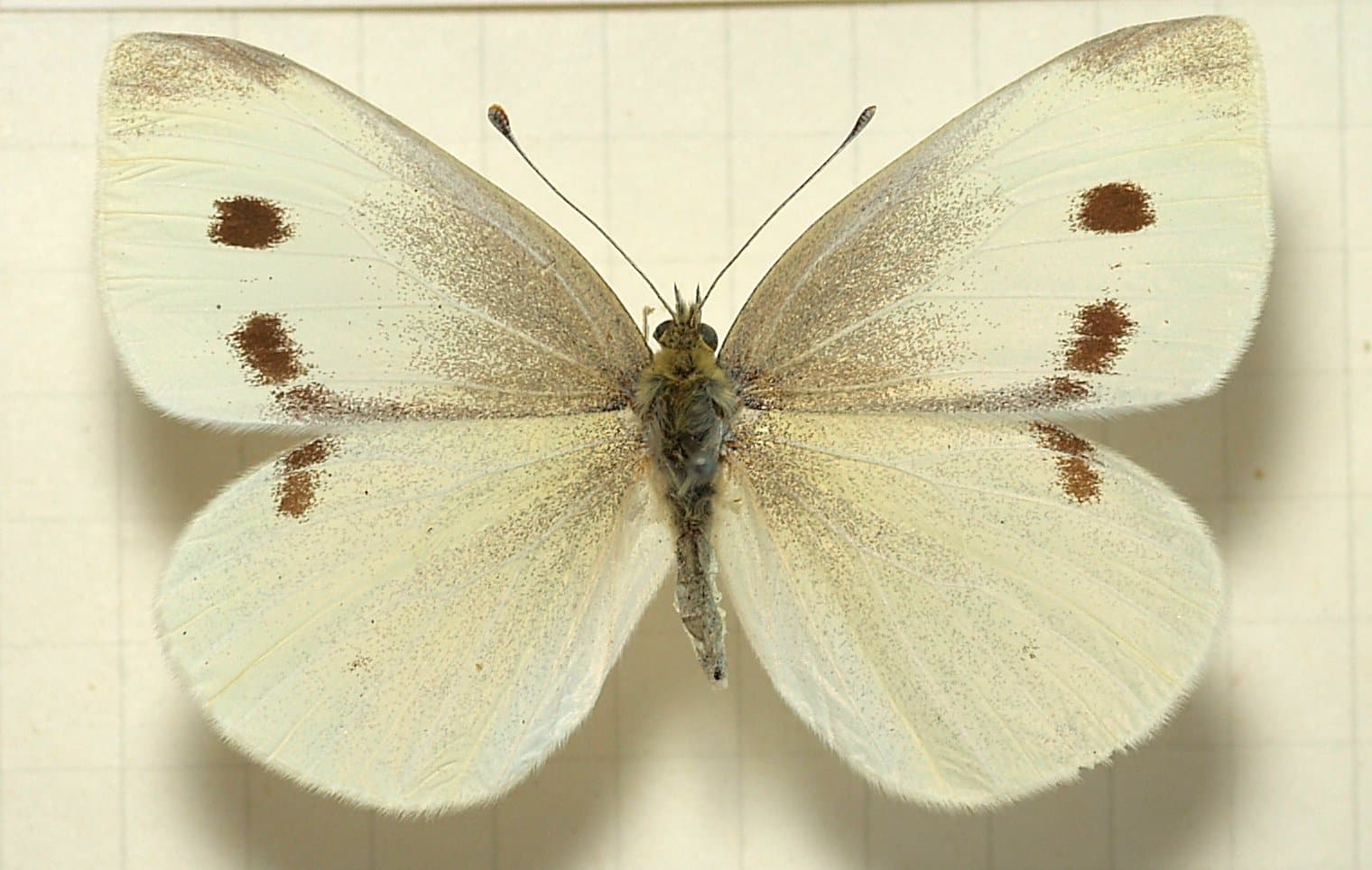
Cabbage Worm
The imported cabbageworm is the larval stage of the cabbage white butterfly, Pieris rapae, a small white butterfly introduced from Europe that is now one of the most common butterflies in North America. Gardeners growing any member of the brassica family — cabbage, broccoli, kale, Brussels sprouts, cauliflower, kohlrabi — should expect to encounter it. The adult butterfly is easy to identify: white wings with one or two small black spots, and a wingspan of roughly two inches.
Females lay pale, bullet-shaped eggs singly on leaf surfaces. Eggs hatch in about a week, and the pale green larvae blend well against foliage, making them easy to miss until damage is obvious. Larvae feed for two to three weeks before pupating. In Zone 6b, there are typically three or more overlapping generations from late spring through early fall, so pressure builds through the season. The species overwinters as a pupa attached to garden debris or structures.
Because this species was introduced and lacks many of its native European parasitoids in North America, populations can build quickly without natural checks. However, the parasitic wasp Cotesia glomerata, itself introduced as a biocontrol agent, does attack cabbageworm larvae in many regions and can provide meaningful population suppression in established garden ecosystems.
Pest — larvae cause direct feeding damage to brassica crops throughout the growing season.
Ragged holes in leaves and green velvety caterpillars on undersides; dark green frass collects in leaf crevices and head.
Handpick caterpillars and eggs. Apply Bacillus thuringiensis (Bt) weekly during egg-laying. Use floating row cover to exclude white cabbage moths.