
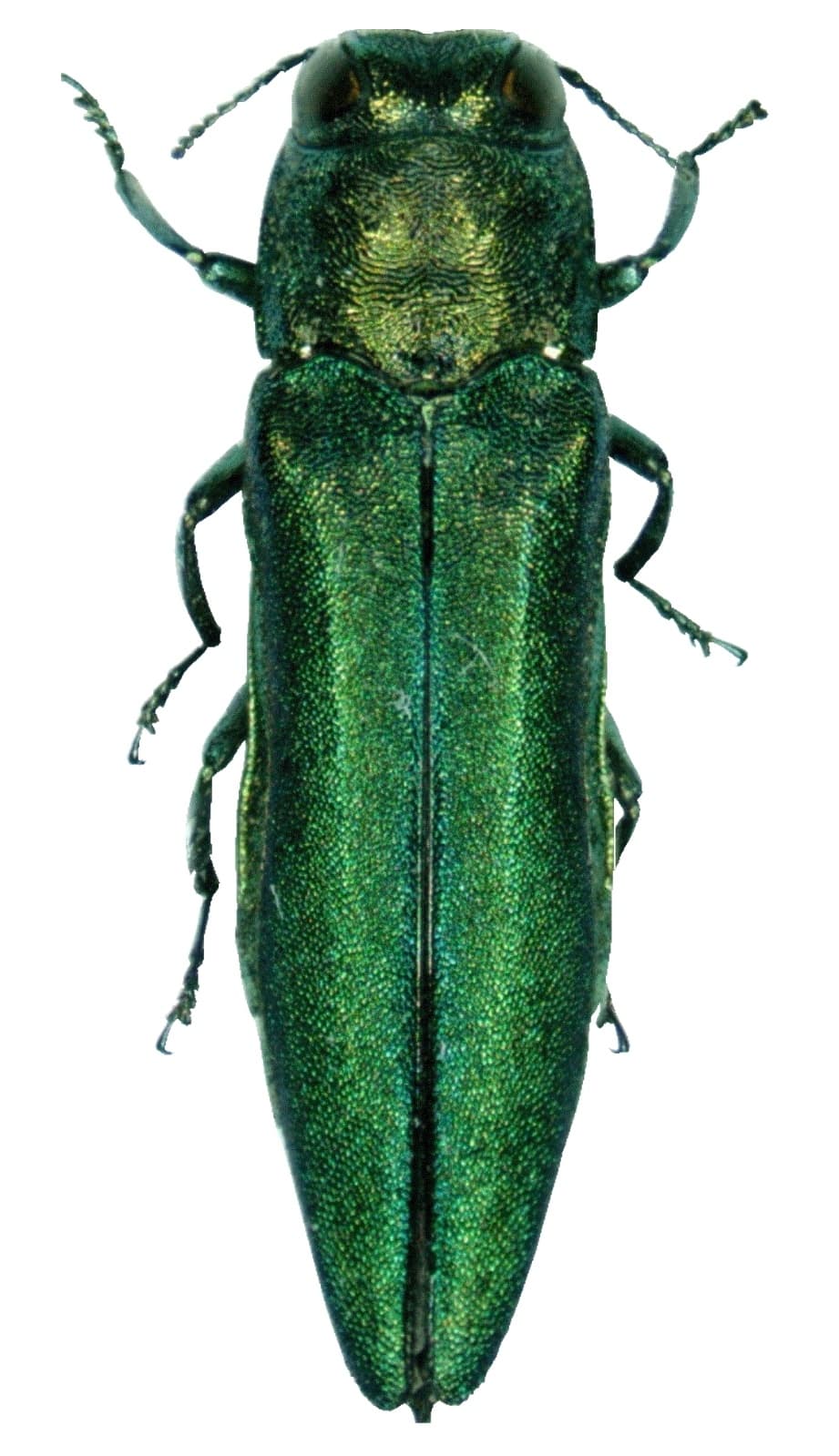
Emerald Ash Borer
The emerald ash borer is, by nearly every measure, the most destructive forest insect ever to reach North America. Native to northeastern Asia — China, Korea, Japan, Mongolia, and the Russian Far East, where it is a minor pest of already-stressed ash — it was first identified in the Detroit, Michigan and Windsor, Ontario area in 2002, almost certainly having arrived years earlier hidden in solid wood packing material inside cargo shipments. With no coevolved natural resistance in North American ash and no established natural predators to check it, the beetle spread rapidly, both on its own and by hitching rides in firewood and nursery stock moved by people. It is now established across most of the eastern half of the United States and adjacent Canada, and in June 2022 it was confirmed in Forest Grove, Oregon — its first detection anywhere on the West Coast, opening an entirely new front against a species (Oregon ash) that had no prior exposure at all.
The damage is almost entirely done by the larval stage, which lives its whole feeding life hidden under the bark. After adult females lay eggs in bark crevices in early summer, larvae hatch and tunnel into the phloem and outer sapwood, carving winding, S-shaped galleries as they feed and grow through the following year. Because the phloem is the tree's only pathway for moving sugars from leaves to roots, a heavy enough tangle of galleries effectively strangles the tree from the inside — girdling it — regardless of how healthy the tree looked before infestation. Visible symptoms (canopy thinning and dieback starting at the top, water sprouts on the trunk, vertical bark splits over larval galleries, increased woodpecker activity as birds dig for larvae, and the adult's characteristic D-shaped exit holes) typically appear only after a tree is already seriously compromised, which is part of why the beetle proved so hard to contain: infestations were often invisible until it was too late to save the tree. A healthy, untreated ash usually dies within 3 to 5 years of its first infestation, and in the hardest-hit regions of the Midwest and Northeast, well over 99% of unprotected ash trees have died.
Adults are small, iridescent, metallic-green beetles about half an inch long, active from roughly late spring through summer, when they feed lightly on ash foliage (causing only cosmetic notching) before mating and laying the next generation of eggs. The USDA and university partners have released several species of parasitoid wasps native to Asia — including Tetrastichus planipennisi, Oobius agrili, and Spathius species — as biological control agents in infested areas, with early results suggesting they can meaningfully suppress borer populations over the long term, though not fast enough to save mature trees already in decline. Federal and state quarantines restricting ash wood and firewood movement, once widespread, have been relaxed in many states as the beetle's range expanded past the point where quarantines could meaningfully contain it — but moving firewood remains one of the most effective ways to accidentally start a new, isolated infestation far outside the current range, so avoiding it is still worthwhile everywhere.
Girdles and kills ash trees (Fraxinus spp.) by tunneling through the phloem under the bark, cutting off the tree's ability to move sugars from leaves to roots; kills the overwhelming majority of untreated ash within 3 to 5 years of infestation.
Larval tunneling under the bark girdles the tree's phloem, cutting off nutrient transport; causes canopy dieback progressing from the top down, bark splitting, and death of the majority of untreated ash within 3–5 years of first infestation.
Systemic insecticide trunk injection (emamectin benzoate) by a certified arborist, repeated on a 1–2 year cycle, for trees caught early enough to be worth saving. Biological control via released parasitoid wasps (Tetrastichus planipennisi, Oobius agrili, Spathius spp.) is underway in many states as a longer-term population suppression strategy, not a rescue option for individual trees.
No meaningful tolerance threshold once a tree is infested — by the time damage is visible, the infestation is usually already advanced. In any area where EAB is established or nearby, healthy ash worth keeping should go on a preventive treatment schedule rather than waiting for symptoms.
For a mature, healthy-looking ash worth saving, especially in or near a known infestation, have a certified arborist apply a systemic insecticide (emamectin benzoate trunk injection is the most effective option) on a 1–2 year cycle — this must begin before the tree is heavily infested to work, and is a permanent, ongoing commitment rather than a one-time treatment. For trees already showing significant canopy dieback (more than 30–50%), treatment is rarely worthwhile; plan for removal before the wood becomes brittle and hazardous to take down. Never transport ash firewood, logs, or untreated nursery stock out of a known infested area — this is the primary way the beetle jumps to new, distant locations. Report suspected sightings (adult beetles, D-shaped exit holes, canopy dieback with woodpecker damage) to the local state department of agriculture or USDA APHIS.
Immediate for any tree already showing exit holes, canopy thinning, or bark splitting — these trees are already significantly infested. For healthy ash in or near a known infestation zone, begin preventive treatment before symptoms appear; waiting until damage is visible usually means the tree is already past the point where treatment reliably saves it.