
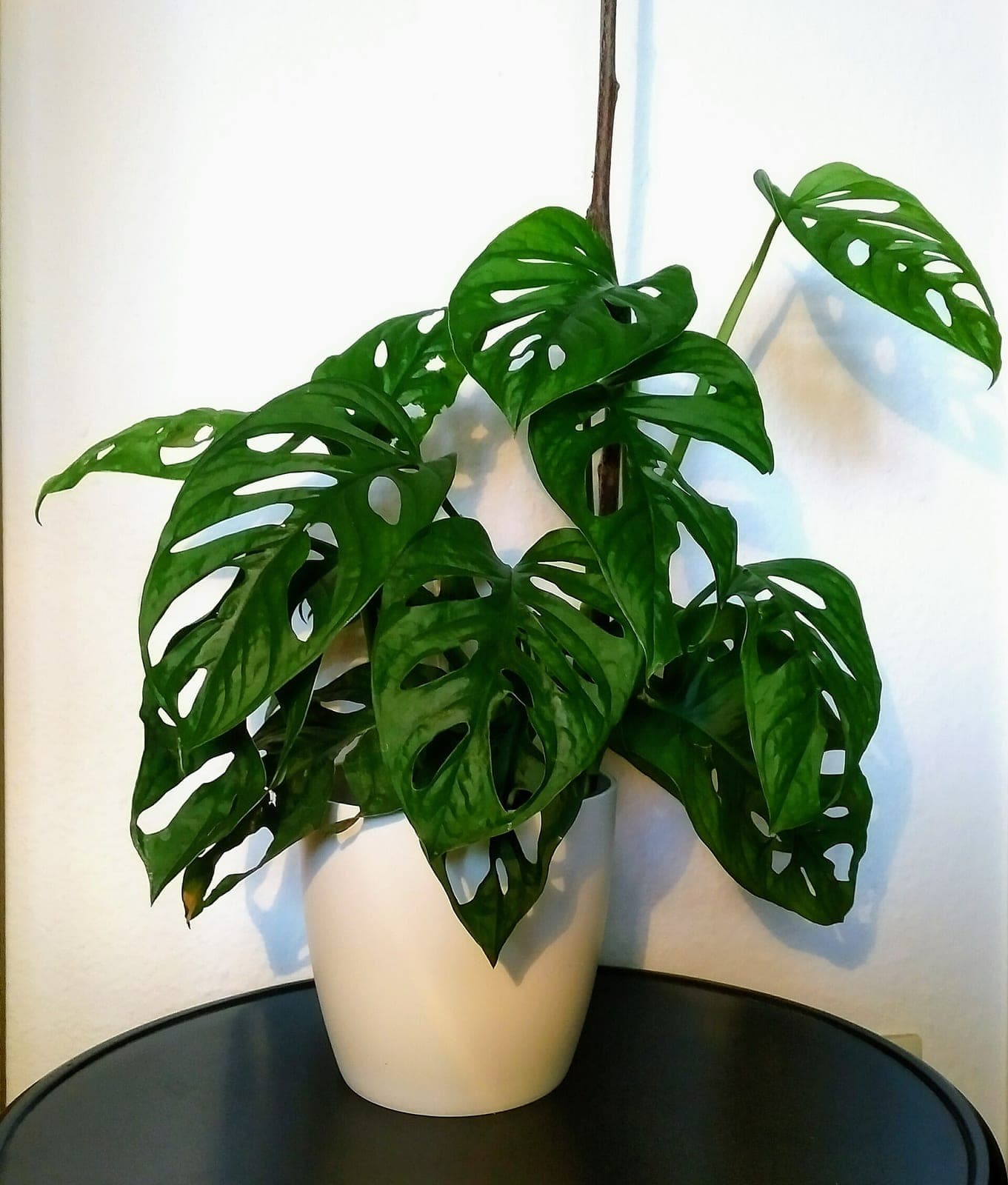
Swiss Cheese Vine
Monstera adansonii is a tropical vine native to Central and South America, where it grows as a hemiepiphyte, threading up trees through humid forest understories. Indoors, it is grown for its oval leaves perforated with multiple oval holes - a trait called fenestration - that earn it the name Swiss Cheese Vine. More compact and faster-growing than its close relative Monstera deliciosa, it suits shelves, hanging baskets, and moss poles in average-sized rooms without overwhelming a space.
The plant does best in warm temperatures consistently above 60°F, bright indirect light, and humidity above 50 percent. Water when the top inch or two of soil has dried out, and use a well-draining aroid mix to keep roots aerated. The most common mistake is overwatering in low light: the soil stays wet too long, roots suffocate, and the plant declines quickly before the problem is obvious.
Given a moss pole or trellis to climb, Monstera adansonii produces progressively larger leaves with more pronounced fenestrations as it ascends and attaches aerial roots. Without support it trails attractively but tends to stay smaller and develop fewer holes per leaf. Stem cuttings root readily in water or moist sphagnum moss, making propagation one of the easier aspects of keeping this plant.
Bright indirect light means a spot within a few feet of a window where direct sun never strikes the leaves - an east-facing window or a position set back from a south or west exposure both work well. Insufficient light slows growth and produces smaller leaves with fewer fenestrations; direct sun scorches the thin leaf tissue quickly.
Water once the top inch of soil is dry
Feed with a balanced houseplant fertiliser
Wipe the leaves to remove dust and check them over
Check leaf undersides for spider mites and mealybugs
Repot when roots crowd the pot
Add a moss pole or trellis: it fruits and fenestrates more when climbing