
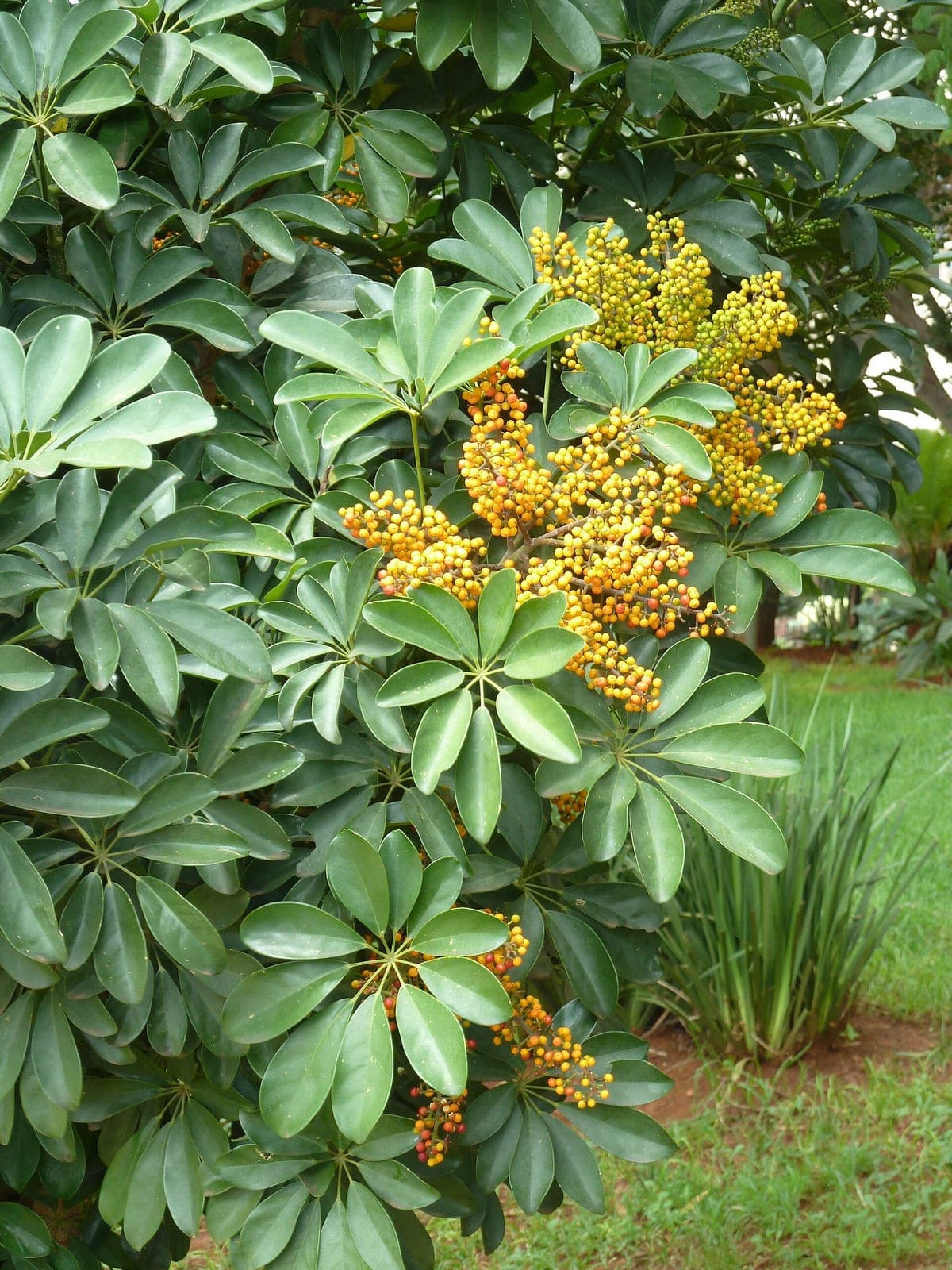
Schefflera / Umbrella Plant
Schefflera arboricola, native to Hainan Province in China and Taiwan, is sold under the names dwarf umbrella tree and schefflera. Its glossy, palmate leaflets radiate outward from a central stem in a spoke pattern that gives the plant its common name. People grow it indoors for its bold tropical foliage, its ability to fill a corner or anchor a bright room, and its reputation as a forgiving plant that tolerates a degree of neglect.
The plant does best near a window that delivers bright, indirect light for most of the day. Watering is where most growers go wrong: schefflera is frequently overwatered, which leads to root rot and sudden, heavy leaf drop. The soil should be allowed to dry out partially between waterings, and the pot must drain freely. Average indoor humidity suits it well, and it is comfortable across the temperature range found in most heated or air-conditioned rooms, though it dislikes cold drafts and should not be positioned near exterior doors in winter.
Schefflera arboricola is sometimes sold with braided or twisted trunks, a shape achieved by training young stems together as they develop. It responds well to pruning and can be kept compact or allowed to grow into a small indoor tree over several years. Stem tip cuttings root readily, making it a straightforward plant to propagate and share.
Bright indirect light means a spot within a few feet of a south- or east-facing window where direct sun is filtered or avoided for most of the day. In too little light the stems stretch, lower leaves drop, and variegated varieties lose their contrast; in unfiltered direct sun the leaflets scorch and yellow at the edges.
Water once the top inch of soil is dry
Feed with a balanced houseplant fertiliser
Wipe the leaves to keep them dust-free
Check leaf undersides for spider mites and scale
Repot when roots crowd the pot