
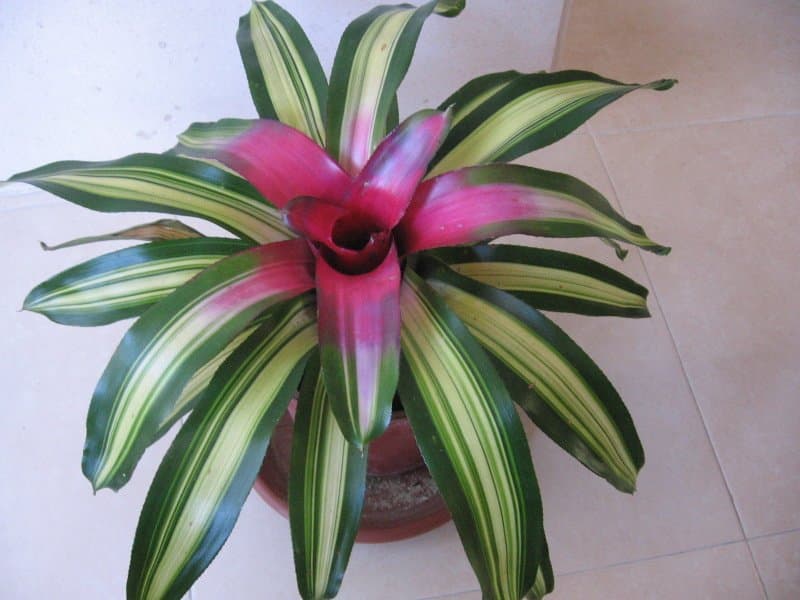
To encourage bloom: A mature rosette flowers once; a ripe apple sealed in a clear bag with the plant for a week or two encourages a stubborn one to bloom.
The centre blushes red as it readies to flower and the small blue flowers sit down in the cup; pups follow.
Neoregelia carolinae, the blushing bromeliad, is a compact rosette-forming epiphyte native to Brazil. Indoors it is grown primarily for its bold, strap-like foliage arranged in a tight funnel, with cultivars ranging from solid green to cream-variegated or red-banded. Its most distinctive trait is the dramatic flush of deep red or pink that develops in the central leaves when the plant is approaching flower, giving it both its common name and a genuinely striking presence on a shelf or windowsill.
The plant thrives in bright indirect light and genuinely high humidity, making a bathroom with a bright window or a spot near a humidifier a natural fit. The most common mistake is treating it like a standard houseplant and watering only the soil. Neoregelia is a tank bromeliad: the central cup formed by the rosette must be kept filled with fresh water at all times, and that water should be fully flushed and replaced every one to two weeks to prevent stagnant buildup. The potting medium should drain quickly and stay barely moist between waterings, never sitting wet.
After the mother plant flowers, it gradually declines and produces offsets called pups at its base. These pups can be left to form a clump or removed and potted on once they reach roughly one-third the mother's size. Because the plant is epiphytic by nature, it does not need a deep container; a shallow pot in a bark-heavy, fast-draining mix suits it far better than dense standard potting soil.
Bright indirect light means strong ambient brightness without direct sun striking the leaves; this keeps the foliage colors vivid and encourages the central blush to develop well. Too little light produces pale, washed-out coloring and a subdued color change, while direct sun will scorch and brown the leaf edges.
Keep the central cup filled with fresh water and water the soil lightly
Feed very lightly, diluted, by misting the leaves
Flush the cup every few weeks to stop stale water building up
Repot the offsets (pups) when they reach a third of the parent's size
Keep the central cup filled with fresh water and flush it every few weeks