
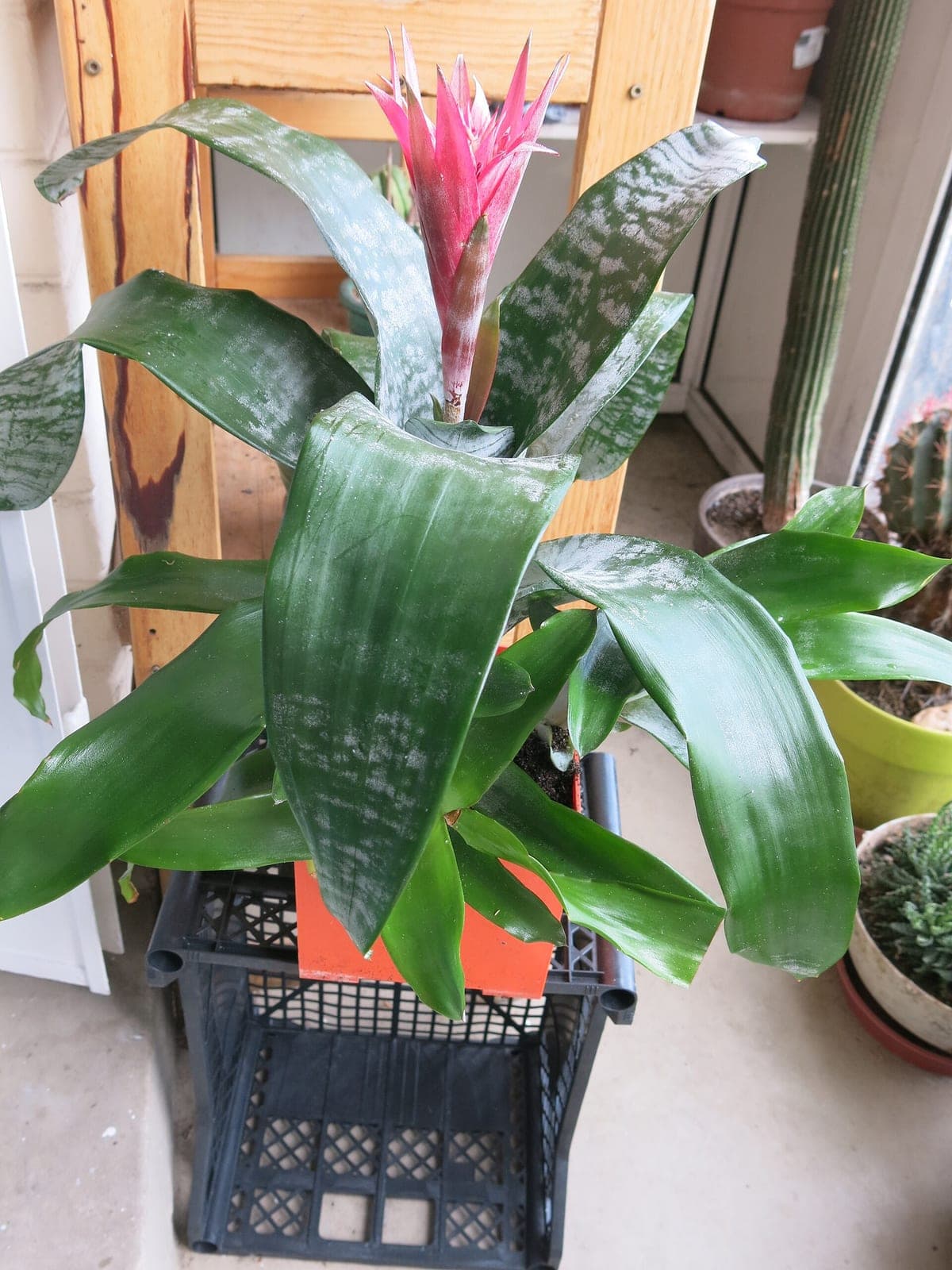
Aechmea
To encourage bloom: A mature rosette flowers once; a ripe apple sealed in a clear bag with the plant for a week or two encourages a stubborn one to bloom.
The pink bract lasts for months; afterwards the rosette slowly dies while pups form at its base.
Aechmea fasciata is a bromeliad native to Brazil, grown indoors for its bold, arching leaves banded in silver-grey and green and the striking pink flower spike that emerges from the center of the rosette. That central inflorescence, a bright pink bract studded with small purple flowers, can hold its color for several months, making the silver vase plant one of the longer-lasting flowering houseplants commonly available. It is the best-known species in its genus and is widely sold as a houseplant in temperate regions.
Care is straightforward once you understand the bromeliad's structure. The rosette forms a central cup, often called the urn or vase, which should be kept filled with fresh water at all times; flush and refill it every one to two weeks so the water does not stagnate and breed bacteria. Soil watering is secondary, as the roots are prone to rot in consistently wet potting medium. The most common mistake is treating it like a conventional houseplant, watering the soil heavily while ignoring the cup entirely.
After flowering, the mother rosette gradually declines - this is a normal part of the plant's life cycle, not a sign of poor care. Before it dies, it produces offsets called pups at the base, which can be separated once they reach roughly one-third the size of the parent and potted on individually to start the next generation.
Bright indirect light means a spot within a few feet of a window where the leaves receive no direct sun, such as near an east-facing window or set back from a south- or west-facing one. Too little light dulls the silvery leaf banding and reduces bract color intensity; prolonged direct sun bleaches and scorches the foliage.
Keep the central cup filled with fresh water and water the soil lightly
Feed very lightly, diluted, by misting the leaves
Flush the cup every few weeks to stop stale water building up
Repot the offsets (pups) when they reach a third of the parent's size
Keep the central cup filled with fresh water; after the plant flowers it slowly declines but leaves pups to replace it