
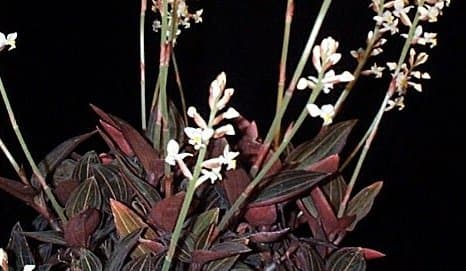
Grown for the leaves; the small spikes of white flowers in midwinter are a bonus and worth leaving on.
The jewel orchid breaks nearly every rule that governs the rest of the family: it's grown for its foliage, not its flowers, planted in ordinary potting mix instead of bark, and it wants low to medium light rather than bright. Grown as a houseplant since the Victorian era for its dark, velvety leaves brushed with silvery veins, it's frequently cited as the single easiest orchid for a beginner precisely because its care resembles a normal foliage houseplant far more than an orchid.
Its trailing stems suit a shelf or hanging pot, and as it ages the lower stems bare out - refresh the plant by rooting a few cuttings rather than trying to keep an old stem full forever.
Grown for its velvety, silver-veined leaves rather than its modest white flower spikes - unlike most orchids it prefers low to medium light and scorches in anything bright or direct.
Check every few days and water when the surface starts to dry - never let it fully dry out
Feed with a dilute, balanced fertiliser
Pinch leggy stems to keep growth bushy rather than sparse
Bare lower stems as it ages are normal - root a few cuttings to refresh the plant