
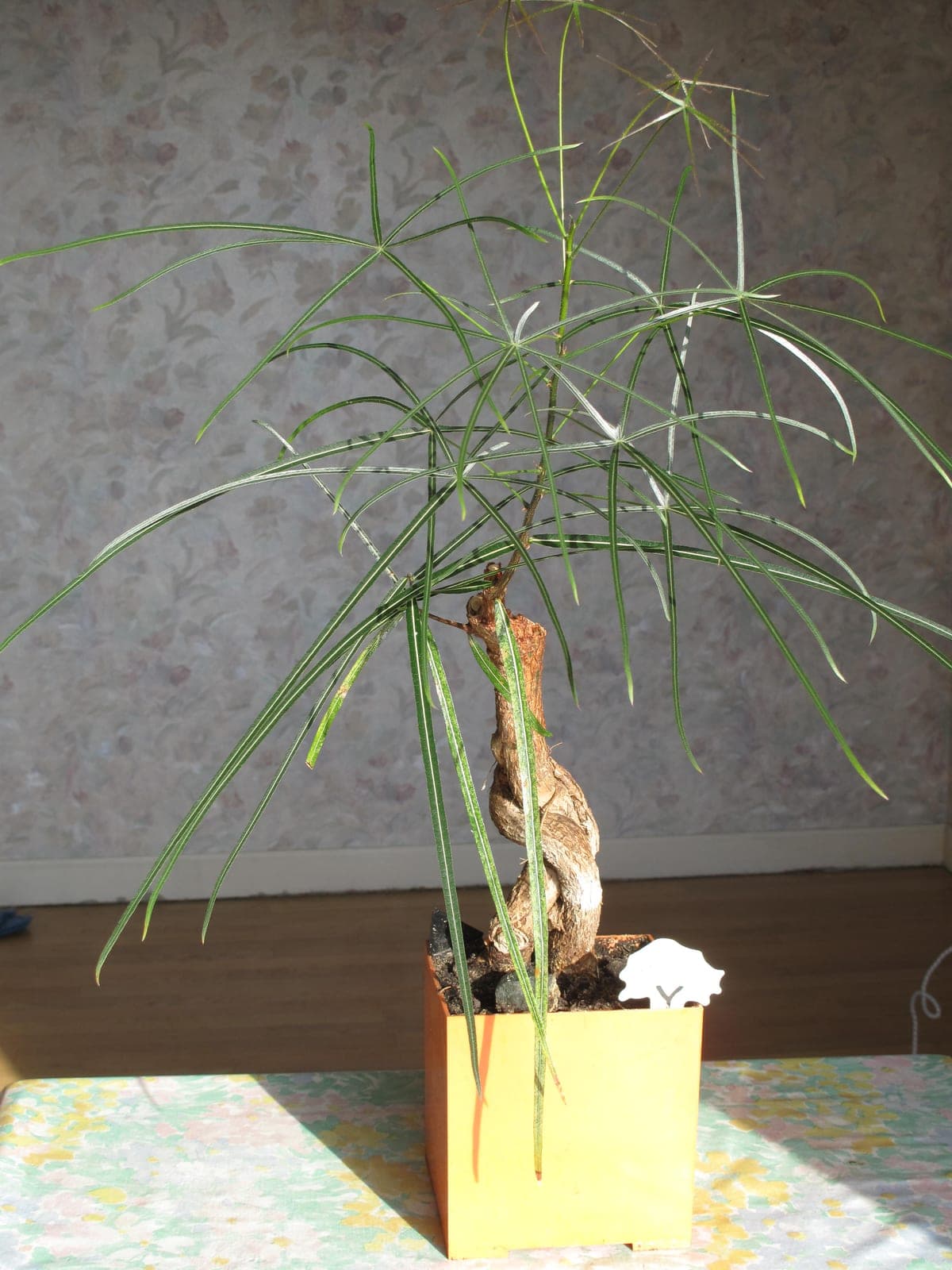
Narrow-Leaf Bottle Tree
Brachychiton rupestris is a Queensland native in the family Malvaceae, recognized immediately by its dramatically swollen, bottle-shaped trunk that stores water through long dry periods. In its natural range it reaches 10–25 meters, but indoors it is grown as a slow-moving novelty specimen or informal bonsai, prized almost entirely for that sculptural caudex. The narrow, strap-like leaves are secondary to the trunk as an ornamental feature, and the plant makes a bold architectural statement even when young.
The most consistent way to fail with this plant indoors is to water it like a tropical. It is a drought-adapted tree, and its swollen trunk is essentially a water reservoir; soggy soil causes roots to rot and the trunk to soften and collapse from the base. It needs a very fast-draining, gritty soil mix and should be watered only when the growing medium has dried out completely. Equally important is light: it wants genuine direct sun for several hours each day. Without it, growth becomes thin and weak and the trunk never develops its characteristic bulge. Being naturally deciduous, it will drop its leaves periodically indoors in response to seasonal light shifts or dry conditions; this is normal behavior, not a distress signal.
Brachychiton rupestris is most reliably propagated from seed, which germinates readily given warmth. Keeping the plant slightly root-bound and watering conservatively encourages trunk swelling, since the plant responds to mild resource stress by directing energy into its water-storage structures rather than into excess canopy growth.
Direct sun means at least three to four hours of unobstructed sunlight daily from a south- or west-facing window; insufficient light produces etiolated, spindly growth and prevents the trunk from thickening, while strong direct sun through glass is well tolerated and actively beneficial.
Water only once the soil has dried out completely - the swollen trunk stores water like a succulent and rots quickly if kept moist
Feed lightly with a balanced houseplant fertiliser
Keep away from cold drafts and unheated rooms in winter - it drops leaves and sulks below its comfortable range
Repot into only a slightly larger pot - a snug pot encourages the caudex (trunk) to swell