
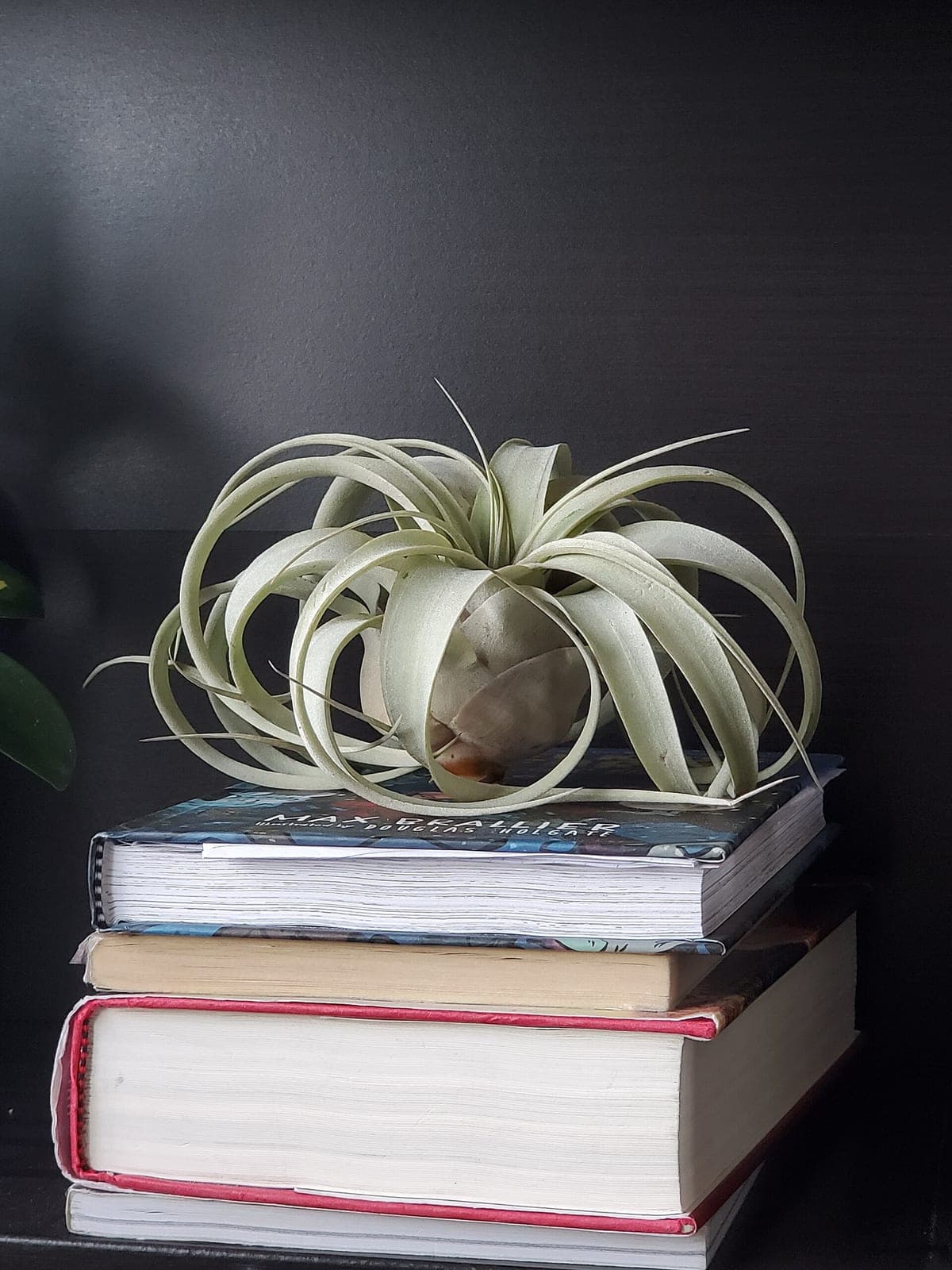
Air Plant
Tillandsia ionantha is a small epiphytic bromeliad native to Central America and Mexico. In the wild it anchors itself to trees and rocks, drawing moisture and nutrients from the air through specialized leaf structures called trichomes rather than from soil. Indoors it is kept as a display plant - set on driftwood, placed in glass globes, mounted on cork bark, or simply arranged loose - because it needs no pot or growing medium and stays compact at just a few inches tall.
The most reliable care routine is a weekly soak: submerge the whole plant in room-temperature water for 20 to 30 minutes, shake off the excess, then set it upside down on a towel or rack and let it dry completely before returning it to its spot. Air circulation during that drying period matters; water that pools at the base or inside the central cup leads to rot, which is by far the most common way people lose these plants. Bright indirect light from a nearby window and ordinary indoor temperatures between 60°F and 90°F cover the rest of the plant's needs.
After it flowers, Tillandsia ionantha produces small offsets at the base called pups. These can be left attached to form a growing clump or removed once they reach roughly one-third the size of the parent and grown on as individual plants.
Bright indirect means within a few feet of a well-lit window but shielded from direct midday rays. Too little light results in slow, soft growth; prolonged direct sun dries out the leaves faster than the trichomes can rehydrate them and can scorch the tips.
Soak in water for 20–30 minutes, then shake it dry upside down
Add a diluted bromeliad or air plant fertiliser to the soak
Make sure it dries within 4 hours: trapped water in the base rots it