
Stone breaker
The third of the alpines carries the family's whole idea in its Latin name: saxum, a stone, and frangere, to break.
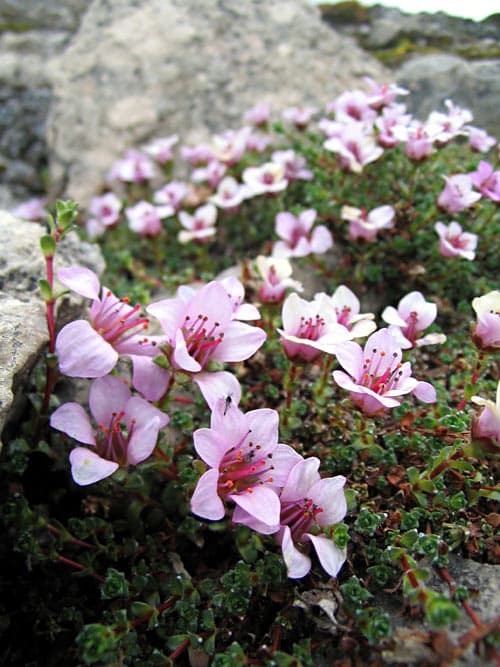
Our third alpine in this series has a name that is the plainest confession of what it does. Saxifraga is saxum frangere — stone-breaker — and there are two stories about why. The dramatic one is you find these plants rooted in the hairline cracks of cliffs and boulders, seeming to prise the rock apart as they swell, so that a hiker reads the flower as the thing that split the stone. The older and truer story is medical. Under the medieval doctrine of signatures — the belief that a plant's appearance told you what it cured — the saxifrages were read as a remedy for the stone, meaning kidney and bladder gravel, partly because some of them, like the meadow saxifrage, carry little seed-like bulbils at the root that looked to a herbalist exactly like the calculi they were meant to dissolve. The plant that grew among stones, and grew stones of its own, must surely break the stones in a man. It did not, of course. But the name held — and it was not alone. Half a world away, in the tropics, an unrelated little herb goes by exactly the same idea in Spanish: chanca piedra, Phyllanthus niruri, "break-stone," still taken across South America and South Asia for kidney and gallstones, and still being turned over in the laboratory for whether the old claim holds any water. Two plants on two continents, a cushion of the high Arctic and a weed of the warm lowlands, named by two peoples for the same hope pinned on the same affliction.
The one I have added is Saxifraga oppositifolia, purple mountain saxifrage, and it lives further out on the edge of the possible than either the edelweiss or the sky pilot before it. It is one of the northernmost flowering plants on Earth, recorded above 83 degrees north on the ice-scoured land of northern Greenland and Ellesmere, and it holds altitude records in the Alps too, found clinging on at over four thousand metres where there is little else with a flower. The species name means opposite-leaved, and if you get down to the mat you can see it: tiny scale-like leaves set in neat opposing pairs, packed into a dense cushion that hugs the grit against the wind. It flowers earlier than almost anything, the rose-purple stars opening at or before the snowmelt, so that in the high Arctic it is one of the first meals of the year for a bumblebee. Nunavut took it for its territorial flower, and Inuit have long eaten the sweet blooms; it is a plant that gives, at a latitude where almost nothing does.
This plant is not for the faint of heart. Cold is not what kills a saxifrage; wet and heat are. It wants lean, gritty, sharply drained soil, a collar of stone chippings around the crown so meltwater runs off rather than sitting. Full sun, cool roots — a trough, a raised scree bed, or a crevice between rocks where it can do the one thing it was named for. Give it those, leave it alone, and it will hold on the way it holds on everywhere else: quietly, at the edge of the world, where life is barely possible.