
Every weed has a silver lining
Nearly every resveratrol capsule sold is made from the root of the plant you have spent years trying to kill.
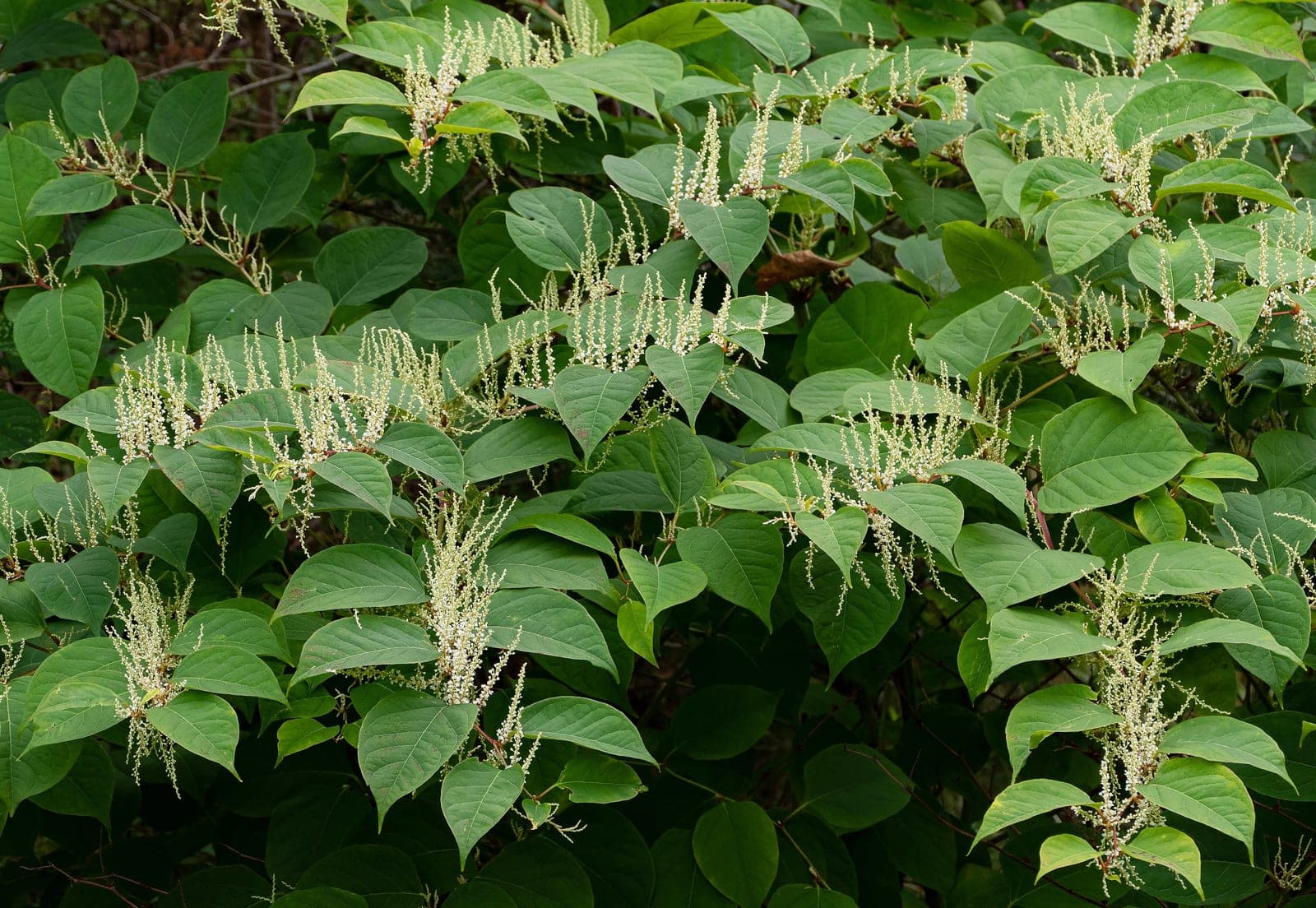
Read the back of a resveratrol bottle and you will expect grapes. What you will usually find, in the small print, is Polygonum cuspidatum — an old name for Japanese knotweed. The wine connection is real but thin: a glass of red carries perhaps a milligram of the stuff, which is why nobody extracts it from grapes commercially. Knotweed root runs to a few per cent resveratrol by dry weight, it grows without being asked, and there is a great deal of it. The most destructive plant in Britain and much of North America turns out to be the world's supply line for its most sought after molecule.
Why the plant makes it at all. Resveratrol is a phytoalexin, which is to say a chemical the plant does not keep on hand but manufactures under attack. Fungal infection, insect damage, a wound, or a hard dose of ultraviolet light all switch on the same response. The route is the phenylpropanoid pathway, the assembly line that gives plants most of their aromatic chemistry. Phenylalanine is stripped of its amine by phenylalanine ammonia-lyase to make cinnamic acid; a hydroxylase turns that into p-coumaric acid; a ligase attaches coenzyme A. Then comes the branch point that matters. That p-coumaroyl-CoA can go two ways, and both use the same three units of malonyl-CoA as building material. Chalcone synthase folds it one way and the plant gets flavonoids — pigments, sunscreens, the colour chemistry of flowers. Stilbene synthase folds it the other, losing a carbon as carbon dioxide and closing the ring differently, and the plant gets resveratrol instead. Two enzymes, one substrate, competing for the same pool. Grapevines, peanuts, and knotweed all carry stilbene synthase; most plants do not, which is why resveratrol is a specialty rather than a commonplace.
What happens when you swallow it. Here the story gets less flattering. Trans-resveratrol is absorbed well enough across the gut wall, and then almost all of it is immediately conjugated — glucuronidated and sulfated by the intestinal lining and the liver before it ever reaches general circulation. Plasma levels of the free molecule after a substantial oral dose are measured in nanomoles, well below the concentrations that produce the striking effects in a dish. What circulates instead is a pool of metabolites, plus whatever the gut bacteria make of the remainder, including dihydroresveratrol. Some of that pool is probably doing the work, through slow release of the free compound back out of its conjugates in tissue.
The mechanism that got revised. Resveratrol became famous in 2003 as a direct activator of SIRT1, a sirtuin enzyme tied to the lifespan effects of calorie restriction — the finding that launched a thousand supplements. The activation turned out to be partly an artefact of the assay: the test peptide carried a bulky fluorescent tag, and resveratrol was helping the enzyme bind the tag rather than the substrate. Strip the fluorophore out and the direct effect largely goes. What replaced it is more interesting and more roundabout. Resveratrol inhibits cyclic nucleotide phosphodiesterases, chiefly PDE4, so cyclic AMP accumulates; cAMP acts through Epac1 to release calcium, which activates CaMKK-beta, which phosphorylates AMP-activated protein kinase. AMPK is the cell's low-fuel sensor, and one consequence of switching it on is a rise in NAD+, the cofactor sirtuins require. SIRT1 does get activated, in other words, but downstream and indirectly, and it then deacetylates PGC-1-alpha, the master switch for mitochondrial biogenesis. The plant molecule does not flip a longevity switch. It convinces the cell it is short of fuel, and the cell responds as it would to exercise or hunger.
Why a stressed plant should matter to us. The idea behind that is xenohormesis: the proposal that animals evolved to read the chemistry of stressed plants as an early signal of hard times ahead, and to shift their own metabolism in response. Eat the compound a drought-struck or fungus-attacked plant made in its defence, and you inherit a chemical warning about the state of the food supply. It is a hypothesis rather than a settled fact, but it makes sense of the awkward observation that a compound present in trace amounts, poorly absorbed, and quickly conjugated should have coherent metabolic effects at all. The dose is small so it acts as a signal, not a nutrient.
Before you dig a root
Every fragment is a viable plant, and a knotweed root carried home in a bag is how a new colony starts. Take root only from a stand you know has never been sprayed — never a roadside or a site under treatment. Process it where it grew, wash tools and boots before you leave, and burn or bag the scraps as controlled waste rather than composting them. In some places moving knotweed is an offence.
Making the tincture. If you want the root rather than the capsule, dig it in late fall, after frost has taken the canes down and the plant has pulled its reserves back underground — the same seasonal logic that concentrates the stilbenes is what the commercial extractors follow. Scrub the root hard, chop it small while it is still fresh, and fill a clean jar about two-thirds. Cover it completely with 80-proof vodka, keeping a good two inches of spirit above the root, and seal it. Shake it daily and keep it dark for six weeks, topping up the alcohol if the root ever works its way above the surface. Strain through cheesecloth or a coffee filter, bottle in dark glass, and store it cool and dark. Alcohol is the right solvent here rather than water: resveratrol and polydatin are far more soluble in spirit, which is why the traditional preparation is a tincture and not a tea. The full method is on the knotweed page.
Knotweed root carries more than resveratrol. Emodin, an anthraquinone, is a genuine laxative at modest doses. Polydatin, the glucoside form of resveratrol, is often the larger fraction in the root and is converted after ingestion. The root is the reason Stephen Buhner's Lyme protocols reach for this plant, and the reason a dug-and-tinctured knotweed root is not a casual thing to take alongside anticoagulants or in pregnancy. What the chemistry does not do is redeem the plant in the garden. It remains the worst thing that can happen to a boundary wall, and every fragment of the root you dig for medicine is a viable new colony if you carry it home carelessly. Take it from a stand you know has never been sprayed, process it where it grew, and burn what you do not use.