
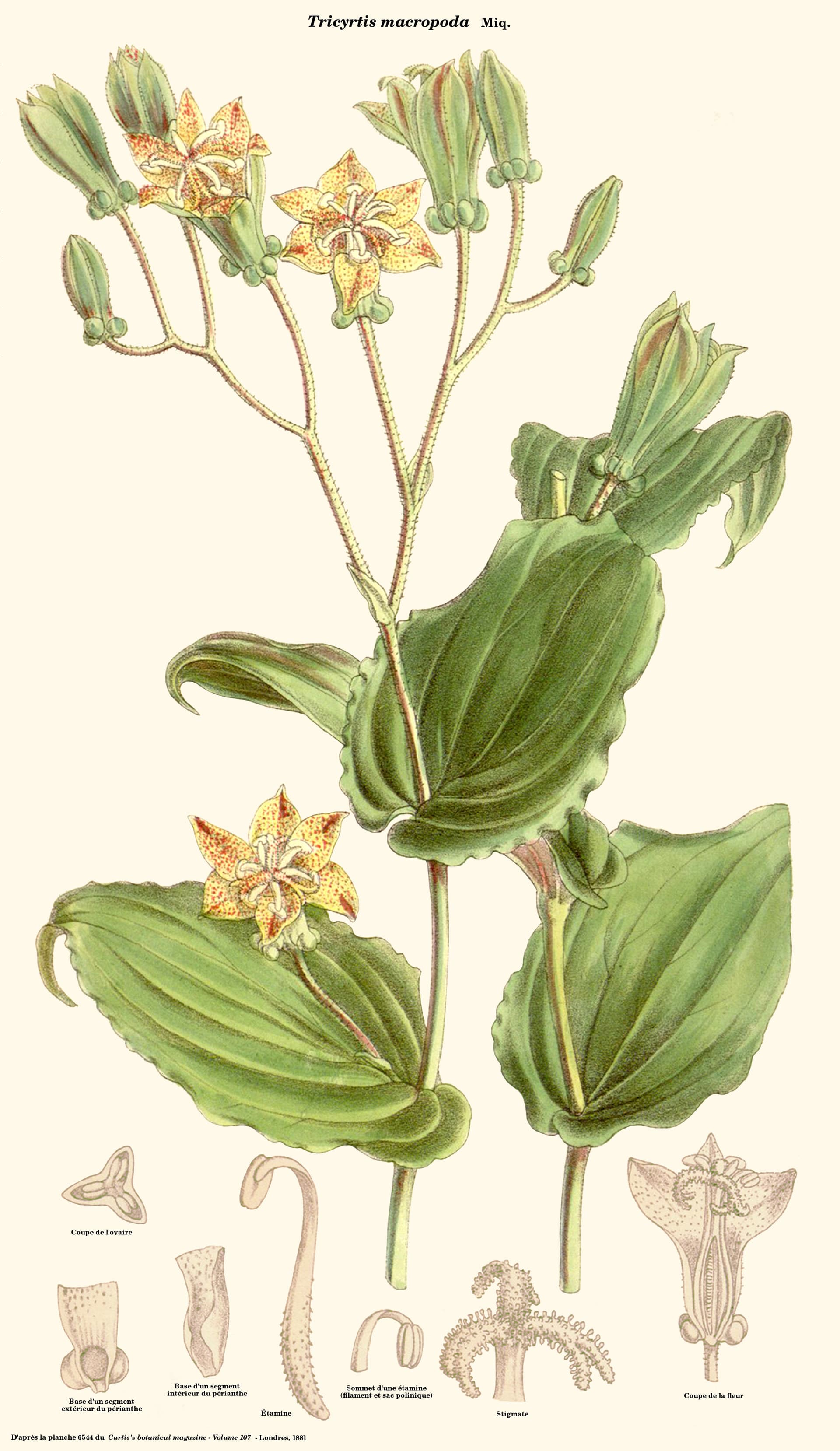
Tricyrtis macropoda is a clump-forming woodland perennial native to forested slopes in China, Korea, and Japan. It fills a difficult niche in the shade garden, producing white flowers heavily spotted with purple along arching stems in late summer and into fall, when few shade perennials are performing.
The plant spreads slowly by rhizomes and self-seeds lightly. It thrives in humus-rich soil with consistent moisture and declines quickly in dry or compacted ground. A 2–3 in mulch layer over the root zone conserves moisture and keeps roots cool through summer. Soil pH between 5.5 and 7.0 is suitable; alkaline conditions cause gradual decline. Stems die back each winter while rhizomes overwinter reliably through zone 4.
Fungal leaf spot
Brown or purplish spots on the leaves, often ringed with a yellow halo, that spread and merge in warm, humid, or wet weather; heavily spotted leaves yellow and drop early.
Pick off spotted leaves and clear fallen debris to remove overwintering spores. Improve air circulation by thinning, and water at the base so foliage dries quickly. If it persists, apply a copper- or sulfur-based fungicide at the first sign.
Botrytis (grey mould)
Grey fuzzy mould on petals and stems, worst in cool wet conditions.
Remove affected parts immediately. Improve air circulation. Avoid overhead watering. Apply copper fungicide if severe.
Foliar Nematode
Angular brown patches appear between leaf veins, progressing upward from lower leaves. The geometric, vein-bounded pattern distinguishes nematode damage from fungal leaf spots. Heavily infested leaves yellow and drop prematurely.
Remove and dispose of all affected foliage away from the garden; do not compost. Switch to drip or base watering to keep foliage dry - water on leaves allows nematodes to migrate between plants. Divide clumps only from clean, symptom-free sections. No chemical treatment is reliably effective once established; strict sanitation and dry foliage are the primary controls.