
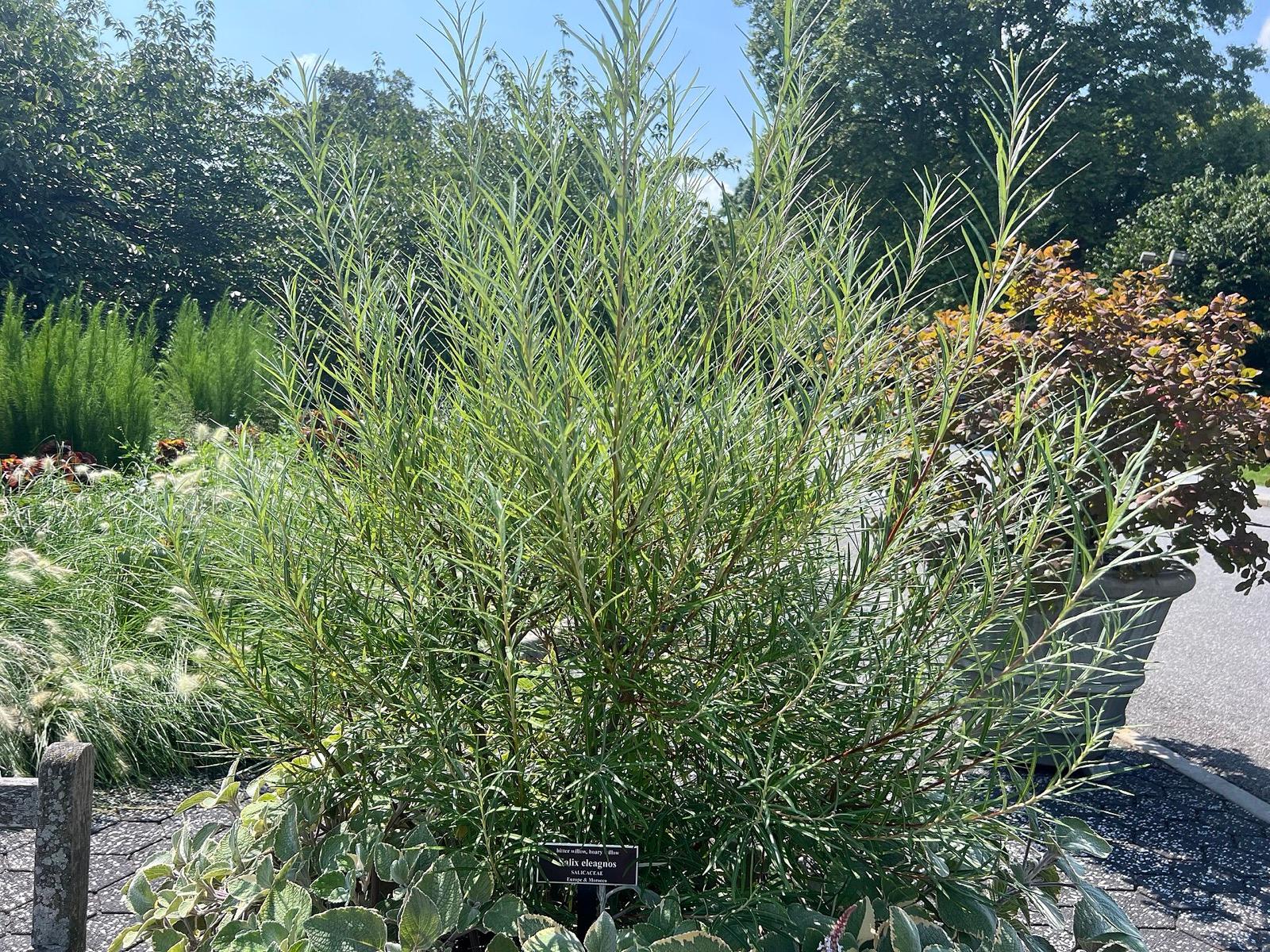
Rosemary willow (Salix eleagnos) is a large deciduous shrub native to streambanks and rocky riverine margins across central and southern Europe and southwest Asia. Its exceptionally narrow, grey-green leaves closely resemble rosemary foliage, giving it a fine texture uncommon among willows. Green catkins emerge alongside new leaves in spring; male catkins carry yellow anthers. Foliage turns yellow in autumn before leaf drop.
It performs best where roots have consistent access to moisture, tolerating periodic flooding, clay, and compacted soils. It is well suited to bank stabilization and erosion control along water features and naturalized areas. Left unchecked it can reach 10 ft tall and 15 ft wide; coppicing to 6–12 in above ground every two to three years in late winter keeps it manageable and encourages vigorous young growth. Fully cold-hardy across its rated zone range without special protection.
Like most Salix species, the bark contains salicin, the glycoside that served as the chemical basis for aspirin. Willow bark has a documented history in European herbal medicine as an analgesic, antipyretic, and anti-inflammatory remedy.
These dates are for Zone 6b. Enter your ZIP to time every job to your own frost dates.
- watch · Any time in fallObserve autumn color; uniform yellow before leaf drop is normal, but early browning or sudden leaf drop without yellowing may indicate drought stress or root disease.
- watch · Dec 5 - Dec 19Order plants or hardwood cuttings - about two months before planting
- plant · Feb 13Take 8–12 in hardwood cuttings before buds swell; insert into moist sand or directly into prepared, consistently moist ground near the planting site.
- cut · Feb 27Coppice established shrubs to 6–12 in above ground every 2–3 years before new growth begins, to rejuvenate the plant and control its spread.
- watch · Mar 13Look for catkins emerging alongside new leaves; male catkins with yellow anthers confirm the plant is breaking dormancy.
- cut · Apr 24Remove dead or winter-killed stems once leaf-out confirms which wood is live; cut cleanly back to healthy tissue.
- watch · Any time in springInspect young shoots and leaves for olive-brown lesions indicating willow scab, which spreads rapidly during cool, wet spring weather.
- watch · Any time in summerCheck leaf undersides through summer for orange-yellow rust pustules; thin overcrowded stems to improve air circulation if infection appears.
Problems & troubleshooting
Common problems
Willow Scab
Olive-brown to black lesions appear on young leaves within days of bud break, causing rapid curling and leaf drop. Shoot tips blacken and die back. Dark, sunken lesions develop on current-season stems, and salmon-colored spore masses may be visible on infected tissue during humid weather.
Rake and destroy all fallen leaves and infected shoot tips each autumn. Apply a copper-based fungicide or myclobutanil at bud swell, then again at bud break. In persistently wet springs, repeat every 10–14 days until new shoot growth hardens off. Improve canopy airflow through selective pruning and avoid overhead irrigation.
Powdery mildew
White or grey powdery coating on leaves - usually starting on older growth in humid conditions or when nights cool.
Improve air circulation by thinning plants. Apply neem oil or potassium bicarbonate spray at first sign. Avoid overhead watering.
Rust
Orange to brown raised pustules on the undersides of leaves, with yellow spotting on the upper surface. Heavy infections cause leaves to yellow and drop.
Remove and destroy infected leaves. Avoid overhead watering and improve air circulation. Apply a sulfur or copper-based fungicide if it spreads. Clear plant debris in fall.
Cytospora Canker
White or blue-white pitch masses ooze from bark on lower branches and the trunk. Affected branches die back progressively from the tip inward; bark beneath the resin is discolored brown and may have a resinous, sunken appearance.
Prune infected branches well below the canker margin into healthy wood and destroy all cuttings. Sterilize pruning tools with 70% isopropyl alcohol between each cut. No effective fungicide is available; prevent recurrence by avoiding drought stress, soil compaction, and mechanical bark injury.