
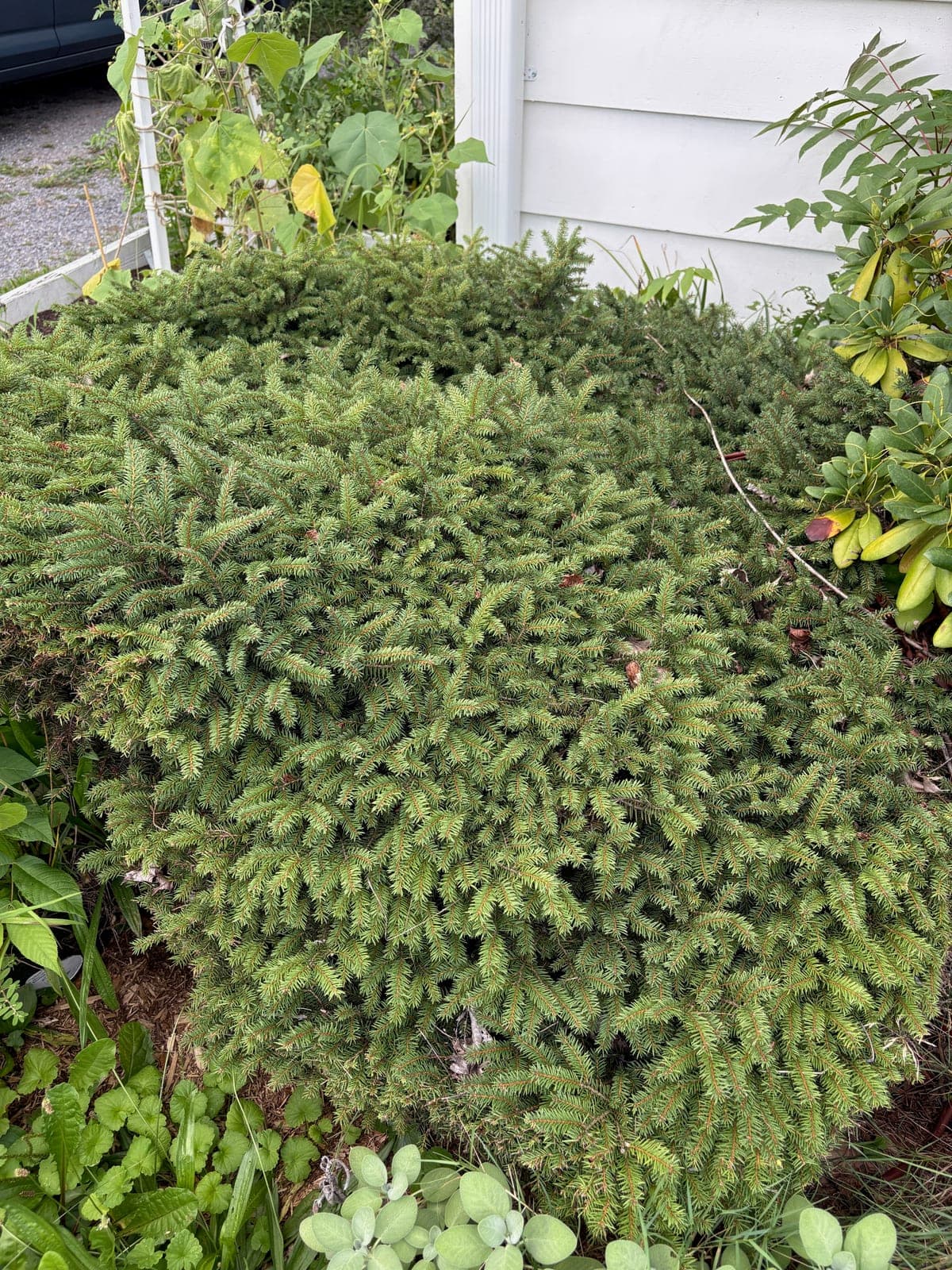
Norway spruce is a large pyramidal evergreen conifer native to Northern, Central, and Eastern Europe and among the most widely planted spruces in North America. Its characteristic pendulous secondary branchlets and fast growth rate-often 1–2 feet per year under good conditions-make it practical for windbreaks, privacy screens, and large-scale specimen planting. It is also the species most commonly grown as a cut Christmas tree.
Best performance comes in cool, humid climates with moist, acidic, well-drained soil. The tree does not tolerate prolonged heat, drought, or compacted soil, and vigor declines noticeably south of zone 7. Maintain 3–4 inches of mulch from the trunk outward to the drip line to moderate root temperature and retain soil moisture. Young trees establish quickly but need consistent irrigation through the first two growing seasons. pH of 4.5–6.0 is ideal; strongly alkaline soil causes chlorosis.
Young spring shoot tips contain vitamin C and have a documented history in Northern European food traditions-brewed into spruce beer, made into syrups, or steeped as tea. The resin has been applied topically for wound care and used as a folk expectorant for respiratory complaints. The wood is commercially important as a tonal resonance wood in soundboards for violins, guitars, and pianos.
Rhizosphaera Needle Cast
Needles on inner and lower branches turn purple-brown in their second year and drop prematurely, leaving progressively bare branch sections that work upward through the canopy over multiple seasons. Rows of small black fungal fruiting bodies (pycnidia) are visible along needle undersides under a hand lens.
Apply chlorothalonil or copper-based fungicide when new needles reach half their final length; repeat 3–4 weeks later. Rake and remove fallen needles beneath the tree. Maintain adequate spacing for air circulation. Treat for 2–3 consecutive springs on heavily infected trees before evaluating recovery.
Cytospora Canker
White or blue-white pitch masses ooze from bark on lower branches and the trunk. Affected branches die back progressively from the tip inward; bark beneath the resin is discolored brown and may have a resinous, sunken appearance.
Prune infected branches well below the canker margin into healthy wood and destroy all cuttings. Sterilize pruning tools with 70% isopropyl alcohol between each cut. No effective fungicide is available; prevent recurrence by avoiding drought stress, soil compaction, and mechanical bark injury.
Phytophthora Root Rot
Wilting despite moist soil, yellowing leaves, stunted growth, and dark, decayed roots and crown tissue. Vines may collapse during hot weather.
Plant in well-draining soil and avoid waterlogging. Remove and destroy affected vines. Improve drainage with raised beds or amended soil and avoid overwatering.
Armillaria Root Rot
Thinning, yellowing canopy with progressive dieback; white, fan-shaped mycelial mats visible beneath bark at or just below the soil line; honey-colored mushroom clusters appearing at the trunk base or on surface roots in autumn.
No chemical cure exists. Improve drainage and avoid any injury to roots or trunk. Remove severely infected trees along with as much root material as possible. Do not replant susceptible species in the same spot.