
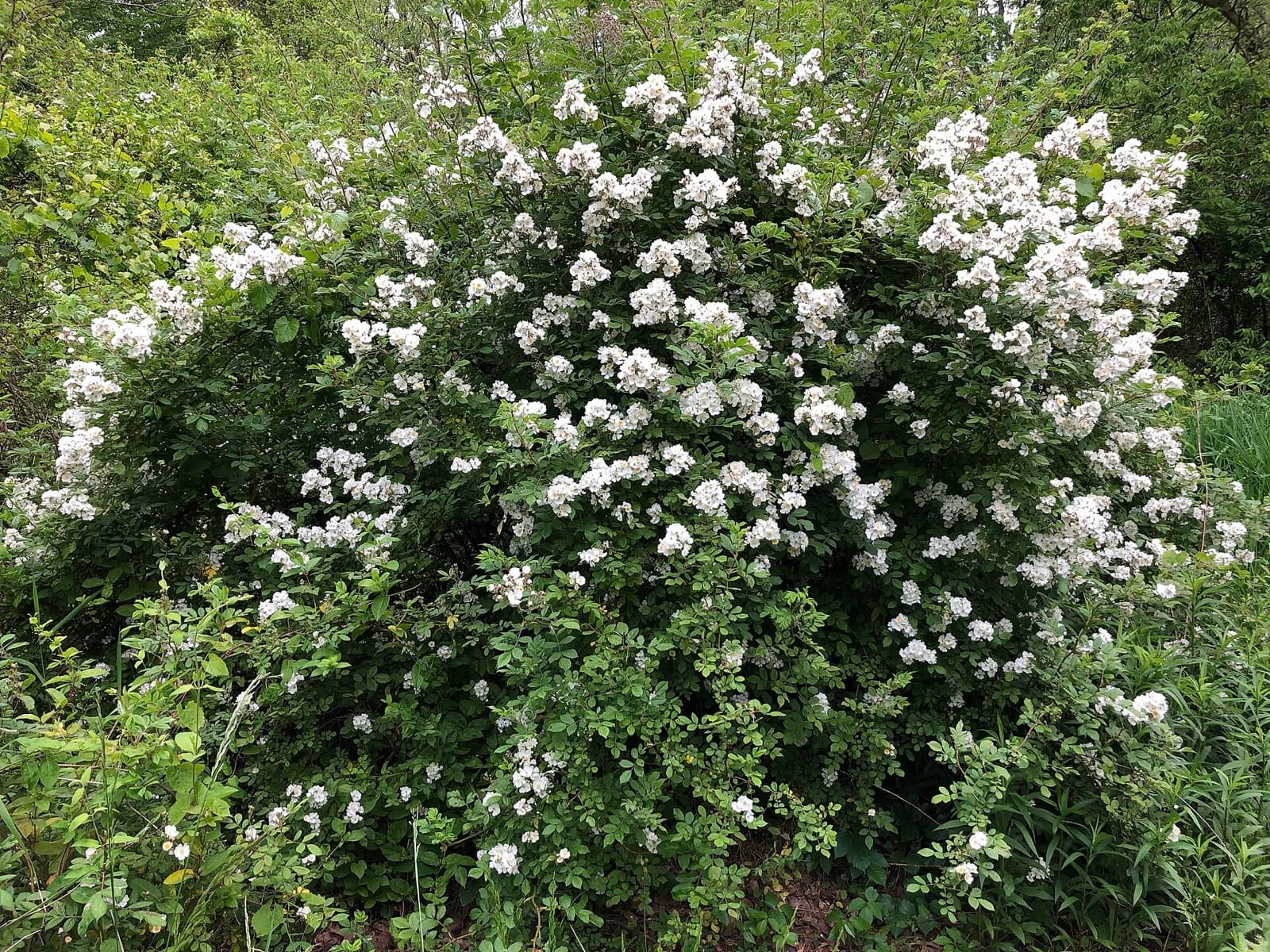
Multiflora rose is one of the worst invasive shrubs in the eastern United States. It was brought from East Asia in the 1860s as rootstock for garden roses, and in the mid-1900s it was promoted for living fences, erosion control and wildlife cover. It escaped everywhere. A single plant can produce hundreds of thousands of seeds a year, birds spread them, and the seed survives in the soil for many years. It is listed as a noxious weed in several states.
It grows into a mound of arching, thorny canes 6 to 15 feet tall that root where they touch the ground and form thickets nothing else can grow through. In late spring it is covered in clusters of small white flowers, followed by masses of small red hips. Two features tell it apart from native roses: the flowers come in large pyramidal clusters, not singly or in small groups, and the base of each leaf stalk has a fringed, comb-like stipule.
To remove it, cut the canes and dig out the crown and roots, since any root left behind resprouts. Pull seedlings while small, and cut flowers off any plant you cannot remove yet so it cannot set seed. Multiflora rose is also the main wild host of rose rosette disease, so clearing it protects garden roses nearby.
Growing roses? Read the Rose Care Calendar - pruning by class, feeding, pests, climbers, and growing for hips, timed to your frost dates.These dates are for Zone 6b. Enter your ZIP to time every job to your own frost dates.
- overwinter · Mar 27 - Apr 17First feed and mulch: As the buds break, work a balanced rose feed into the soil around the base and lay a thick mulch of compost or well-rotted manure over the root zone (keep it off the stems).
- watch · Apr 24 - Jun 5Watch for black spot and aphids: As the new growth softens, aphids cluster on the tips and the first spots of fungal disease appear on the lower leaves.
- cut · Any time in springCut canes to the ground and dig out the crown and main roots - any root left behind resprouts
- watch · Any time in springPull seedlings while small and the soil is moist; seed stays alive in the soil for years, so check the same ground again
- watch · Jun 12 - Jun 26Second feed after the first flush: Once the first big flush fades, feed again to fuel the repeat.
- cut · Jun 26Cut off flower clusters before the hips form - birds eat the hips and drop the seed along fence lines and woodland edges
- watch · Any time in summerMultiflora rose is the main wild host of rose rosette disease, which spreads from wild stands into garden roses - clearing it protects the roses you grow
- watch · Sep 4 - Sep 18Last feed of the year: Stop feeding six to eight weeks before your first frost.
- overwinter · Nov 20 - Dec 25Winter tidy and protect: After leaf-fall, shorten very long canes by a third so winter wind can't rock the roots loose, and mound compost or bark over the graft union of grafted roses in cold zones.